Scientific and Technological Research
Strategic Model for Competitive and Sustainable Strengthening of Beauty Product Retailing in Ibagué
Modelo estratégico para el fortalecimiento competitivo y sostenible del comercio minorista de productos de belleza en Ibagué
Dagoberto Valencia Ortiz1  *, José Alejandro Vera Calderón1 *, Luis Felipe Lozada Valencia2
 *
ABSTRACT
Introduction: The study aimed to design a strategic model to strengthen the competitiveness and sustainability of beauty product retail businesses in Ibagué.
Methodology: To this end, the applied and propositional phase of a mixed-method, non-experimental, cross-sectional study was developed. Evidence from 63 valid business questionnaires, one semi-structured interview, strategic diagnosis matrices, and a technology-watch corpus of 251 Scopus records was integrated.
Results: Findings were organized through a traceability matrix linking gaps, capabilities, trends, and strategic responses. The Strategic Model for Competitiveness and Sustainability of Beauty Retailing in Ibagué (MECOS-BI) was structured around four dimensions: organizational capabilities, digital transformation and omnichannel integration, relational trust and differentiation, and sustainable and institutional legitimacy. Implementation was sequenced into five phases: alignment and formalization, talent and culture, process redesign, value proposition and loyalty, and analytics and continuous improvement.
Conclusions: The model indicated that customer trust could become a more scalable advantage when supported by formalization, managerial capabilities, digital integration, and systematic measurement. Its effectiveness should be assessed through pilot implementation and longitudinal monitoring.
Keywords: business management; electronic commerce; innovation; small enterprises; sustainable development.
JEL Classification: L81; M10; O33.
RESUMEN
Introducción: El estudio tuvo como objetivo diseñar un modelo estratégico para fortalecer la competitividad y la sostenibilidad del comercio minorista de productos de belleza en Ibagué.
Metodología: Para ello, se desarrolló la fase aplicada-propositiva de una investigación mixta, no experimental y transversal. Se integraron 63 cuestionarios empresariales válidos, una entrevista semiestructurada, matrices de diagnóstico estratégico y una vigilancia tecnológica de 251 registros recuperados de Scopus.
Resultados: Los hallazgos se organizaron mediante una matriz de trazabilidad que relacionó las brechas, las capacidades, las tendencias y las respuestas estratégicas. Se estructuró el Modelo Estratégico de Competitividad y Sostenibilidad del Comercio Minorista de Belleza en Ibagué (MECOS-BI), compuesto por cuatro dimensiones: capacidades organizacionales, transformación digital y omnicanalidad, confianza relacional y diferenciación, y legitimidad sostenible e institucional. Su implementación se ordenó en cinco fases: alineación y formalización, talento y cultura, rediseño de procesos, propuesta de valor y fidelización, y analítica y mejora continua.
Conclusiones: El modelo mostró que la confianza con el cliente puede convertirse en una ventaja más escalable cuando se apoya en formalización, capacidades gerenciales, integración digital y medición sistemática. Su eficacia deberá evaluarse mediante la aplicación piloto y el seguimiento longitudinal.
Palabras clave: administración de empresas; comercio electrónico; desarrollo sostenible; innovación; pequeña empresa.
Clasificación JEL: L81; M10; O33.
Received: 25-06-2026 Revised: 27-08-2026 Accepted: 10-09-2026 Published: 18-09-2026
Editor:
Alfredo Javier Pérez Gamboa
1Universidad del Tolima. Ibagué, Colombia.
2Universidad Piloto de Colombia. Girardot, Colombia.
Cite as: Valencia Ortiz, D., Vera Calderón, J. A., & Lozada Valencia, L. F. (2026). Modelo estratégico para el fortalecimiento competitivo y sostenible del comercio minorista de productos de belleza en Ibagué. Región Científica, 5(2), 2026633. https://doi.org/10.58763/rc2026633
INTRODUCTION
Beauty product retailing operates in an environment where competitive intensity no longer depends solely on price, product portfolio breadth, or store location. The shopping experience, trust in recommendations, digital reputation, product availability, cross-channel continuity, and the legitimacy of the offering have become factors that determine the ability to attract and retain customers. Literature on consumer experience and omnichannel retailing shows that the integration of physical touchpoints, digital media, and service processes alters channel choice and perceived value throughout the customer journey (Lemon & Verhoef, 2016; Gerea et al., 2021; Wolf & Steul-Fischer, 2023). For small businesses, this transformation also entails developing capabilities to turn isolated digital tools into coordinated business processes (Bouwman et al., 2019; Garzoni et al., 2020).
In Colombia, the dynamic nature of beauty and personal care consumption coexists with a heterogeneous business landscape. Alongside specialized chains and platforms with established commercial systems, small businesses operate that rely on direct customer relationships, social media, and informal administrative routines. While the sector remains economically and commercially significant, market opportunities do not automatically translate into business sustainability. For micro and small enterprises, the ability to manage finances, inventory, sales channels, product knowledge, and regulatory compliance determines whether commercial growth can evolve into a stable trajectory (Asociación Nacional de Empresarios de Colombia [ANDI], 2024; Organisation for Economic Co-operation and Development [OECD], 2021).
The project's diagnostic phase, conducted in Ibagué, highlighted this tension precisely. Based on an accessible population of 70 economic units, a minimum sample size of 60 was calculated; Furthermore, the fieldwork yielded 63 complete and valid questionnaires, which constituted the effective sample analyzed. 57.1% of the businesses had been operating for two years or less, 47.6% were informal, and only 6.3% identified e-commerce as their primary channel. The most common gaps were found in financial management, planning, and inventory management, whereas personalized service and customer proximity emerged as distinctive assets. The external assessment score was 2.54, and the internal score was 2.47, revealing a strategic opportunity: the business environment offered development possibilities that internal capabilities did not yet allow the businesses to consistently leverage.
Consequently, the challenge for the second phase of the research was not to reiterate the diagnosis, but to transform its findings into a strategic architecture comprising priorities, an implementation sequence, and monitoring mechanisms. This step is crucial because a list of recommendations may prove insufficient when the identified gaps are interdependent. A business lacking discipline in financial and inventory management cannot fully capture the value of an omnichannel strategy; likewise, an intensive digital presence cannot compensate for a lack of formalization, traceability, or service capabilities. From the perspective of resources and capabilities, competitive advantage arises when valuable resources are organized for systematic exploitation (Barney, 1991); from the perspective of dynamic capabilities, adaptation requires detecting changes, mobilizing resources, and reconfiguring routines (Teece et al., 1997).
The technology watch conducted as part of the project reinforced this need for integration. A corpus of 251 Scopus records covering the 2015–2026 period highlighted the following factors: the convergence of e-commerce, purchase intention, consumer behavior, augmented reality, artificial intelligence, social media, customer experience, sustainability, logistics, and inventory management. An integrated analysis of these trends indicated that the competitive digitalization of beauty retail cannot be reduced merely to posting content on social media; it requires connecting customer data, product availability, payment methods, advisory services, order fulfillment, and after-sales support. Similarly, sustainability only gains strategic value when linked to credibility, traceability, accessibility, and trust (Dlamini & Mahowa, 2024; Sadiq et al., 2021; Testa et al., 2024).
Addressing this gap, the article aimed to design a strategic model to strengthen the competitiveness and sustainability of beauty product retail in Ibagué. This was achieved by integrating findings from the business diagnosis with evidence from the technology watch and concepts regarding resources, dynamic capabilities, digital transformation, customer experience, and sustainability. The study’s contribution lies in bridging the gap between diagnosis and action: a structure was proposed linking each observed gap to a strategic dimension, an intervention phase, and a set of monitoring indicators. The model was presented not as a pre-validated intervention, but as an analytical and operational proposal whose effectiveness would need to be verified subsequently through a pilot implementation.
The design was guided by three key questions: Which identified gaps must be addressed first to establish a baseline level of competitiveness? How should formalization, capacity building, omnichannel capabilities, differentiation, and sustainability be sequenced to avoid fragmented interventions? And which indicators allow for monitoring the model's evolution without imposing disproportionate measurement systems on micro-enterprises? These questions took the place of formulating causal hypotheses, given that the aim of this phase was to develop and substantiate a strategic proposal, rather than to estimate the effects resulting from its implementation.
Theoretical basis of the model
Resources, capabilities, and strategic sequence
The resource-based view helps explain why customer proximity can be a strength without automatically becoming a sustainable advantage. A resource generates greater value when, in addition to being relevant, it is supported by organizational structures that allow it to be leveraged and replicated (Barney, 1991). In micro-enterprises, much of this value lies in the owner's tacit knowledge, personal ties with customers and suppliers, responsiveness, and accumulated experience. However, when these capabilities depend on a single individual and are not codified into protocols, data, roles, or routines, their continuity and scalability remain limited (David & David, 2017; Grant, 2019).
Dynamic capabilities complement this perspective by emphasizing adaptation. In a market characterized by rapid trends, technological shifts, and competitive pressure, merely possessing resources is insufficient; instead, it is necessary to recognize opportunities, commit resources, and reconfigure processes (Teece et al., 1997). This logic supports a strategic sequence: first, foundational capabilities in management, formalization, finance, and talent must be built; subsequently, channels can be integrated and the value proposition transformed; finally, measurement enables learning and adjustment. The proposed model is based on this interdependence between stages and avoids treating digitalization, marketing, or sustainability as isolated projects.
Digital transformation and omnichannel strategy
Digital transformation entails changes to the mechanisms by which a company creates and delivers value, going beyond the mere adoption of technologies (Vial, 2019). In small businesses, benefits emerge when digital tools are linked to business model innovation, learning, and management capabilities (Bouwman et al., 2019; Eller et al., 2020). Garzoni et al. (2020) propose a tiered evolution, whereas Priyono et al. (2020) demonstrate that transformation trajectories can be gradual and contingent upon the capacity to reconfigure the business. For the beauty retail sector in Ibagué, this evidence implies a need to distinguish between digital presence and digital capability.
Omnichannel retailing represents a concrete expression of that capability. Its purpose is to integrate information, service, and experience across physical and digital channels, ensuring that customers encounter consistency regarding product availability, pricing, advice, and after-sales support. In the case of beauty products, physical stores remain relevant due to sensory testing and personalized advice, while social media, messaging platforms, and e-commerce expand opportunities for product discovery, comparison, and repeat purchases. Integrating these touchpoints can sustain a seamless experience, but it requires internal coordination of inventories and data (Gerea et al., 2021; Wolf & Steul-Fischer, 2023). Matarazzo et al. (2021) and Warner & Wäger (2019) emphasize that digital value creation depends on organizational capabilities and strategic renewal, rather than on technology alone.
Relational trust, differentiation, and sustainability
In the beauty sector, trust reduces uncertainty regarding product performance, suitability, and safety. Customer experience is built through multiple interactions; thus, expert advice, consistency in brand promises, and responsiveness are integral to the value proposition (Lemon & Verhoef, 2016). In digital environments, the credibility of content and brand advocates influences trust and purchase intention (Lou & Yuan, 2019). Therefore, the model does not aim to replace the personal touch characteristic of small businesses but rather to transform it into a replicable capability through product knowledge, advisory protocols, preference tracking, and after-sales follow-up.
Sustainability adds a dimension of legitimacy. Evidence regarding green cosmetics shows that environmental concern alone does not guarantee a purchase; price, knowledge, perceived risk, and the credibility of product attributes remain key determinants of purchasing decisions (Amberg & Fogarassy, 2019; Dlamini & Mahowa, 2024; Testa et al., 2024). Consequently, a sustainability strategy for micro-enterprises must avoid generic claims and focus on offering verifiable product portfolios, securing reliable suppliers, providing clear information, and promoting practices aligned with the customer's purchasing power. Added to this is institutional legitimacy: formalization, regulatory compliance, and participation in support networks expand opportunities for financing, training, and business cooperation.
Based on these perspectives, the model's central proposition was formulated: the competitive sustainability of beauty retail in mid-sized cities is strengthened when organizational capabilities transform relational trust into a differentiated, digitally integrated value proposition backed by institutional and sustainability-related legitimacy. This proposition was not interpreted as a proven causal relationship; On the contrary, it constituted the organizing principle that guided the construction of the Strategic Model of Competitiveness and Sustainability of the Retail Beauty Trade in Ibagué (MECOS-BI).
METHODOLOGY
Design and scope
This article presents the applied-propositive phase of a study conducted under a pragmatic paradigm and a mixed-methods approach. The research design was non-experimental and cross-sectional, with a descriptive-propositive scope. While the diagnostic phase had characterized the sector's internal and external conditions, the phase reported here utilized those results as inputs to design a structured strategic response. The pragmatic approach was appropriate because the integration of quantitative, qualitative, strategic, and documentary information was aimed at solving a management problem and developing an operational proposal (Creswell & Creswell, 2018).
No new primary data collection was conducted for this manuscript. The study relied on four sources previously consolidated within the same project: first, 63 valid business questionnaires; second, a semi-structured interview with a female entrepreneur in the sector; third, the results of PESTEL (political, economic, social, technological, ecological, and legal) analysis matrices, as well as evaluations of external factors, resources, and capabilities, and assessments of internal factors (weaknesses, opportunities, strengths, and threats); and fourth, a technology watch corpus comprising 251 records retrieved from Scopus for the 2015–2026 period. The interview served as a source for contextualization and cross-referencing rather than as a basis for statistical generalization.
Model construction procedure
The construction of the MECOS-BI model was carried out through five analytical steps. First, diagnostic findings were grouped into three previously identified levels: structural, organizational, and commercial-technological. Second, each factor was linked to a strategic gap or resource and to trends observed through technology monitoring. Third, a diagnostic-response traceability matrix was developed to ensure that strategies did not stem from generic recommendations lacking data support. Fourth, the responses were integrated into four conceptual dimensions: organizational capabilities; digital transformation and omnichannel integration; relational trust and differentiation; and sustainable and institutional legitimacy. Fifth, the actions were organized into a five-phase sequence and linked to monitoring indicators derived from the project’s strategic plan.
Prioritization was based on four criteria: relevance regarding observed gaps, alignment with the theoretical framework, logical interdependence between actions, and feasibility of monitoring. The interdependence criterion was central: capabilities serving as enabling conditions for other interventions were prioritized. Thus, formalization, strategic alignment, and talent development preceded omnichannel redesign; differentiation, marketing, and sustainability followed; and finally, analytics, dashboards, and continuous improvement were incorporated. No numerical performance targets were assigned, as these would need to be defined during implementation based on each business’s baseline.
The model was considered a design proposal rather than a validated intervention. Consequently, the results outlined the architecture, relationships, phases, actions, and indicators, but did not include effects attributable to its actual application. This scope limitation ensured consistency between the level of available evidence and the claims made.
Traceability, ethics, and limitations
Traceability was ensured by maintaining the link between each prioritized issue, the supporting empirical evidence, the corresponding theoretical dimension, and the proposed strategic response. The figures used remained tied to the set of 63 valid questionnaires, while the technology watch component retained its specific search equation, timeframe, corpus, and bibliometric analysis. The proposal did not incorporate synthetic data or unobserved impact estimates.
Participation in the original fieldwork phase was voluntary, and the information was processed in aggregate form. Consolidated results, devoid of individual identifiers, were used for this design phase. Acknowledged limitations include the cross-sectional nature of the diagnosis, the reliance on self-reported data, the use of only a single qualitative interview, and the absence of a pilot test of the model within sector establishments. These conditions constrain any claims regarding effectiveness and necessitate a subsequent implementation and evaluation stage.
Strategic issue and traceability of the proposal
The synthesis of the evidence revealed that the core strategic issue was not a lack of demand, but rather the difficulty of transforming commercial dynamism and customer proximity into stable organizational capabilities. Table 1 summarizes the relationship between diagnostic findings, interpretation, and response within the model. This traceability makes it possible to distinguish a strategic proposal derived from evidence from a generic list of recommendations.
|
Table 1. Traceability between diagnosis and strategic response |
|||
|
Diagnostic evidence |
Strategic interpretation |
MECOS-BI dimension |
Priority response |
|
47.6% of the businesses were informal. |
Informality limits access to networks, financing, and verifiable compliance. |
Sustainable and institutional legitimacy. |
Formalization and compliance pathway; coordination with support programs. |
|
Financial management was the most common area of deficiency; 44.4% rarely or never reviewed their goals. |
Management and control are enabling conditions for investment and growth. |
Organizational capabilities. |
Basic financial management, periodic planning, and decision tracking. |
|
Inventory management was among the areas with the lowest level of proficiency. |
Availability and replenishment determine service levels and omnichannel capabilities. |
Organizational capabilities + digital transformation. |
Reference classification, minimum stock levels and integrated inventory record. |
|
Only 6.3% identified e-commerce as their primary channel. |
A digital presence exists, yet transactional and operational integration remains low. |
Digital transformation and omnichannel strategy. |
Integration of store, social media, delivery services, catalog, payments, inventory, and after-sales support. |
|
55.6% used personalized customer service as a competitive practice. |
Proximity constitutes a relational asset with the potential for differentiation. |
Relational trust and differentiation. |
Protocols for advisory services, product knowledge, follow-up, and customer loyalty. |
|
65.1% had not participated in business trade shows. |
Poor coordination limits access to knowledge, partnerships, and visibility. |
Sustainable and institutional legitimacy. |
Participation in networks, trade fairs, and training; partnerships with support organizations. |
|
28.6% cited sustainable products as a competitive practice. |
Sustainability remains a secondary opportunity and must be linked to value and trust. |
Sustainable and institutional legitimacy + differentiation. |
Verifiable portfolios, reliable suppliers, and responsible communication of product attributes. |
|
Note. Own elaboration based on the project's consolidated results. |
|||
MECOS-BI Architecture
The MECOS-BI framework was structured as a system of four interdependent dimensions underpinned by a central axis of data, measurement, learning, and continuous improvement. Its logic is based on the premise that sustainable competitiveness is not achieved by maximizing a single dimension in isolation. A company might engage in intense social media activity yet remain vulnerable if it lacks financial control, reliable inventory management, or regulatory compliance; conversely, it might achieve legal formalization without generating a value proposition that drives customer preference. The architecture therefore sought to link the administrative foundation with the market and with legitimacy.
The first dimension, organizational capabilities, encompasses planning, finance, inventory management, technical knowledge, leadership, and learning. Its function is to transform intuitive practices into repeatable routines. The second dimension, digital transformation and omnichannel integration, integrates channels, payments, information, inventory, and after-sales service. The third dimension, relational trust and differentiation, transforms close customer interaction into specialized advisory services, reputation, loyalty, and a compelling value proposition. The fourth dimension, sustainable and institutional legitimacy, coordinates formalization, traceability, compliance, responsible supplier selection, sustainability attributes, and participation in support networks. The cross-cutting measurement axis ensures that actions are evaluated based on more than just perception.
Figure 1 illustrates these relationships. Sustainable competitiveness emerges as the expected outcome of the interaction between these dimensions, while five distinct phases structure the implementation process. This proposal aligns with literature viewing digital capabilities as complementary to organizational capabilities (Matarazzo et al., 2021; Warner & Wäger, 2019) and with the resource-based view, which holds that the organization of a resource is just as important as its existence (Barney, 1991).
Figure 1.
Architecture of the Strategic Model for Competitiveness and Sustainability in the Beauty Retail Sector in Ibagué (MECOS-BI)
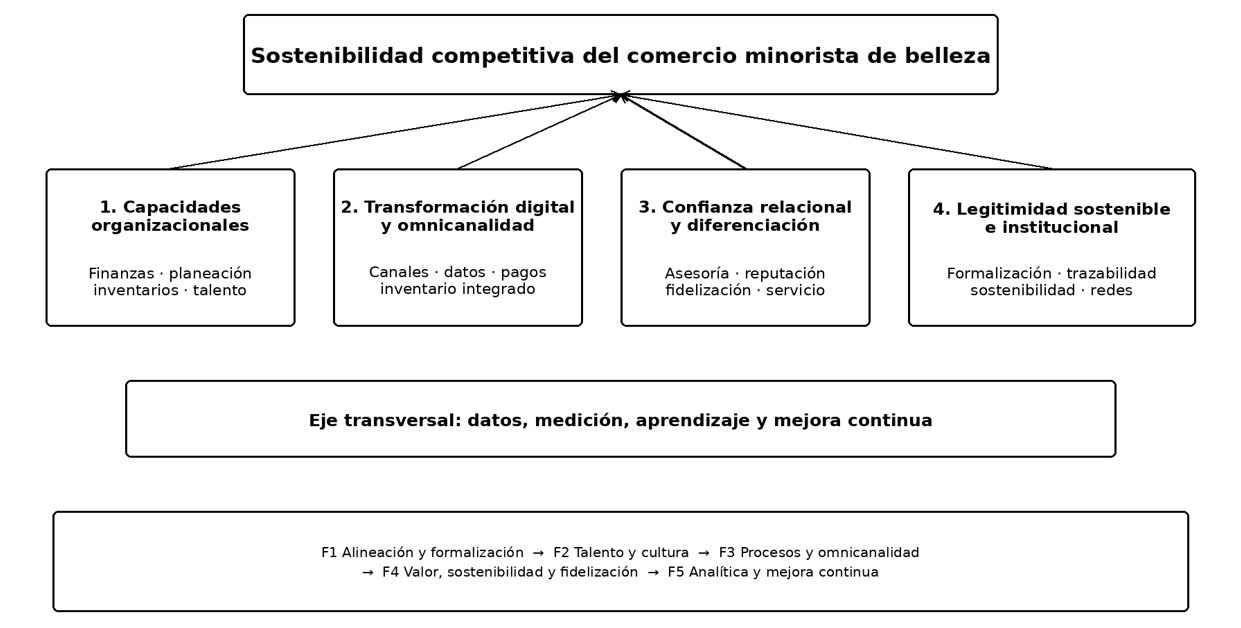
Note. Own elaboration with support from ChatGPT (OpenAI, GPT-5.6 Sol) for diagramming, based on the model developed and conceptually validated by the authors. The figure appears in its original language.
Five-phase implementation roadmap
The key design decision was to arrange the actions along a cumulative path. The phases do not represent isolated compartments: once a capability is implemented, it must be maintained while progressing to the next stage. This sequence aims to mitigate the risk of investing in visible marketing initiatives before addressing structural weaknesses that would otherwise hinder sustained growth.
|
Table 2. Strategic implementation route of the MECOS-BI |
|||
|
Phase |
Purpose |
Key actions |
Monitoring indicators |
|
1. Alignment and formalization |
Build a foundation based on strategy and legitimacy. |
Sharing the diagnosis; defining direction and priorities; reviewing business registration, the RUT, sanitary requirements, and suppliers; connecting with support programs. |
Formalization status; participation in training and networks; frequency of strategic review. |
|
2. Talent and culture |
Bridge the managerial and technical gaps hindering the scaling of the customer relationship. |
Training in finance, inventory management, leadership, product knowledge, advisory skills, and digital competencies; internal feedback. |
Training coverage and completion; knowledge assessment; service performance. |
|
3. Processes and omnichannel approach |
Transform acquired capabilities into integrated operational routines. |
In-person and digital service protocols; unified inventory; minimum stock levels; response times; order preparation and tracking. |
Stockouts; response time; order fulfillment; protocol compliance. |
|
4. Value, sustainability, and loyalty |
Differentiate the offering and increase purchase frequency. |
Curated product portfolios; verifiable sustainable lines; educational content; local influencers; live shopping; loyalty and referral programs. |
Satisfaction; retention; digital conversion; sales of differentiated product lines; registered customers. |
|
5. Analytics and continuous improvement |
Establish a discipline of measurement and learning to refine the model. |
Spreadsheet or basic CRM; dashboard; periodic meetings; variance analysis; process and campaign adjustments. |
Use of reports in decision-making; sales and cost trends; repeat business; operational indicator compliance. |
Note. Own elaboration based on the project's strategic plan.
Phase 1. Strategic alignment and formalization
The first phase addresses structural weaknesses. The diagnosis revealed that nearly half of the businesses were informal and that goal reviews were inconsistent. Consequently, the model begins with a shared strategic direction and recognizes regulatory compliance as a business enabler rather than merely an isolated administrative task. Formalization opens up opportunities to connect with formal suppliers, training programs, and institutional networks, while also highlighting the need to separate personal and business decisions. The Ibagué Chamber of Commerce has developed sector-coordination initiatives, providing a framework to strengthen business networks and regional visibility (Cámara de Comercio de Ibagué, 2025).
Phase 2. Organizational culture and talent development
The second phase focuses on the human element. The diagnosis identified a distinct pattern: strengths in customer service and interpersonal relationships, contrasted with weaknesses in finance, planning, inventory management, and business acumen. This suggests that relational advantages could erode if growth necessitates decisions that go beyond the owner's intuitive experience. The proposed training goes beyond digital skills; it encompasses basic financial literacy, planning, inventory turnover, technical product knowledge, leadership, and advisory support. Literature on SME transformation agrees that knowledge and learning capacity are prerequisites for the successful adoption of technology (Crupi et al., 2020; Eller et al., 2020).
Phase 3. Process redesign and omnichannel experience
The third phase translates learning into operational processes. The goal is to ensure a consistent customer experience, regardless of whether the interaction begins in a physical store, on social media, via WhatsApp, or through a digital catalog. Achieving this requires establishing service protocols and response times, maintaining unified information on pricing and availability, and managing inventory systems that support both in-person and digital sales. This approach aligns with omnichannel literature, which emphasizes the continuity of information and service across touchpoints (Gerea et al., 2021; Wolf & Steul-Fischer, 2023). In the local context, the proposal leverages the business's existing closeness to customers; the innovation lies in making this closeness replicable and integrating it with the operational system.
Phase 4. Value proposition, digital marketing, sustainability, and loyalty
Only after strengthening the internal foundation does the model intensify external differentiation. The proposal integrates curated product portfolios, expert advice, educational content, demonstrations, collaborations with local creators, and loyalty programs. Evidence regarding social media suggests that content credibility and informational value are more significant than mere exposure (Lou & Yuan, 2019). Meanwhile, sustainability is incorporated as a verifiable attribute rather than a generic promise, featuring reliable products and suppliers, clear information, and options compatible with price sensitivity. This approach responds to studies showing that green purchasing depends on perceived value, knowledge, and trust, in addition to environmental concern (Dlamini & Mahowa, 2024; Sadiq et al., 2021).
Phase 5. Analytics system and continuous improvement
The fifth phase establishes a learning mechanism. No complex technological infrastructure was proposed for micro-enterprises; a structured spreadsheet or a basic CRM can track customers, issues, repeat business, response times, and sales by channel. The goal is for follow-up meetings to utilize this information, ensuring that adjustments to inventory, campaigns, or service cease to rely solely on intuition. Digitalization creates value when data is transformed into decisions and changes in routine operations (Matarazzo et al., 2021; Vial, 2019). The scorecard thus acts as a link between strategy and operations.
Strategic monitoring system
The model organized the indicators into four perspectives consistent with the logic of the scorecard used in the project. Universal targets were not defined because the heterogeneity of the businesses requires the establishment of individual baselines. Table 3 presents a minimal dashboard that can be implemented without requiring sophisticated systems.
|
Table 3. Minimal dashboard for monitoring MECOS-BI |
||
|
Perspective |
Control objective |
Proposed indicators |
|
Financial |
Monitor growth and economic discipline. |
Sales growth rate; logistics and operating costs as a percentage of sales; share of revenue from recurring customers. |
|
Customer and market |
Verify whether trust translates into satisfaction and retention. |
Satisfaction with advisory services; complaints relative to sales volume; retention rate; conversion from digital channels. |
|
Internal processes |
Monitor service consistency and availability. |
Adherence to protocols; stockouts; response time; complete and on-time omnichannel orders. |
|
Learning and growth |
Assess capability development and the use of information. |
Staff members passing product/advisory assessments; service performance; analytical reports used in follow-up meetings. |
|
Note. Own elaboration based on the indicators defined in the project. |
||
Integrative analysis
The primary contribution of MECOS-BI lies in the fact that it does not position technology as the starting point. Local evidence revealed that existing digitalization efforts were largely intuitive and that e-commerce played a minor role as a primary sales channel. Literature warns that the isolated adoption of technology does not equate to digital transformation; performance improves when technology is integrated with the business model, leadership, and learning processes (Bouwman et al., 2019; Garzoni et al., 2020; Vial, 2019). Consequently, the model prioritizes capabilities and formalization before intensifying omnichannel strategies. This sequence is particularly relevant for micro-enterprises with limited resources, where disjointed investment can increase complexity without addressing fundamental shortcomings.
A second contribution is treating trust as a strategic resource requiring institutionalization. Project results indicated that personalized service is a key competitive practice. From a resource-based perspective, this close relationship can be valuable and difficult for large-scale players to replicate; however, its reliance on the business owner limits the capacity to sustain growth. The model proposes codifying some of this knowledge through protocols, records, training, and monitoring. The goal is not to mechanize human interaction, but to prevent information loss as the business takes on new staff, channels, or customer volumes.
The third contribution involves integrating sustainability and formalization into a single dimension of legitimacy. In small businesses, both are often viewed merely as external obligations. The model interprets them instead as signals of trust: verifiable origins, legitimate products, reliable suppliers, and environmental practices backed by evidence. This approach avoids framing sustainability as a luxury detached from the business's economic reality. Literature shows that while consumers may value "green" attributes, purchasing decisions remain driven by price, perceived value, and credibility (Amberg & Fogarassy, 2019; Testa et al., 2024).
The fourth contribution lies in institutional coordination. The low level of participation in trade fairs noted in the diagnostic assessment demonstrates that the mere existence of support programs does not guarantee they will be utilized effectively. Crupi et al. (2020) highlight the role of knowledge intermediaries in the digital transformation of SMEs. In Ibagué, chambers of commerce, educational institutions, training bodies, and entrepreneurship programs can serve as knowledge infrastructure, provided their services address the specific challenges faced by businesses and participation leads to actionable learning.
Finally, the model proposes a logic of conditional scaling. The original project envisioned the possibility of expanding to other municipalities in Tolima and creating new segments once the system had reached maturity. This article does not include such expansion as a standard phase, because extending coverage before stabilizing capabilities could exacerbate existing weaknesses. Territorial growth should be viewed as a subsequent decision, grounded in indicators of formalization, profitability, turnover, service, and omnichannel capability. This principle aligns with the concept of dynamic capabilities: reconfiguring resources first requires an organizational foundation capable of absorbing change (Teece et al., 1997).
From a research perspective, MECOS-BI should be understood as a strategic proposition subject to empirical validation. The design outlines which elements should be integrated and in what sequence, but it does not yet demonstrate the extent to which profitability, survival, formalization, or customer loyalty would improve. The next stage involves selecting pilot businesses, establishing baselines, implementing the phases within a defined timeframe, and comparing the evolution of indicators. Such an evaluation will make it possible to identify unnecessary components, unforeseen relationships, and the conditions under which the model generates greater or lesser value.
CONCLUSIONS
The strategic design enabled the transformation of the diagnosis of the beauty retail sector in Ibagué into an intervention architecture aligned with the sector's actual capabilities. The resulting proposal, named MECOS-BI, integrated four dimensions: organizational capabilities; digital transformation and omnichannel strategies; relational trust and differentiation; and sustainable and institutional legitimacy. These dimensions were coordinated through a central axis of data, measurement, and continuous improvement.
The five-phase sequence demonstrated that strengthening competitiveness should not begin with isolated promotional actions. Strategic alignment and formalization form the foundation; talent development reduces reliance on intuition; process redesign turns knowledge into routines; differentiation and marketing amplify the value created; and analytics enable learning, correction, and performance sustainability. This logic addresses the primary tension identified: while customer demand and trust exist, internal capabilities still limit the ability to capture these opportunities consistently.
The proposal also redefines the sector's relational strength. Customer proximity should not be replaced by digitalization but rather scaled through it. When advisory services are backed by technical knowledge, reliable inventories, integrated channels, and data recording, the personal relationship can evolve into an organizational capability. Concurrently, formalization and sustainability bolster the legitimacy of the market offering and open up opportunities for cooperation, access to programs, and differentiation.
MECOS-BI represents a design proposal rather than a proven model of effectiveness. Its main limitation is that it has not yet been implemented longitudinally across a group of establishments. Therefore, future research should apply the model through pilot programs, establish comparable baselines, and analyze changes in sales, repeat business, formalization, inventory management, digital channel usage, and customer satisfaction. It will also be relevant to compare formal and informal businesses, examine differences based on age and size, incorporate the consumer perspective, and evaluate the model's transferability to other intermediate cities.
REFERENCES
Amberg, N. y Fogarassy, C. (2019). Green consumer behavior in the cosmetics market. Resources, 8(3), 137. https://doi.org/10.3390/resources8030137
Asociación Nacional de Empresarios de Colombia [ANDI]. (2024, 25 de junio). Cada colombiano gasta un promedio de $449.000 al año en productos de belleza, cuidado personal y aseo del hogar. https://www.andi.com.co/Home/Noticia/17696-cada-colombiano-gasta-un-promedio-de-44
Barney, J. (1991). Firm resources and sustained competitive advantage. Journal of Management, 17(1), 99-120. https://doi.org/10.1177/014920639101700108
Bouwman, H., Nikou, S., y de Reuver, M. (2019). Digitalization, business models, and SMEs: How do business model innovation practices improve performance of digitalizing SMEs? Telecommunications Policy, 43(9), 101828. https://doi.org/10.1016/j.telpol.2019.101828
Cámara de Comercio de Ibagué. (2025, 16 de julio). Tolima se proyecta en Colombia, el País de la Belleza 2025. https://ccibague.org/tolima-se-proyecta-en-colombia-el-pais-de-la-belleza-2025/
Creswell, J. W. y Creswell, J. D. (2018). Research design: Qualitative, quantitative, and mixed methods approaches (5th ed.). SAGE Publications.
Crupi, A., Del Sarto, N., Di Minin, A., Gregori, G. L., Lepore, D., Marinelli, L., y Spigarelli, F. (2020). The digital transformation of SMEs: A new knowledge broker called the digital innovation hub. Journal of Knowledge Management, 24(6), 1263-1288. https://doi.org/10.1108/JKM-11-2019-0623
David, F. R. y David, F. R. (2017). Strategic management: A competitive advantage approach, concepts and cases (16th ed.). Pearson.
Dlamini, S. y Mahowa, V. (2024). Investigating factors that influence the purchase behaviour of green cosmetic products. Cleaner and Responsible Consumption, 13, 100190. https://doi.org/10.1016/j.clrc.2024.100190
Eller, R., Alford, P., Kallmünzer, A., y Peters, M. (2020). Antecedents, consequences, and challenges of small and medium-sized enterprise digitalization. Journal of Business Research, 112, 119-127. https://doi.org/10.1016/j.jbusres.2020.03.004
Garzoni, A., De Turi, I., Secundo, G., y Del Vecchio, P. (2020). Fostering digital transformation of SMEs: A four levels approach. Management Decision, 58(8), 1543-1562. https://doi.org/10.1108/MD-07-2019-0939
Gerea, C., Gonzalez-Lopez, F., y Herskovic, V. (2021). Omnichannel customer experience and management: An integrative review and research agenda. Sustainability, 13(5), 2824. https://doi.org/10.3390/su13052824
Grant, R. M. (2019). Contemporary strategy analysis (10th ed.). Wiley.
Lemon, K. N. y Verhoef, P. C. (2016). Understanding customer experience throughout the customer journey. Journal of Marketing, 80(6), 69-96. https://doi.org/10.1509/jm.15.0420
Lou, C. y Yuan, S. (2019). Influencer marketing: How message value and credibility affect consumer trust of branded content on social media. Journal of Interactive Advertising, 19(1), 58-73. https://doi.org/10.1080/15252019.2018.1533501
Matarazzo, M., Penco, L., Profumo, G., y Quaglia, R. (2021). Digital transformation and customer value creation in Made in Italy SMEs: A dynamic capabilities perspective. Journal of Business Research, 123, 642-656. https://doi.org/10.1016/j.jbusres.2020.10.033
Organisation for Economic Co-operation and Development [OECD]. (2021). The digital transformation of SMEs. OECD Publishing. https://doi.org/10.1787/bdb9256a-en
Priyono, A., Moin, A., y Putri, V. N. A. O. (2020). Identifying digital transformation paths in the business model of SMEs during the COVID-19 pandemic. Journal of Open Innovation: Technology, Market, and Complexity, 6(4), 104. https://doi.org/10.3390/joitmc6040104
Sadiq, M., Adil, M., y Paul, J. (2021). An innovation resistance theory perspective on purchase of eco-friendly cosmetics. Journal of Retailing and Consumer Services, 59, 102369. https://doi.org/10.1016/j.jretconser.2020.102369
Teece, D. J., Pisano, G., y Shuen, A. (1997). Dynamic capabilities and strategic management. Strategic Management Journal, 18(7), 509-533. https://doi.org/10.1002/(SICI)1097-0266(199708)18:7%3C509::AID-SMJ882%3E3.0.CO;2-Z
Testa, R., Vella, F., Rizzo, G., Schifani, G., y Migliore, G. (2024). What drives and obstacles the intention to purchase green skincare products? A study of the Italian market of green skincare products. Journal of Cleaner Production, 484, 144358. https://doi.org/10.1016/j.jclepro.2024.144358
Vial, G. (2019). Understanding digital transformation: A review and a research agenda. The Journal of Strategic Information Systems, 28(2), 118-144. https://doi.org/10.1016/j.jsis.2019.01.003
Warner, K. S. R. y Wäger, M. (2019). Building dynamic capabilities for digital transformation: An ongoing process of strategic renewal. Long Range Planning, 52(3), 326-349. https://doi.org/10.1016/j.lrp.2018.12.001
Wolf, L. y Steul-Fischer, M. (2023). Factors of customers’ channel choice in an omnichannel environment: A systematic literature review. Management Review Quarterly, 73, 1575-1630. https://doi.org/10.1007/s11301-022-00281-w
FINANCING
The authors received no financing for the development of this research.
CONFLICT OF INTEREST STATEMENT
The authors declare that there is no conflict of interest.
ARTIFICIAL INTELLIGENCE USE STATEMENT
ChatGPT (OpenAI; GPT-5.6 Sol), a generative artificial intelligence tool, was used to assist in organizing the manuscript, improving clarity and cohesion, translating the abstract, and laying out the conceptual representation of the model based on information and results provided by the authors. The tool played no role in data collection, nor did it generate or modify empirical results. The authors verified the data, references, methodological coherence, translation, alignment between the figure and the proposed model, and the final version of the manuscript, and they assume full responsibility for its content.
AUTHORSHIP CONTRIBUTION
Conceptualization: Luis Felipe Lozada and José Alejandro Vera.
Data curation: Luis Felipe Lozada and José Alejandro Vera.
Formal analysis: José Alejandro Vera and Dagoberto Valencia.
Investigation: Luis Felipe Lozada, José Alejandro Vera, and Dagoberto Valencia.
Methodology: Luis Felipe Lozada and Dagoberto Valencia.
Project administration: José Alejandro Vera.
Software: Luis Felipe Lozada.
Supervision: José Alejandro Vera and Dagoberto Valencia.
Validation: José Alejandro Vera and Dagoberto Valencia.
Visualization: Luis Felipe Lozada and José Alejandro Vera.
Writing—original draft: Luis Felipe Lozada, José Alejandro Vera, and Dagoberto Valencia.
Writing—proofreding and editing: Luis Felipe Lozada, José Alejandro Vera, and Dagoberto Valencia.