Scientific and Technological Research Article
Fatigue and health-related quality of life in nursing teachers in Argentina
Fatiga y calidad de vida relacionada con la salud en docentes de enfermería de Argentina
Carlos Canova-Barrios1  *, Rosana
Inés Nores2 *, Adriana Camio3 *, María Fernanda Herrera4 *, Mirta Inés Vilte5 *, Sara Leonor Mercado6,7 *, María Alejandra Mangano6,7 *, Rita Raquel Espeche8 *, Analía Ortigoza9 *
ABSTRACT
Introduction: The context of university higher education is particularly complex and exposes teachers to multiple structural stresses that predispose them to the development of work fatigue, thereby affecting their Health-Related Quality of Life.
Objective: To analyze the relationship between work fatigue and health-related quality of life in nursing teachers at eight higher education institutions in Argentina.
Methods: Descriptive, cross-sectional, quantitative study. A total of 343 academics agreed to participate and completed the MFI-19 and MOS-12 instruments.
Results: Quality of life was positive in all dimensions; however, general health and vitality were found to be at risk. The prevalence of work fatigue was moderate and was related to nursing degree training, working in public universities, and performing caregiving roles. Work fatigue has a negative impact on teachers' quality of life, with a more pronounced impact on mental health.
Conclusions: Interventions are needed to reduce the prevalence of fatigue and prevent the deterioration of teachers' health, so that they can cope with the demands of the university context.
Keywords: Academic teaching personnel, Fatigue, Higher education, Public health, Quality of life.
JEL Classification: I11, I23, I31.
RESUMEN
Introducción: El contexto de la educación superior universitaria es particularmente complejo y expone al docente a múltiples tensiones estructurales que predisponen al desarrollo de fatiga laboral, y que, con ello, se afecte su calidad de vida relacionada con la salud.
Objetivo: Analizar la relación entre la fatiga laboral y la calidad de vida relacionada con la salud en docentes de la Licenciatura en Enfermería de ocho instituciones de educación superior de Argentina.
Metodología: Estudio descriptivo, transversal y cuantitativo. Participaron 343 docentes que accedieron a participar en el estudio y diligenciaron los instrumentos MFI-19 y MOS-12.
Resultados: La calidad de vida fue positiva en todas las dimensiones; sin embargo, la salud general y la vitalidad se detectaron en riesgo. La prevalencia de fatiga laboral fue moderada y se relacionó con la formación de grado en enfermería, desempeñarse en universidades públicas y cumplir roles asistenciales. La fatiga laboral incide de manera negativa sobre la calidad de vida de los docentes, con un impacto más pronunciado en la salud mental.
Conclusiones: Son necesarias intervenciones para disminuir la prevalencia de la fatiga y prevenir el deterioro de la salud de los docentes, de modo que puedan hacer frente a las demandas del contexto universitario.
Palabras clave: Calidad de Vida, Enseñanza Superior, Fatiga, Personal académico docente, Salud Pública.
Clasificación JEL: I11, I23, I31.
Received: 20-05-2026 Revised: 15-08-2026 Accepted: 01-09-2026 Published: 11-09-2026
Editor: Alfredo Javier Pérez Gamboa
1Universidad de Ciencias Empresariales y Sociales. Buenos Aires, Argentina.
2Universidad Nacional de Rosario. Rosario, Argentina.
3Universidad Favaloro. Buenos Aires, Argentina.
4Universidad Nacional de Chilecito. Chilecito, Argentina.
5Universidad Nacional de Salta. Salta, Argentina.
6Universidad Nacional del Sur. Bahía Blanca, Argentina.
7Universidad Provincial del Sudoeste. Bahía Blanca, Argentina.
8Universidad Nacional de Córdoba. Córdoba, Argentina.
9Universidad Nacional de Tucumán. Tucumán, Argentina.
Cite as: Canova-Barrios, C., Nores, R. I., Camio, A., Herrera, M. F., Vilte, M. I., Mercado, S. L., Mangano, M. A., Espeche, R. R., & Ortigoza, A. (2026). Fatiga y calidad de vida relacionada con la salud en docentes de enfermería de Argentina. Región Científica, 5(2), 2026626. https://doi.org/10.58763/rc2026626
INTRODUCTION
The context of university-level higher education is particularly complex, exposing faculty members to multiple structural tensions. On one hand, they are expected to train competent professionals; on the other, they must meet institutional demands regarding student retention and successful graduation, fulfill multiple roles (teaching, research, and community engagement), and participate actively in institutional life. These challenges are often compounded by various psychosocial risk factors—such as stress, competitive environments, a lack of administrative support, isolated work, and excessive workloads—within a landscape characterized by the massification of access to higher education (Loayza Torres et al., 2022; Flores-Meza et al., 2022). Consequently, occupational fatigue emerges as a direct result of these prolonged and sustained pressures.
Occupational fatigue is defined as a state of extreme physical and mental exhaustion that impairs the ability to work effectively. Caused by stress, excessive workloads, long hours, and a lack of rest, it manifests as poor performance, tiredness, reduced concentration, and general malaise (Gutierres Ruivo et al., 2023a), potentially leading to health problems if left unaddressed. Levels of occupational fatigue are particularly high in professions involving significant social interaction, including higher education teaching (Wu et al., 2021). For educators in nursing and other health professions, professional demands are even greater; their role requires constant updating within their discipline, continuous development of specific teaching skills—encompassing disciplinary, pedagogical, and human dimensions—and the ongoing adoption and mastery of new technologies (Elizalde Ordoñez et al., 2024; Gutierres-Ruivo et al., 2023b; Ortigoza, 2023; Steege et al., 2022; Wu et al., 2021).
A decline in health can extend beyond the educator's personal life to negatively impact their work performance, resulting in lower-quality instruction, increased dissatisfaction, and reduced work commitment (Garcia & Juliani, 2024). Based on these observations, a link is identified between psychosocial risk factors—including occupational fatigue—and the educator's psychophysical health (Canova Barrios et al., 2025; Casimiro et al., 2025).
Health, viewed holistically, is assessed through the construct of Health-Related Quality of Life (HRQoL). This is defined as “the subjective influence of health status, healthcare, and health prevention and promotion activities on an individual's capacity to achieve and maintain a level of functioning that allows for the attainment of life goals and is reflected in general well-being,” encompassing physical, psychological-cognitive, and social dimensions (Tudela, 2009).
Regarding prior research, a study conducted in Peru with a sample of 326 university educators found a moderate positive correlation between workload and HRQoL. Another study conducted in Argentina, involving 159 health sciences faculty members, identified moderate negative correlations between fatigue and health-related quality of life (HRQoL), with a greater impact on aspects related to mental health (Canova Barrios et al., 2025). Both studies conclude that higher levels of occupational fatigue negatively affect faculty members' perceived well-being and performance. This finding is supported by various other studies on the subject (Alves et al., 2019; Cobos-Sanchiz et al., 2022; Silva et al., 2025).
Given the scarcity of research on the impact of occupational fatigue on HRQoL among university faculty in the Argentine context, it is essential to generate evidence that highlights issues often treated as normal, identifies psychosocial risk factors, and provides a basis for designing institutional policies aimed at promoting health, preventing occupational burnout, and improving educational quality. Furthermore, these studies contribute to strengthening the sustainability of Higher Education Institutions (HEIs) by recognizing that faculty well-being is a key component in ensuring high-quality, socially responsible educational processes.
Based on the elements described, the objective of this study is to analyze the relationship between occupational fatigue and health-related quality of life among faculty members in Nursing degree programs at eight HEIs in Argentina.
METHODS
This is a descriptive, correlational, multicenter, cross-sectional study with a quantitative approach. The study population consisted of all faculty members in the Bachelor of Nursing program across eight higher education institutions (HEIs) in Argentina. The sample consisted of 364 teachers who agreed to participate voluntarily, accepting the Informed Consent and completing the data collection instrument. Twenty-one observations were excluded due to incomplete completion of the instrument, resulting in a final sample of 343 observations. Non-probability sampling was employed. Data collection took place during the second academic term of 2025.
Inclusion criteria were defined as follows: being a faculty member in the Bachelor of Nursing program, being affiliated with one of the eight institutions where the study was conducted, having at least six months of employment tenure at the time of data collection, and agreeing to participate voluntarily. Members of the research team and program administrators were excluded. Incomplete and/or improperly completed instruments were discarded.
Two instruments were used for data collection: the MFI-19 and the MOS-12. The MFI-19 (Multidimensional Fatigue Inventory in Work Environment) is a questionnaire designed to measure work-related fatigue; it consists of 19 items grouped into three factors: General Fatigue (eight items), Physical Fatigue (six items), and Concentration/Motivation (five items) (Boada-Grau et al., 2014). Responses to the instrument's items are recorded on a scale ranging from 1 ("Yes, that is true") to 7 ("No, that is not true"). The final scale values are interpreted such that a higher score indicates greater work-related fatigue. To maintain the instrument's directionality, the values of nine items were reversed. The MFI-19 demonstrated good reliability in the sample (α=0.90).
The MOS-12 (Medical Outcomes Study) is a 12-item questionnaire used to assess HRQoL across eight dimensions (Physical Functioning, Role-Physical, Bodily Pain, General Health, Vitality, Social Functioning, Role-Emotional, and Mental Health) and two components (Physical and Mental Summary Components) (Canova-Barrios & Oviedo-Santamaría, 2021; Canova Barrios et al., 2025; Ware et al., 1996). Items are rated on Likert-type scales with two to six response options. Final scores for both the dimensions and the summary components range from 0 to 100, with higher scores indicating better physical and/or mental health. The cutoff score distinguishing between good and poor quality of life is 50±10. The MOS-12 demonstrated good reliability in the sample (α=0.86).
Data collection was supplemented by the inclusion of thirteen questions to characterize the teachers sociodemographically and in terms of their education and employment; these inquiries covered variables such as age, work experience, sex, marital status, type of employing institution, subjects taught, and workload (hours/week), among others.
Data collection was carried out using Google Forms. Invitations to participate, informed consent forms, and the link to complete the instrument were distributed via email and instant messaging applications (WhatsApp). Once the responses were obtained, they were exported to a Microsoft Excel spreadsheet and analyzed using the free version of Infostat (April 2020).
Parametric tests were used for data analysis, taking into account the normal distribution of the data. Quantitative variables were described using means, standard deviation (SD), and 95% confidence intervals (95% CI), while qualitative variables were described using absolute (n) and relative (%) frequencies. Inferential analysis involved independent-samples Student's t-tests, ANOVA, and Pearson correlation tests. A statistical significance level of p=0.05 was established.
Regarding ethical considerations, this study is observational, anonymous, and voluntary. It was approved by the Research Department's Ethics Committee under Resolution I24-25 of 2025. The study was classified as "no-risk."
Participants included 343 faculty members from Nursing degree programs at eight higher education institutions in Argentina. Their mean age was 48.92 years (SD=10.59); the majority were women (73.47%), married or in a domestic partnership (53.35%), and had children (70.26%). They held nursing qualifications (88.92%) and postgraduate degrees (58.89%), were affiliated with public institutions (72.89%) and a single institution (65.01%), and had a teaching workload of 10 to 20 hours per week (46.06%). They taught courses involving hospital- or community-based clinical practice (65.60%) and worked in healthcare institutions performing clinical care roles (55.39%) (Table 1). Professional work experience averaged 22.18 years (SD=11.37), and teaching experience averaged 13.15 years (SD=9.33).
|
Table 1. Characterization of the institution and year the test was taken |
|||
|
Variable |
Categoriess |
n |
% |
|
Sex |
Male |
91 |
26.53 |
|
Female |
252 |
73.47 |
|
|
Marital status |
Single |
114 |
33.24 |
|
Married or Common-law partner |
183 |
53.35 |
|
|
Widowed or Divorced |
46 |
13.41 |
|
|
Children |
Yes |
241 |
70.26 |
|
No |
102 |
29.74 |
|
|
Nursing qualification |
Yes |
305 |
88.92 |
|
No |
33 |
9.62 |
|
|
Don't know/No response |
5 |
1.46 |
|
|
Institution type |
Public |
250 |
72.89 |
|
Private |
83 |
24.20 |
|
|
Don't know/No response |
10 |
2.92 |
|
|
Educational level |
Bachelor's degree |
91 |
26.53 |
|
Bachelor's degree + Postgraduate certificate |
50 |
14.58 |
|
|
Specialization |
129 |
37.61 |
|
|
Master's degree |
65 |
18.95 |
|
|
Doctorate |
8 |
2.33 |
|
|
Working hours per week |
Less than 10 hours |
78 |
22.74 |
|
10 to 20 hours |
158 |
46.06 |
|
|
21 to 30 hours |
55 |
16.03 |
|
|
31 to 40 hours |
36 |
10.50 |
|
|
41 hours or more |
16 |
4.66 |
|
|
Multiple teaching jobs |
Yes |
120 |
34.99 |
|
No |
223 |
65.01 |
|
|
Course with hospital/community clinical placements |
Yes |
225 |
65.60 |
|
No |
118 |
34.40 |
|
|
Clinical practice |
Yes |
190 |
55.39 |
|
No |
153 |
44.61 |
|
|
Total |
343 |
100.00 |
|
Source: own elaboartion.
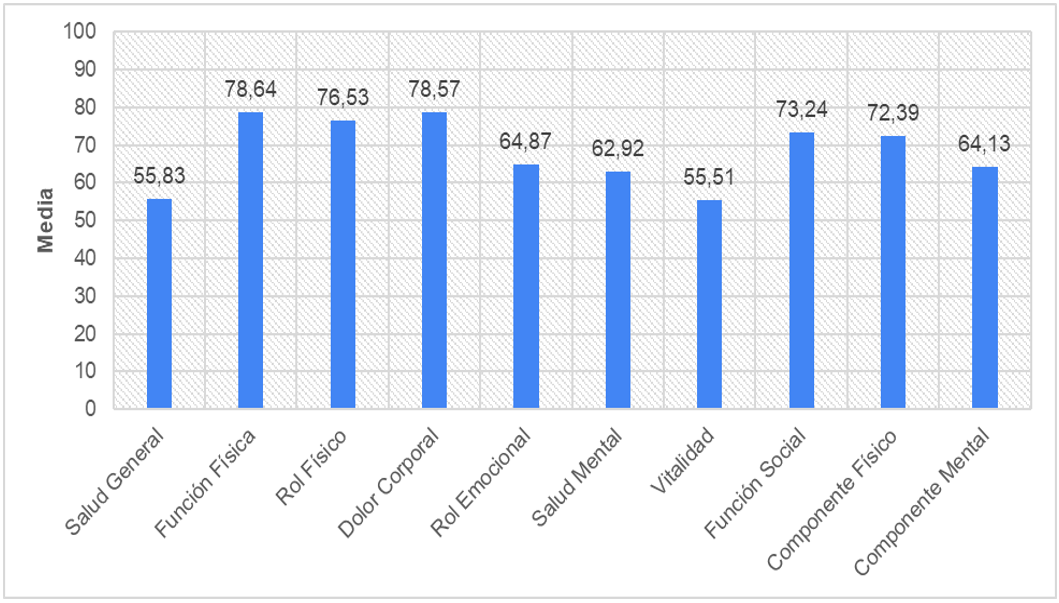
When analyzing the health-related quality of life of the respondents, higher mean scores were found in the dimensions comprising the physical component. Physical Functioning and Bodily Pain showed the highest average values, with means of 78.64 (SD=26.86) and 78.57 (SD=24.33), respectively. In contrast, Vitality had the lowest mean score, at 55.51 (SD=24.80). The Physical Component Summary scored higher (Mean=72.39; SD=21.37; 95% CI=70.12–74.66) compared to the Mental Component Summary (Mean=64.13; SD=23.16; 95% CI=61.67–66.59) (Figure 1).
A very weak positive correlation was found between age, work experience, and HRQoL dimensions (r<0.2; p<0.05). Men showed better Physical Functioning (p=0.035); respondents with children had a lower prevalence of Bodily Pain (p=0.017); single individuals reported better mental health (p=0.014); those with a background in Nursing had lower mean scores in the dimensions of Physical Functioning (p=0.001), Bodily Pain (p=0.030), and Physical Component Summary (p=0.024); those working in public universities had lower mean scores across all dimensions (p<0.05), except for General Health, Physical Functioning, and Role-Emotional. Those not performing clinical care roles had higher mean scores in Role-Emotional (p=0.031). Finally, it was found that a higher weekly workload was associated with greater impairment in the dimensions of General Health (p=0.019), Social Functioning (p=0.048), and Physical Component Summary (p=0.041).
Figure 1.
Mean scores for health dimensions among faculty members in Bachelor of Nursing programs in Argentina (n=343)
Source: own elaboration.
Note: the figure appears in its original language.
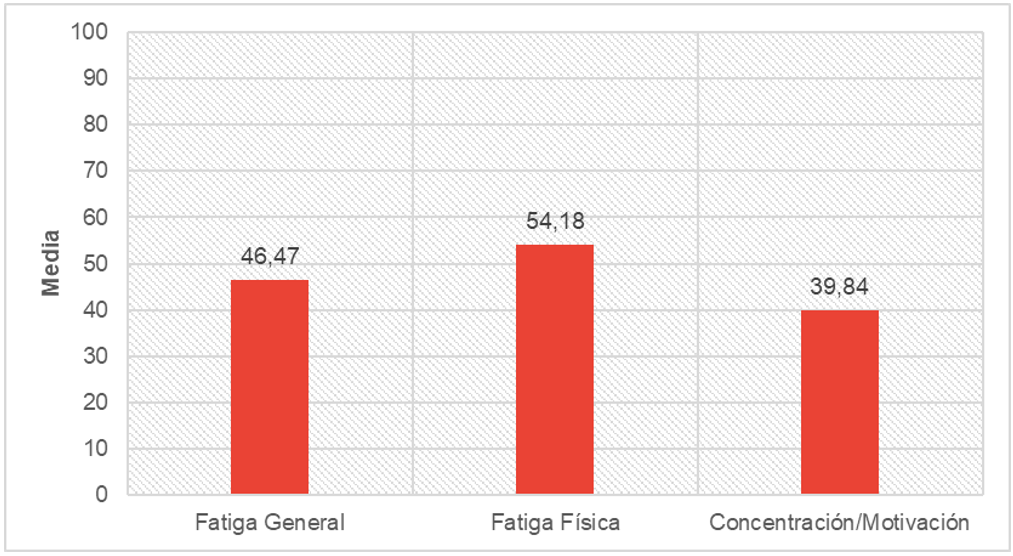
Analysis of the prevalence of occupational fatigue among teachers revealed a moderate level, affecting 46.83% of the sample. Fatigue was highest in the Physical Fatigue factor, with a mean score of 54.18% (SD=18.52) out of a possible 100 points. In contrast, the Reduced Concentration/Motivation factor was the least affected, with a mean score of 39.84% (SD=18.72) (Figure 2). Regarding the MFI-19 instrument, the item with the highest score (indicating the highest level of occupational fatigue) was “I feel rested,” with a mean of 4.38 (SD=1.88) out of 7 points.
Inferential analysis revealed higher occupational fatigue levels among faculty members with a background in nursing (p<0.05) and those working in public universities (p<0.001). Faculty members who also held clinical roles showed higher scores in the factors of General Fatigue (p=0.043) and Reduced Concentration/Motivation (p=0.038). Age showed a low correlation with occupational fatigue (r=-0.12, p=0.027).
Figure 2.
Average scores for occupational fatigue factors among faculty in Bachelor of Nursing programs in Argentina (n=343)
Source: own elaboration.
Note: the figure appears in its original language.
Finally, the correlation between occupational fatigue and health-related quality of life indices was analyzed; negative correlations ranging from low (r=0.2–0.4) to moderate (r=0.4–0.6) were found, indicating that higher fatigue levels were associated with lower quality of life. General fatigue and reduced concentration/motivation had the greatest influence on the Mental Component Summary of HRQoL (Table 2).
|
Table 2. Correlation between occupational fatigue and health-related quality of life among Nursing faculty in Argentina (n=343) |
|||
|
Dimensions |
General Fatigue |
Physical Fatigue |
Concentration / Motivation |
|
General Health |
-0.46 |
-0.53 |
-0.32 |
|
Physical Functioning |
-0.37 |
-0.42 |
-0.27 |
|
Role-Physical |
-0.37 |
-0.32 |
-0.31 |
|
Bodily Pain |
-0.35 |
-0.32 |
-0.29 |
|
Role-Emotional |
-0.43 |
-0.37 |
-0.37 |
|
Mental Health |
-0.52 |
-0.47 |
-0.41 |
|
Vitality |
-0.52 |
-0.49 |
-0.42 |
|
Social Functioning |
-0.45 |
-0.34 |
-0.37 |
|
Physical Component Summary |
-0.49 |
-0.52 |
-0.37 |
|
Mental Component Summary |
-0.58 |
-0.50 |
-0.47 |
Note: All values were statistically significant (p < 0.001).
Source: own elaboration.
DISCUSION
The drive for greater efficiency within higher education institutions (HEIs) has led to an increasing workload for teaching staff. This burden stems not only from performance demands in contexts of mass student enrollment but also from the need to fulfill multiple roles—many of them unpaid—such as outreach, research, student advising and mentoring, and continuous disciplinary and pedagogical training (Cao et al., 2025). Compounding this are the tasks inherent to the faculty members' original disciplines—such as clinical practice for those in health-related fields—alongside family and social demands. Against this backdrop, teaching is recognized as one of the professions with the highest levels of work-related stress.
Work-related fatigue emerges as a direct consequence of these working conditions and constitutes a significant psychosocial risk factor with a potentially negative impact on teachers’ health. This study identified a significant relationship between levels of work-related fatigue and health-related quality of life (HRQoL); specifically, higher fatigue was associated with lower HRQoL, with a particularly pronounced impact on the mental health component. This finding aligns with reports by Alves et al. (2019), Canova Barrios et al. (2025), Cobos-Sanchiz et al. (2022), and Silva et al. (2025), all of whom described health deterioration associated with the development of work-related fatigue. Furthermore, mental health issues among university faculty have been widely documented, with evidence showing high levels of burnout, anxiety, stress, depression, irritability, and sleep disturbances (Moreno Castillo, 2025).
The level of work-related fatigue observed in this study was lower than that reported in other studies, such as the one by Wu et al. (2021), in which 60.49% of teachers experienced moderate stress levels and 38.05% experienced low levels. The finding of higher levels of occupational fatigue among nursing faculty members who work in public universities and also perform clinical care duties can be explained by the convergence of multiple work-related and contextual demands. For nursing educators, professional identity is historically rooted in the concept of care, which entails a heavy physical and emotional burden in both clinical and academic settings (Pi et al., 2025; Poole & Spies, 2022). This situation is intensified in public universities, where higher institutional demands, resource constraints, large student populations, and significant pressure to maintain core functions with limited structural support often coexist (Cao et al., 2025; Pujol-Cols, 2018; Tito-Huamani et al., 2022). Furthermore, the simultaneous performance of teaching and clinical roles leads to extended working hours, fragmented rest periods, and continuous exposure to stressful situations, thereby increasing the risk of occupational fatigue. Collectively, these factors create a scenario of heightened psychosocial vulnerability that helps explain the fatigue levels observed in this group of educators.
Age emerged as a slightly protective factor for teachers’ health. This aligns with findings reported by Machado Sánchez et al. (2019) and Yao et al. (2022), who noted that older teachers perceive greater professional recognition, income, stability, and access to resources for meeting role demands—factors that mitigate the impact of adverse working conditions on health.
Limitations of this study include the sampling method used (non-probabilistic), the cross-sectional design, the use of self-administered instruments, and the low representation of private institutions. These factors may affect the representativeness and reliability of the findings and preclude the establishment of cause-and-effect relationships between the variables analyzed.
Strengths include the large sample size, the use of validated instruments, and the participation of multiple institutions. The large sample size represents a significant methodological strength, as it increases the study’s statistical power, improves the precision of estimates, reduces random error, allows for the identification of associations with greater reliability, and enhances the representativeness of the study population. The use of validated instruments ensures that the variables of interest are measured reliably and consistently, guaranteeing construct validity and the comparability of results with previous studies. Furthermore, the multicenter nature of the study—encompassing both public and private institutions—is a substantial strength, as it captures the heterogeneity of academic and work environments, thereby reducing bias associated with single-institution studies. This institutional diversity enriches the analysis, improves the generalizability of the findings, and provides a more comprehensive view of the issue under study.
CONCLUSIONS
The health-related quality of life of nursing faculty members was generally positive; however, significant deterioration was identified in the General Health and Vitality dimensions.
The prevalence of occupational fatigue was moderate, affecting approximately half of the surveyed faculty. Furthermore, professional nursing practice (holding a nursing degree), employment at public universities, and the combination of teaching and clinical care roles were associated with higher levels of occupational fatigue.
Levels of occupational fatigue—as well as health-related quality of life—were similar across the eight participating institutions.
The results demonstrated that occupational fatigue negatively affects faculty health-related quality of life, with a more pronounced impact on mental health (Mental Component Summary).
Based on these findings, it is essential for Higher Education Institutions (HEIs) to design and implement policies to support and care for faculty, aimed at preventing occupational fatigue and preserving psychophysical health. Doing so will help ensure better health outcomes and effective performance in the core functions of HEIs: teaching, research, and community outreach.
REFERENCES
Alves, P. C., Oliveira, A. F., & Da Silva Paro, H. B. M. (2019). Quality of life and burnout among faculty members: How much does the field of knowledge matter? PloS one, 14(3), e0214217. https://doi.org/10.1371/journal.pone.0214217
Boada-Grau, J., Merino-Tejedor, E., Gil-Ripoll, C., Segarra-Pérez, G., & Vigil-Colet, A. (2014). Adaptación al español del Inventario Multidimensional de Fatiga (MFI) al entorno laboral. Universitas Psychologica, 13(4). http://doi.org/10.11144/Javeriana.UPSY13-4.aeim
Canova Barrios, C., Padilla, M. J., Diez, P., Pecker, L., Lichtensztejn, M., & Spector, C. H. (2025). Fatiga y calidad de vida en docentes de la facultad de ciencias de la salud de la Universidad de Ciencias Empresariales y Sociales. Revista Argentina de Educación Médica, 14(2). https://raem.afacimera.org.ar/articulos/c4a5776b-3b22-49f8-954f-b3735f5b4a4b
Canova-Barrios, C., & Oviedo-Santamaría, P. (2021). Health-related quality of life among intensive care unit workers. Enfermería Intensiva (English ed.), 32(4), 181-188. https://doi.org/10.1016/j.enfie.2020.11.002
Cao, B., Hassan, N. C., & Omar, M. K. (2025). Interventions to Reduce Burnout Among University Lecturers: A Systematic Literature Review. Behavioral Sciences, 15(5), 649. https://doi.org/10.3390/bs15050649
Casimiro, L. G., Geisse Vyhmeister, J. R., Oviedo, A. M., & Canova-Barrios, C. (2025). Psychosocial risk factors perceived by the nursing staff of a Neonatal Intensive Care Unit in Buenos Aires, Argentina. Health Leadership and Quality of Life, 4, 161. https://doi.org/10.56294/hl2025161
Cobos-Sanchiz, D., López-Noguero, F., Gallardo-López, J. A., & Martín, M. C. (2022). Incidencia del agotamiento en los docentes universitarios: Estudio de caso en una universidad española. Formación Universitaria, 15(2), 83–92. https://doi.org/10.4067/S0718-50062022000200083
Elizalde Ordoñez, H., Rodríguez Quezada, F. C., Cobos Alvarracín, M. Y., & Tinoco Luna, L. A. (2024). La relación del docente universitario de enfermería con los estudiantes en los hospitales docentes del Ecuador. Revista InveCom, 4(2), e040213. https://doi.org/10.5281/zenodo.10558741
Flores-Meza, G., Cuaya-Itzcoatl, I. G., & Rojas-Solís, J. L. (2021). Estrés laboral en el contexto universitario: Una revisión sistemática. Dilemas contemporáneos: educación, política y valores, 9(spe1), 00008. https://doi.org/10.46377/dilemas.v9i.2912
Garcia, T. V., & Juliani, C. C. (2024). Teacher's health and presenteeism. Revista brasileira de medicina do trabalho, 22(2), e2022973. https://doi.org/10.47626/1679-4435-2022-973
Gutierres Ruivo, É. D., Pereira Rocha, L., Tomaschewski-Barlem, J. G., Dalmolin, G. L., Juliano, L. F., & Yasin, J. C. M. (2023a). Validity study of the Three-Dimensional Work Fatigue Inventory among higher education nursing faculty. Revista Brasileira de Enfermagem, 76(4), e20230020. https://doi.org/10.1590/0034-7167-2023-0020
Gutierres-Ruivo, É. D., Pereira Rocha, L., Barlem, E. L. D., Sena-Castanheira, J., Cecagno, D., & Juliano, L. F. (2023b). Analysis of fatigue among nurse educators in brazilian public universities during the covid-19 pandemic. Texto & Contexto - Enfermagem, 32, e20230013. https://doi.org/10.1590/1980-265X-TCE-2023-0013en
Loayza Torres, G. A., Troya Heras, L. Y., González-Ramón, E. X., & Sánchez Cabrera, L. C. (2022). La sobrecarga y el estrés en el ámbito laboral, analizado desde la óptica del trabajador. Ciencia Latina Revista Científica Multidisciplinar, 6(3), 3569-3586. https://doi.org/10.37811/cl_rcm.v6i3.2485
Machado Sánchez, H., Gouveia de Morais Sanchez, E., Alves Barbosa, M., Carvalho Guimarães, E., & Porto, C. C. (2019). Impact of health on quality of life and quality of working life of university teachers from different areas of knowledge. Ciência & Saúde Coletiva, 24(11), 4111-4123. https://doi.org/10.1590/1413-812320182411.28712017
Moreno Castillo, S. (2025). La Salud Mental de los Docentes de Educación Superior en América Latina. Ciencia y Reflexión, 4(3), 1298–1318. https://doi.org/10.70747/cr.v4i3.495
Ortigoza, A. (2023). Estudio de las trayectorias académicas de estudiantes de la Licenciatura en Enfermería de la Universidad Nacional de Tucumán en las voces de sus actores (Tesis de doctorado, Instituto Universitario Hospital Italiano de Buenos Aires). https://trovare.hospitalitaliano.org.ar/greenstone/cgi-bin/library.cgi?c=tesisytr&a=d&d=D1993
Pi, R., Liu, Y., Yan, R., OuYang, Y., Li, W., Hou, Z., De, Z., Liu, F., He, Z., Mei, Y., & Li, S. (2025). "I can't endure it" vs. "I can handle it" - experiencing work fatigue risk for nurses: a qualitative study. BMC nursing, 24(1), 361. https://doi.org/10.1186/s12912-025-03022-y
Poole, E. L., & Spies, M. A. (2022). Relationship among faculty fatigue, academic rank, and scholarship and service productivity. Journal of Advanced Nursing, 78(2), 395-403. https://doi.org/10.1111/jan.14990
Pujol-Cols, L. J. (2018). Work engagement, satisfacción laboral, salud física y salud mental en académicos de una universidad pública argentina. Salud de los Trabajadores, 26(1), 6-19. https://www.redalyc.org/journal/3758/375857991002/html/
Silva, F. H. R. d., Barbosa, M. A., Porto, C. C., Sanchez, E. G. d. M., Silva, L. A. d., Maia, L. G., Silva, M. L. d., & Sanchez, H. M. (2025). Occupational Factors on QOL of University Teachers. International Journal of Environmental Research and Public Health, 22(10), 1546. https://doi.org/10.3390/ijerph22101546
Steege, L. M., Arsenault Knudsen, É. N., Brzozowski, S., & Cho, H. (2022). Addressing Occupational Fatigue in Nurses: A User-Centered Design Approach for Fatigue Risk Management. The Journal of Nursing Administration, 52(3), 167–176. https://doi.org/10.1097/NNA.0000000000001125
Tito-Huamani, P. L., Torres-Pecho, M., & Pérez-Palacios, E. E. (2022). Predictores del síndrome de burnout en docentes universitarios: un análisis factorial exploratorio. Enfermería Global, 21(67), 50-81. https://doi.org/10.6018/eglobal.496901
Tudela L. L. (2009). La calidad de vida relacionada con la salud. Atención primaria, 41(7), 411–416. https://doi.org/10.1016/j.aprim.2008.10.019
Ware, J., Kosinski, M., & Keller, S. D. (1996). A 12-Item Short-Form Health Survey: construction of scales and preliminary tests of reliability and validity. Medical care, 34(3), 220–233. https://doi.org/10.1097/00005650-199603000-00003
Wu, P., Tseng, S., Tseng, Y., Chen, L., Pai, H., & Yen, W. (2021). Job stress and occupational burnout among clinical nursing teachers: A cross-sectional study. Journal of Professional Nursing, 37(5), 907-915. https://doi.org/10.1016/j.profnurs.2021.07.014
Yao, Q., Yang, F., Li, H., Tang, K., & Liu, C. (2022). Health-related quality of life of young academics: A cross-sectional survey of universities in Wuhan, China. Frontiers in Psychology, 13, 996219. https://doi.org/10.3389/fpsyg.2022.996219
FINANCING
The authors received no funding for the development of this research.
CONFLICT OF INTEREST STATEMENT
The authors declare that there is no conflict of interest.
STATEMENT ON THE USE OF ARTIFICIAL INTELLIGENCE
No AI was used in the development of the article.
AUTHORSHIP CONTRIBUTION
Conceptualization: Carlos Canova-Barrios, Analía Ortigoza.
Data curation: Carlos Canova-Barrios, Analía Ortigoza.
Formal analysis: Carlos Canova-Barrios, Rosana Inés Nores, Adriana Camio, María Fernanda Herrera, Mirta Inés Vilte, Sara Leonor Mercado, María Alejandra Mangano, Rita Raquel Espeche, Analía Ortigoza.
Research: Carlos Canova-Barrios, Rosana Inés Nores, Adriana Camio, María Fernanda Herrera, Mirta Inés Vilte, Sara Leonor Mercado, María Alejandra Mangano, Rita Raquel Espeche, Analía Ortigoza.
Methodology: Carlos Canova-Barrios, Rosana Inés Nores, Adriana Camio, María Fernanda Herrera, Mirta Inés Vilte, Sara Leonor Mercado, María Alejandra Mangano, Rita Raquel Espeche, Analía Ortigoza.
Project administration: Carlos Canova-Barrios.
Supervision: Carlos Canova-Barrios.
Validation: Carlos Canova-Barrios, Analía Ortigoza.
Visualization: Carlos Canova-Barrios, Sara Leonor Mercado.
Writing – original draft: Carlos Canova-Barrios, Rosana Inés Nores, Adriana Camio, María Fernanda Herrera, Mirta Inés Vilte, Sara Leonor Mercado, María Alejandra Mangano, Rita Raquel Espeche, Analía Ortigoza.
Writing – proofreading and editing: Carlos Canova-Barrios, Adriana Camio, Sara Leonor Mercado, María Alejandra Mangano, Analía Ortigoza.