Review Article
doi: 10.58763/rc2026610
Microindicators for measuring economic circularity in clients of Venezuelan consulting firms
Microindicadores para la medición de la circularidad económica en los clientes de las empresas consultoras venezolanas
Jesús Alonso Campos García1  *
*
ABSTRACT
Introduction: The transition from a linear to a circular economic paradigm has created an imperative need to develop tools for evaluating the impact of implemented transformations. In this context, the present research was undertaken with the purpose of establishing a measurement framework comprised of circularity micro-indicators for use by Venezuelan consulting firms to assess their clients’ progress in adopting a circular economy.
Methodology: The methodology was based on a post-positivist and documentary approach, which involved a systematic literature review in databases such as SCOPUS, WoS, and EBSCOhost (2015-2025), following the PRISMA protocol.
Results: The results identified 24 circularity micro-indicators grouped into eight key dimensions: dismantling, resource efficiency, life extension, end-of-life management, waste management, recycling, remanufacturing, and reuse.
Discussion: The importance of these indicators as inputs for strategic diagnosis and for promoting sustainability, innovation, and informed decision-making was discussed.
Conclusions: Micro-indicators stand out as a valuable resource for consulting firms to facilitate the effective transition of their client portfolio toward a circular economy model.
Keywords: sustainable development, economy, environmental economics, green economy.
JEL Classification: M21, Q56, L84.
RESUMEN
Introducción: La transición del paradigma económico lineal hacia uno circular ha suscitado una imperativa necesidad de desarrollar herramientas para la evaluación del impacto de las transformaciones implementadas. En este contexto, se ha planteado la presente investigación, cuyo propósito radica en establecer un marco de medición constituido por microindicadores de circularidad, para que sean aprovechados por las consultoras venezolanas en pro de evaluar el nivel de avance de sus clientes en la adopción de la economía circular.
Metodología: La metodología estuvo sustentada en el enfoque postpositivista y documental, que involucró la realización de una revisión sistemática de literatura en bases de datos como SCOPUS, WoS y EBSCOhost (2015-2025), siguiendo el protocolo PRISMA.
Resultados: Los resultados permitieron identificar 24 microindicadores de circularidad agrupados en ocho dimensiones clave: desmontaje, eficiencia de recursos, extensión de vida, gestión de fin de vida, gestión de residuos, reciclaje, remanufactura y reutilización.
Discusión: Se discutió sobre la importancia de estos indicadores como insumos de diagnóstico estratégico y de promoción de la sostenibilidad, la innovación y la toma de decisiones informadas.
Conclusiones: Los microindicadores se erigen como un recurso valioso para que las consultoras propicien la transición efectiva de su cartera de clientes hacia el esquema de la circularidad.
Palabras clave: desarrollo sostenible, economía, economía medioambiental, economía verde.
Clasificación JEL: M21, Q56, L84.
Received: 16-06-2026 Revised: 31-07-2026 Accepted: 10-08-2026 Published: 18-08-2026
Editor:
Alfredo Javier Pérez Gamboa
1Universidad de Oriente extensión Región Centro-Sur. Anaco, Venezuela
Cite as: Campos García, J. A. (2026). Microindicadores para la medición de la circularidad económica en los clientes de las empresas consultoras venezolanas. Región Científica, 5(2), 2026610. https://doi.org/10.58763/rc2026610
INTRODUCTION
The need to conserve resources to achieve a more sustainable planet through proper waste management is driving a transformation in production systems toward a circular economy (CE) approach. Both businesses and governments face the significant challenge of collaborating to modify how society produces, uses, and disposes of goods. This involves reducing the use of harmful substances and waste generation, with the aim of minimizing and, ideally, reducing environmental impact (Almeida Guzmán & Díaz Guevara, 2020).
It is worth highlighting that the CE presents a fundamental challenge: optimizing the life cycle of materials (Haro Sarango et al., 2024). While waste reduction is a priority, developing infrastructure and technologies that allow for the recovery and valorization of generated waste is equally vital (Baziene et al., 2024). This is how recycling, reuse, and remanufacturing acquire strategic importance in transforming waste into resources, in order to reduce pressure on the environment and create new economic opportunities (Gómez Víquez, 2023).
In accordance with the above, the transition to a circular economy is a multidimensional and complex process that requires robust measurement tools to evaluate the impact of implemented initiatives, in order to guide strategic decision-making (Barros et al., 2024; Papageorgiou et al., 2021). Within this framework, circularity indicators have been proposed as methods to quantify progress toward a circular economy, taking into account the opinions expressed by various scholars in the field, who agree on the simplicity and practicality of these tools (Bahramimianrood et al., 2024; Carrión Grancha, 2023; Escalona Rojas, 2024). However, the research reveals an underlying complexity, since many indicators lack simplicity, and their use in a practical context is often prone to subjective data interpretation, as noted by De Oliveira et al. (2021). Furthermore, they require extensive data collection that is not always readily available.
Generally speaking, an indicator is represented by a quantitative or qualitative variable that allows for the verification and measurement of the performance, progress, or current state of a specific phenomenon, making it an essential resource in evaluation and analysis, as it provides data that facilitates decision-making, planning, and the effective formulation of policies (Beltrán Jaramillo, 2000; Campos García, 2024). Thus, circularity indicators aim to evaluate different dimensions inherent in productive activities, while also ensuring regulatory compliance, identifying temporal patterns, assisting high-level decision-making processes, and informing the public about progress toward a circular economy (Martínez González, 2024). Therefore, it is imperative that these indicators be easily applicable in the organizational field, which highlights the importance of offering guidelines and accessible information to companies that require an agile assessment of their level of circularity (Castillo Díaz, 2024).
However, this measurement initiative faces a significant limitation, as highlighted in the consulted literature, namely the lack of metrics that measure circularity at the micro level (specific products and services, which is fundamental for companies, regardless of their nature, to have the necessary inputs to evaluate developers and consumers) (Gómez Velasco et al., 2020). It is worth noting that since 2016 there has been a marked increase in scientific publications exploring circularity indicators at the micro level, such as those formulated by De Pascale et al. (2021) and Kristensen and Mosgaard (2020). This reflects a much greater awareness of the need to evaluate and document progress toward a more circular economy, viewed in terms of organizations and their products.
Consequently, when addressing the implementation process of circularity micro-indicators, consulting firms play a leading role, thanks to their holistic view of organizations and their deep knowledge of management tools. This positions them as key players in supporting other organizations in their transition to the circular economy (Piña Zambrano & Campos García, 2024). Their role is linked to designing specific strategies, identifying opportunities for improvement, and facilitating the implementation of circular practices at all levels of the companies and institutions they advise. This, of course, also includes implementing indicators to measure the level of circularity present in their clients (Gómez Víquez, 2023).
When studying the adoption of the circular economy in Venezuela in depth, it can be said that, generally speaking, it has been a multifaceted process due to the country’s socioeconomic, legal, and political environment. Although consulting firms have proven potential to lead and support this process, current realities reveal significant obstacles ranging from resource scarcity to a lack of appropriate infrastructure for recycling and waste management. At the same time, the national context, characterized by a legal vacuum that would support the implementation of circularity, represents another important factor that has limited the widespread reach of this objective (Peña Farías, 2024).
According to the Cámara Venezolana de Empresas Consultoras, for a large part of its clientele, issues related to circularity and sustainability remain disconnected from their mission and are reduced to very few objectives, “these being fundamentally those linked to the environment, waste management, and volunteering” (CAVECON, 2022, p. 28). This situation certainly reveals a widespread lack of knowledge regarding the circular economy in the Venezuelan business sector, a fact that contributes to generating a fragmented perception of it, causing, at the same time, the complete underutilization of the benefits associated with this economic scheme (Osto, 2023).
It is worth noting that statistics are a key resource for accurately understanding the degree of applicability of circular practices in the country, and specifically among consulting sector clients. However, to date, these figures are not available to verify this progress, hindering the development of objective diagnoses and strategies grounded in the realities of the organizations involved.
This evident lack of information has led to numerous sectors of the economy, even the most prosperous, exhibiting a low level of commitment to long-term sustainability and circularity (Opferkuch et al., 2023). This situation has resulted in a fragmented and limited view of the circular economy, focused primarily on environmental issues related to waste management, which undermines other important aspects of this paradigm (Sánchez Ramírez & Franco Romero, 2024; Stucki et al., 2022). At the same time, organizations face limitations in accessing appropriate technology that also facilitates the incorporation of circular economy practices, a situation that further exacerbates the possibility of beginning the gradual adoption of these types of initiatives. In addition to all of the above, there is a lack of tax incentives and regulations regarding circularity, which diminishes the possibilities for consulting firms, as well as their clients, to have the necessary foundation to transition towards incorporating a circular economic model that not only contributes to achieving the goal of promoting sustainability, but also allows for obtaining additional advantages in terms of efficiency and profitability (Henzen & Weenk, 2022).
As a result of this complex circumstance, a significant number of clients in the consulting segment have not perceived the incorporation of the circular model as an interesting strategy to respond to the scarcity of resources and materials that has been observed in Venezuela in recent years, in order to turn this into an opportunity to boost economic reactivation in strategic productive sectors (Laverde Rodríguez et al., 2022).
In this sense, the development of specific micro-indicators to measure circularity among clients of Venezuelan consulting firms is presented as an innovative solution. This would not only facilitate the evaluation of companies’ performance in terms of sustainability, but would also contribute to the creation of a benchmark that allows for comparing the progress of different organizations within the same sector, thus establishing a standard of circular practices in the Venezuelan context. In this way, consulting firms are called upon to redefine their actions and advisory models, aiming to guide each client’s mission toward the full adoption of circular practices. Therefore, it is necessary to have measurement frameworks that facilitate the diagnosis of their clients’ current situation and thus articulate strategies that guarantee an effective transformation from a linear to a circular model (Valbuena Otalvaro & Viña Uribe, 2024).
Based on the above, the fundamental purpose of this research emerges: to propose a measurement framework that allows Venezuelan consulting firms to accurately evaluate the circular performance of their clients, with the aim of adapting and applying it in other countries with emerging economies and similar socioeconomic contexts. This, in turn, will contribute to a transition towards more environmentally friendly production and consumption models. Therefore, the research question is: what set of micro-indicators should Venezuelan consulting firms consider when measuring the level of circularity among their clients?
To answer this question, this article uses a literature review as a way to examine, in broad terms, the meaning of micro-indicators as a resource that helps consulting firms based in Venezuela identify opportunities for improvement in their clients’ production, service, and consumption processes; and to communicate their sustainability progress more effectively to their stakeholders. To contribute to the achievement of internationally established sustainable development goals; and to foster innovation through the development of new products and services that align with sustainability (Sánchez Rodríguez, 2022). All of the above aims to provide a more detailed view of circular performance at the product level, so the micro-indicators should enable Venezuelan consulting firms to suggest more informed and strategic decisions, helping their clients move towards adopting circular practices.
METHODOLOGY
This article is based on the post-positivist paradigm, while also employing a qualitative approach and documentary typology. Regarding the methodological design, it was based on a systematic literature review structured according to the principles outlined in the PRISMA statement, taking into account various information sources indexed in databases. The aim was to consolidate a body of knowledge that would elucidate the essential foundations of the circular economy, with particular emphasis on circularity micro-indicators, conceived as strategic tools to consider for integration into the operational practices of Venezuelan consulting firms.
This review focused on identifying studies with empirical, conceptual, or methodological evidence that addressed the application of micro-indicators in business contexts, giving greater priority to those that developed models that could be replicated within the context of Venezuelan consulting firms for their respective adaptation to their clientele. To achieve the research objectives, the guidelines proposed by the PRISMA statement, referenced above, were followed, involving a total of four (4) stages: identification, screening, eligibility, and inclusion (Espinoza-Freire, 2025).
To ensure that the selected studies were relevant and applicable to the research context, the following inclusion criteria were established: scientific articles, books, and research on circular economy (CE) in the business sector in Latin America, published in Spanish and English between 2015 and 2025 in journals indexed in the WoS, Scopus, or EBSCOhost databases, and whose themes included micro-indicators and micro-level indicators on the applications of circularity in products and services. It is worth noting that the three databases chosen were associated with their broad multidisciplinary coverage, their well-known rigor in indexing scientific publications, and the access they provide to specialized academic literature in the social and business sciences.
The following exclusion criteria were used: publications that did not present practical and applied approaches to the circular economy, articles that did not focus on the business sector, articles that were not relevant to the consultancy context, articles that did not clearly specify the type of indicator used, and duplicate documents or those with incomplete content.
For the collection and location of articles, the following terms were defined as descriptors: “economía circular”, “circular economy”, “microindicadores”, “micro level indicators”, “indicadores” or “indicators,” specifying their location in the title, abstract, or keywords. The searches involved the combined use of Boolean operators (AND, OR) to obtain greater coverage and refine the results, ensuring that the sources obtained were related to the object of study.
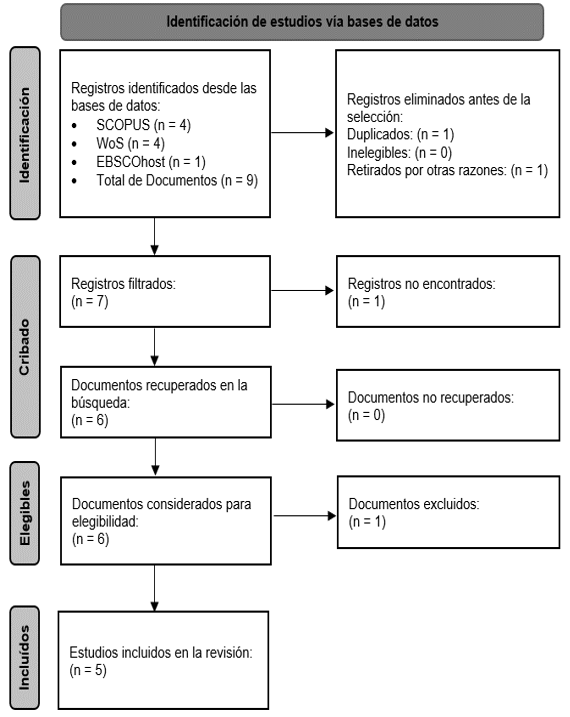
Figure 1.
PRISMA protocol used for the applied systematic review process
Source: own elaboration.
Note: the figure appears in its original language.
Subsequently, a preliminary list of nine (9) references was obtained, which was later refined using the previously defined inclusion and exclusion criteria, in order to obtain those documents where micro metrics on economic circularity were proposed and that could be extrapolated for use by consulting firms, specifically in the Venezuelan context, which allowed the process to be closed with a total of (5) studies, as can be seen in Figure 1, which summarizes, in a schematic way, the systematic review process framed according to the PRISMA protocol guidelines.
The refinement of the compiled material was carried out through a critical reading of the texts in their entirety, applying an evaluation matrix that integrated various aspects of interest, such as thematic relevance, practical applicability, methodological quality, and clarity in the definition of the micro-indicators.
The synthesis technique employed consisted of thematic coding of the most relevant content, leading to a comparative analysis of the positions developed by the different authors to identify common patterns and significant differences regarding the conception and applicability of the indicators. For the analysis, categories were established to facilitate the grouping of the micro-indicators according to their operational purpose, thus facilitating their interpretation and subsequent implementation in the business environment.
RESULTS
Micro-indicators of circularity: their incorporation into the practice of Venezuelan consulting firms
As repeatedly mentioned throughout this article, the transition to a CE has become the fundamental framework for achieving sustainable development (Shaharudin et al., 2024), becoming, in turn, a priority objective for various organizations. This has increased the need to measure and evaluate the impact of sustainable practices implemented or yet to be implemented. It is here that consulting firms, in their role as strategic advisors, become key players in this process, assuming not only the task of identifying and proposing sustainable practices for their clients to implement, as Piña Zambrano and Campos García (2024) point out, but also defining metrics and evaluation tools aimed at measuring the environmental and social impact of these practices.
The literature reviewed shows the existence of various methodologies that include diverse indicators for measuring progress toward a CE (Pennella, 2021). In particular, the proposal formulated by Ghisellini et al. (2016) is quite interesting, as it establishes three (3) levels of measurement: macro (associated with states or cities), meso (linked to industrial parks or economic sectors), and micro (applicable to products and services). It is precisely at this last level that Venezuelan consulting firms should concentrate to accurately evaluate their clients’ performance in terms of applying the principles of economic circularity.
It is important to mention that defining the indicators begins with thoroughly understanding the organizations’ value chain, in order to know how they perform throughout all the links in the circularity process (Van Hoof et al., 2022). Based on this, the main dimensions that will allow for measurement are established, with the understanding that these facilitate the grouping of indicators by common characteristics to be evaluated (Farfán Matiz, 2024; Valbuena, 2023).
In light of the above, a total of eight (8) dimensions of interest related to circularity have been selected, which are shown in Table 1. These are proposed by the studies of Formentini and Ramanujan (2023), Kristensen and Mosgaard (2020), Potting et al. (2017), Hirsch and Schempp (2020), as well as by the European Environment Agency (2016), which provides a clearer perspective on the distribution of the indicators that must be proposed to cover all these categories.
|
Table 1. Dimensions associated with the measurement of circularity using micro-indicators |
||
|
Dimensions |
Scope |
References |
|
Dismantling |
Disassemble parts or materials from products at the end of their useful life to facilitate subsequent processes such as remanufacturing or recycling. |
Formentini & Ramanujan (2023); Kristensen & Mosgaard (2020) |
|
Resource Efficiency |
Optimize the use of natural resources and materials. |
Kristensen & Mosgaard (2020) |
|
Life Extension |
Extend the useful life of products and components. |
Kristensen & Mosgaard (2020) |
|
End-of-Life Management |
Manage products responsibly at the end of their useful life. |
Kristensen & Mosgaard (2020) |
|
Waste Management |
Reduce waste accumulation and minimize losses associated with the dissipation of resources that still have value. |
European Environment Agency (2016) |
|
Recycling |
Recover materials from waste to reprocess them and convert them into new products, materials, or substances, either for their original purpose or for other purposes. |
Potting et al. (2017); Hirsch & Schempp (2020) |
|
Remanufacturing |
Use parts of the discarded product in a new product with the same function. |
Potting et al. (2017); Hirsch & Schempp (2020) |
|
Reuse |
Reuse a product that is still in good condition and fulfills the same purpose for which it was originally designed. |
Potting et al. (2017); Hirsch & Schempp (2020) |
Note: Adapted from: Formentini and Ramanujan (2023), Kristensen and Mosgaard (2020), Potting et al. (2017), Hirsch and Schempp (2020) and European Environment Agency (2016).
It is from the aforementioned dimensions that the micro-level indicators are defined to measure the circularity actions undertaken by consulting firms’ clients. Thus, Table 2 presents the 24 proposed micro-indicators so that Venezuelan consulting firms can assess the current status of their clients in terms of compliance with the principles of CE.
It is worth noting that the list of indicators presented is the product of a broad review of various published studies on metrics used to quantify the transition to CE (Elia et al., 2017; Feil et al., 2015; Kristensen & Mosgaard, 2020; Saidani et al., 2019). In the author’s judgment, the most relevant indicators were selected, as well as those applicable to the largest number of productive sectors covered by Venezuelan consulting firms, according to information provided by CAVECON (2023). Similarly, as an example, the business processes in which the consulting firms could suggest its applicability are presented.
|
Table 2. Proposed circularity micro-indicators |
||||
|
Dimensions |
Name of the micro-indicator |
Purpose of the micro-indicator |
Formula or Calculation Method |
Associated business process |
|
Dismantling |
Average disassembly time |
Evaluate the ease and speed of product disassembly |
Sum of disassembly time for all products / Total number of products |
Maintenance and Production |
|
Percentage of reusable components after disassembly |
Measure the number of components that can be reused |
(Number of reusable components / Total number of components) x 100 |
Logistics and Product Engineering |
|
|
Ease of disassembly for the end user |
Evaluate how easily the end user can disassemble a product |
Scale from 1 to 5, where 1 is very difficult and 5 is very easy |
Sales (After-Sales Service) |
|
|
Resource Efficiency |
Water consumption per unit of product |
Measure water consumption in the production process |
Liters of water / Product unit |
Production and Operations |
|
Energy consumption per unit of product |
Measure energy consumption in the production process |
kWh / Product unit |
Production and Operations |
|
|
Renewable energy consumption |
Measure the use of renewable energy in the production process |
Percentage of energy consumed from renewable sources |
Operations and Environmental Management |
|
|
Life Extension |
Average product lifespan |
Measure the lifespan of products |
Sum of useful life of all products / Total number of products |
Engineering and Sales |
|
Product repair rate |
Evaluate the frequency with which products are repaired |
(Number of products repaired / Total number of products) x 100 |
Maintenance and Sales (After-Sales Service) |
|
|
Product repairability index |
Evaluate the ease of product repair |
Scale from 1 to 5, where 1 is very difficult and 5 is very easy |
Engineering and Sales (After-Sales Service) |
|
|
End-of-Life Management |
Waste recovery rate |
Measure the percentage of waste that is recovered (recycled, reused, etc.) |
(Amount of waste recovered / Total amount of waste) x 100 |
Logistics and Environmental Management |
|
|
End-of-life management cost |
Evaluate the cost associated with end-of-life management of products |
Total end-of-life management cost / Total number of products |
Logistics and Accounting/Finance |
|
|
Extended Producer Responsibility (EPR) |
Evaluate compliance with Extended Producer Responsibility (EPR) legislation |
Percentage of products managed under the Extended Producer Responsibility (EPR) scheme |
Legal and Environmental Management |
|
Waste Management |
Waste generation rate per unit of product |
Measure the amount of waste generated in the production process |
Amount of waste generated / Number of products produced |
Production and Environmental Management |
|
Waste management cost |
Evaluate the cost associated with waste management |
Total waste management cost / Total amount of waste |
Logistics and Accounting/Finance |
|
|
Hazardous waste generation per unit of product |
Measure the generation of hazardous waste in the production process |
Amount of hazardous waste / Number of products produced |
Production and Industrial Safety |
|
|
Recycling |
Material recycling rate |
Measure the percentage of recycled materials in production |
(Amount (Number of recycled materials / Total amount of materials) x 100 |
Production and Environmental Management |
|
Percentage of recycled waste used in new products |
Measure the degree to which recycled materials are reintroduced into the value chain |
(Number of recycled waste used in new products / Total amount of recycled waste) x 100 |
Engineering and Production |
|
|
Cost per ton of recycled material |
Evaluate the economic efficiency of the process of recycling |
Total recycling cost / Total amount of recycled material |
Logistics and Accounting/Finance |
|
|
Remanufacturing |
Product remanufacturing rate |
Measure the percentage of remanufactured products |
(Number of remanufactured products / Total number of products) x 100 |
Engineering and Production |
|
Remanufacturing cost per unit of product |
Evaluate the economic efficiency of the remanufacturing process |
Remanufacturing cost / Number of remanufactured products |
Production and Accounting/Finance |
|
|
Number of life cycles of a remanufactured product |
Measure the number of times a product can be remanufactured |
Number of life cycles |
Engineering |
|
|
Reuse |
Product reuse rate |
Medir la frecuencia con la que se reutilizan los productos |
(Number of reused products / Total number of products) x 100 |
Sales and Logistics |
|
Average lifespan of reused products |
Medir la duración de uso de los productos reutilizados |
Sum of the lifespan of all reused products / Total number of reused products |
Sales and Production |
|
|
Platforms of reuse implemented |
Medir el uso de plataformas digitales para facilitar la reutilización de productos |
Number of platforms implemented |
Information Technology and Sales |
|
|
Note: Adapted from Kristensen and Mosgaard (2020); Elia et al. (2017); Saidani et al. (2019) and Feil et al. (2015). |
||||
The proposed measurement framework has been structured to be sufficiently simple and expedient for both consulting firms and their clients, with the aim of empowering these clients to implement a more effective circularity transition or assessment process.
It is also worth highlighting that this set of indicators was developed considering the qualities they should possess according to the World Business Council for Sustainable Development (WBCSD, 2023), which states that they must be: simple (for easy application in the context of the circular economy); uniform (i.e., applicable across different types of organizations); comprehensive and flexible (so that they can be used or adapted by companies according to their nature and needs); complementary (to promote the incorporation of other business metrics that help to better understand the circularity landscape internally) and neutral (which implies that no type of material or dimension is prioritized over others, as all are relevant to the context of circularity).
DISCUSSION
Upon examining the 24 proposed circularity micro-indicators, it can be said that this measurement framework should allow Venezuelan consulting firms to obtain a comprehensive overview of the level of circularity their clients have achieved. The results have highlighted that dividing the framework into eight dimensions (assembly, resource efficiency, life extension, end-of-life management, waste management, recycling, remanufacturing, and reuse) facilitates the disaggregation of various strategic elements of the circular economy for their proper application within companies dedicated to the production of goods and services. This not only simplifies the identification of opportunities for improvement but also provides greater guidance for implementing better-structured decision-making processes (Aguilera & Sapere, 2024)
The implementation of these micro-indicators takes on significant importance for evaluating circular performance (Gursel et al., 2023), as it allows for the measurement of operational aspects (such as average disassembly time or waste generation rate per unit of product), as well as more strategic elements (such as the reparability index or the average useful life of reused products). This provides an initial framework for Venezuelan consulting firms to assess their clients’ level of compliance with aspects inherent to the circular model, considering that many of them have not yet integrated these practices into their daily activities (Piña Zambrano & Campos García, 2024). It is important to note that this measurement framework is not rigid; on the contrary, it is entirely adaptable or tailored to the specific needs of the companies where it will be applied.
Studies such as those by Li et al. (2025) and Mejía-Moncayo et al. Halter et al. (2025), Costa et al. (2025), and Costa et al. (2025) suggest the relevance of the proposed set of metrics, which can not only be perceived as diagnostic tools but also as inputs to drive change by revealing critical points that require strategic interventions, as well as the incorporation of best practices that enhance the transition towards circular models.
In this sense, this represents a significant contribution for consulting firms, and particularly for those based in Venezuela, given that specific publications on circularity micro-indicators focused on organizations of this nature are practically nonexistent. This situation is even more pronounced in Venezuela, where not only is there a significant lack of literature on these types of metrics, but also, in general, very limited scientific dissemination regarding circularity, highlighting local models or experiences that could promote the adoption of this economic model (Llanos Encalada et al., 2023).
However, the implementation of this model faces a series of operational limitations in the Venezuelan context, primarily due to the scarcity of concrete data available to consulting firms to understand the performance of circularity in the business sector they serve, as well as the absence of public policies that promote the adoption of these metrics. Consequently, the consulting sector is called upon to assume a decisive role in training its clients on topics related to the circular economy, in order to pave the way for the implementation of circular metrics.
Given that it has been mentioned that these indicators should and can be adapted to the context of each organization, it could be said, then, that they can be replicated or transferred to other countries that share similar structural characteristics to those of Venezuela. This opens up possibilities for conducting comparative analyses and even promoting the design of regional strategic frameworks that drive circularity on a larger scale, especially in countries with emerging economies.
CONCLUSIONS
Although the CE remains a concept under construction and definition, it is vital that organizations, especially in Venezuela, have effective measurement tools to evaluate their transition to this new economic model. In this regard, micro-indicators are presented as a key tool for measuring progress toward circularity, focusing on specific processes, products, and services within organizations. Consulting firms in Venezuela have a significant opportunity to position themselves as leaders in circularity measurement and in providing a comprehensive measurement framework to evaluate performance in relation to CE principles.
Implementing these micro-indicators in the Venezuelan context presents a clear challenge, given the diversity of productive sectors advised by consulting firms. That said, this research successfully developed a set of micro-indicators that can be generally applied to a wide range of companies and institutions, regardless of sector or size. However, it is essential that, during implementation, consulting firms actively participate in adapting these metrics to the specific characteristics of each organizational and sectoral context.
Likewise, the process of continuous measurement and monitoring of circularity becomes one of the most critical activities to ensure the model’s success. Circularity is a dynamic process that requires periodic adjustments, and this is where consulting firms must establish mechanisms for ongoing evaluation that allow organizations to regularly assess their progress toward circularity, make adjustments, and optimize their strategies based on the results obtained.
It is important to note that, although the literature review facilitated the acquisition of an interesting set of micro-indicators, the research faced two (2) significant methodological limitations: first, the scarcity of scientific literature produced in Venezuela on the circular economy, especially when these references are situated within the field of consulting; and second, the lack of statistical data from consulting firms to empirically validate the results of the proposed metrics. Finally, the documentary approach prevented a direct comparison of the micro-indicators with practical field experiences, suggesting the need for complementary studies using mixed methodologies or case studies.
Finally, the issues addressed open the door to countless additional lines of analysis, especially related to the application of the circular economy in the various sectors of the Venezuelan economy. Future research could focus on identifying best practices for the implementation of micro-indicators by consulting firms, as well as on evaluating the economic, environmental, and social impact of these initiatives within organizations. This will allow for a deeper understanding not only of the effectiveness of the proposed tools but also of the real impact that circular practices can have on sustainability at both the local and global levels.
REFERENCES
Aguilera, B., y Sapere, G. (2024). Planificación estratégica para la implementación de un modelo de economía circular entre una empresa de recuperación de residuos plásticos y un balneario de la ciudad de Mar del Plata [Trabajo de grado de pregrado no publicado, Universidad Nacional de Mar del Plata]. https://rinfi.fi.mdp.edu.ar/handle/123456789/799
Almeida Guzmán, M., y Díaz Guevara, C. (2020). Economía circular, una estrategia para el desarrollo sostenible. Avances en Ecuador. Estudios de la Gestión, (8), 35-57. https://doi.org/10.32719/25506641.2020.8.10
Bahramimianrood, B., Xie, S., Malaibari, M., y Abdoli, S. (2024). Reviewing Circularity Indicators for a Sustainable Transition to a Circular Economy. Procedia CIRP, 122, 1065-1070. https://doi.org/10.1016/j.procir.2024.01.144
Barros, M. V., Salvador, R. B., Pieroni, M. de P. P., y Piekarski, C. M. (2024). How to measure circularity? State-of-the-art and insights on positive impacts on businesses. Environmental Development, 50, 100989. https://doi.org/10.1016/j.envdev.2024.100989
Baziene, K., Gargasas, J., Rajendran, S., y Solomon, J. (2024). Towards circular economy through novel waste recycling technologies. Entrepreneurship and Sustainability Issues, 12(2), 460–472. https://doi.org/10.9770/m5297249738
Beltrán Jaramillo, J. M. (2000). Indicadores de gestión. Herramientas para lograr la competitividad (2a. ed.). 3R Editores.
Cámara Venezolana de Empresas Consultoras (CAVECON). (2022). Sostenibilidad en la gestión empresarial. Informe diagnóstico. Parte 1: Empresas consultoras.
Cámara Venezolana de Empresas Consultoras (CAVECON). (2023). Empresas afiliadas.
Campos García, J. A. (2024). Cuadro de Mando Integral: herramienta estratégica aplicada en una empresa venezolana de asesoría y consultoría. Revista Uniandes Episteme, 11(3), 374–387. https://doi.org/10.61154/rue.v11i3.3500
Carrión Grancha, B. (2023). Indicadores y medidas europeas para la implementación de la economía circular en el sector de las telecomunicaciones: analisis comparativo europeo. Universitat Politècnica de València. http://hdl.handle.net/10251/192838
Castillo Díaz, F. J. (2024). Evaluación de la sostenibilidad del sistema agroalimentario europeo en el marco de la economía circular [Tesis doctoral no publicada, Universidad de Almería]. https://repositorio.ual.es/bitstream/handle/10835/14826/01.%20Tesis.pdf?sequence=1&isAllowed=y
Costa, L., Scur, G., y Streit, J. (2025). Challenges of circular economy assessment tools at the micro level: A bibliometric exploration and systematic review. RAE - Revista de Administraçao de Empresas, 65(4), e2024–0131. https://doi.org/10.1590/S0034-759020250403
De Oliveira, C., Dantas, T., y Soares, S. (2021). Nano and micro level circular economy indicators: Assisting decision-makers in circularity assessments. Sustainable Production and Consumption, 26, 455–468. https://doi.org/10.1016/J.SPC.2020.11.024
De Pascale, A., Arbolino, R., Szopik-Depczyńska, K., Limosani, M., y Ioppolo, G. (2021). A systematic review for measuring circular economy: The 61 indicators. Journal of Cleaner Production, 281, 124942. https://doi.org/10.1016/j.jclepro.2020.124942
Elia, V., Gnoni, M. G., y Tornese, F. (2017). Measuring circular economy strategies through index methods: A critical analysis. Journal of Cleaner Production, 142(4), 2741-2751. https://doi.org/10.1016/j.jclepro.2016.10.196
Escalona Rojas, G. E. (2024). Plan estratégico para la creación de valor en la oferta de servicios de cambio climático en consultoría para incrementar en 25% los ingresos de E-Consulting [Trabajo de grado de maestría no publicado, Universidad de Chile]. https://repositorio.uchile.cl/handle/2250/204331
Espinoza-Freire, E. E. (2025). PRISMA en la práctica: Guía y desafíos en la conducción de revisiones sistemáticas. Sociedad & Tecnología, 8(S2), 623–646. https://doi.org/10.51247/st.v8iS2.227
European Environment Agency. (2016). 5.A Biological treatment of waste - Solid waste disposal on land 2016. https://www.eea.europa.eu/en/analysis/publications/emep-eea-guidebook-2016/part-b-sectoral-guidance-chapters/5-waste/5-a-biological-treatment-of
Farfán Matiz, J. J. (2024). Propuesta para la formulación de un indicador ambiental relacionado con la calidad visual urbana. Área de estudio centro de Bogotá DC [Trabajo de grado de pregrado no publicado, Universidad de La Salle]. https://ciencia.lasalle.edu.co/items/ccaa6acf-24bd-4afc-9319-75cd41b686ec/full
Feil, A., Muller de Quevedo, D., y Schreiber, D. (2015). Selection and identification of the indicators for quickly measuring sustainability in micro and small furniture industries. Sustainable Production and Consumption, 3, 34-44. https://doi.org/10.1016/j.spc.2015.08.006
Formentini, G., y Ramanujan, D. (2023). Design for circular disassembly: Evaluating the impacts of product end-of-life status on circularity through the parent-action-child model. Journal of Cleaner Production, 405, 137009. https://doi.org/10.1016/j.jclepro.2023.137009
Ghisellini, P., Cialani, C., y Ulgiati, S. (2016). A review on circular economy: the expected transition to a balanced interplay of environmental and economic systems. Journal of Cleaner Production, 114, 11-32. https://doi.org/10.1016/j.jclepro.2015.09.007
Gómez Velasco, N., Soto Arango, D. E., y Lima Jardilino, J. R. (2020). Políticas y medición en ciencia y tecnología en la universidad colombiana 1992-2014. Editorial de la Universidad Pedagógica y Tecnológica de Colombia.
Gómez Víquez, K. M. (2023). Desarrollo Sostenible: Indicadores para medir el potencial de integración de economía circular y la gestión de residuos sólidos en Costa Rica [Trabajo de grado de pregrado, Universidad Nacional de Costa Rica]. https://repositorio.una.ac.cr/items/8470f2f1-6bc5-4bb7-a922-512851db0b67
Gursel, I. V., Elbersen, B., y Meesters, K. P. H. (2023). Monitoring circular biobased economy – Systematic review of circularity indicators at the micro level. Resources Conservation and Recycling, 197, 107104. https://doi.org/10.1016/j.resconrec.2023.107104
Halter, F., Wietschel, L., Thorenz, A., y Tuma, A. (2025). Techno-sustainable analysis of circular economy-indicators for corporate supply chains. Journal of Cleaner Production, 503, 145078. https://doi.org/10.1016/j.jclepro.2025.145078
Haro Sarango, A. F., Pico Lescano, J. C., Moina Sánchez, P. V., Carrillo Barragán, C. E., y López Velasco, J. E. (2024). Economía Circular: Modelos de Negocio y Estrategias Sostenibles. Know Press.
Henzen, R., y Weenk, E. (2022). Economía circular: Un enfoque práctico para transformar los modelos empresariales. Bogotà : Alpha Editorial. https://digital.casalini.it/9789587788235
Hirsch, P., y Schempp, C. (2020). Categorisation system for the Circular Economy. European Commission. https://op.europa.eu/en/publication-detail/-/publication/ca9846a8-6289-11ea-b735-01aa75ed71a1
Kristensen, H., y Mosgaard, H. (2020). A review of micro level indicators for a circular economy – moving away from the three dimensions of sustainability? Journal of Cleaner Production, 243, 118531. https://doi.org/10.1016/j.jclepro.2019.118531
Laverde Rodríguez, C. A., Vera Leyton, J. M., López Naranjo, H. A., y Sellamén Garzón, A. (2022). Tendencias en la economía colaborativa: una aproximación analítica. Ediciones USTA. https://doi.org/10.2307/j.ctv31vqngt
Li, Q., Saelens, D., Kayaçetin, N., Aslanoğlu, R., Van Hoof, J., y Piccardo, C. (2025). A systematic literature review on circularity assessment indicators and frameworks in the built environment. Sustainable Production and Consumption, 58, 412-431. https://doi.org/10.1016/j.spc.2025.07.004
Llanos Encalada, M., Bell Heredia, R. E., & Correa Vaca, A. M. (2023). Visibilidad regional de prácticas de economía circular en publicaciones científicas de alto impacto. Universidad y Sociedad, 15(6), 185-195. https://rus.ucf.edu.cu/index.php/rus/article/view/4136
Martínez González, P. (2024). Propuesta de una ruta metodológica para el acompañamiento y la evaluación de la circularidad en las empresas del Distrito Especial de Ciencia, Tecnología e Innovación de Medellín [Trabajo de grado de pregrado no publicado, Universidad de Antioquia]. https://bibliotecadigital.udea.edu.co/entities/publication/7a60e771-8c15-4189-9025-550385c1bbbe
Mejía-Moncayo, C., Chaabane, A., Kenné, J., y Hof, L. (2025). Key performance indicators for sustainable remanufacturing: A literature review and methodological framework. Cleaner Logistics and Supply Chain, 17, 100260. https://doi.org/10.1016/j.clscn.2025.100260
Opferkuch, K., Walker, A. M., Lindgreen, E. R., Caeiro, S., Salomone, R., y Ramos, T. (2023). Towards a framework for corporate disclosure of circular economy: Company perspectives and recommendations. Corporate Social Responsibility and Environmental Management, 30(5), 2457-2474. https://doi.org/10.1002/csr.2497
Osto, R. (2023). La administración estratégica en las empresas consultoras venezolanas. Una aproximación multidimensional apoyada en los clásicos gerenciales. Revista de Estudios Gerenciales y de las Organizaciones, 7(13), 93-116. http://regyo.bc.uc.edu.ve/v7n13/art05.pdf
Papageorgiou, A., Henrysson, M., Nuur, C., Sinha, R., Sundberg, C., y Vanhuyse, F. (2021). Mapping and assessing indicator-based frameworks for monitoring circular economy development at the city-level. Sustainable Cities and Society, 75, 103378. https://doi.org/10.1016/J.SCS.2021.103378
Pennella, C. (2021). Desarrollo de un indicador para medir la calidad como valor agregado de las exportaciones argentinas [Trabajo de grado de maestría no publicado, Universidad Nacional de San Martín]. https://repositorio.unlz.edu.ar/handle/123456789/496
Peña Farías, J. R. (2024). Modelo de negocios para la conformación de una empresa consultora, especializada en la implementación de proyectos en el marco de la emergencia humanitaria compleja en Venezuela [Tesis doctoral, Universidad Monteávila]. https://repositoriodigital.uma.edu.ve/server/api/core/bitstreams/81927c86-b9ca-4725-8747-d2d19d5439a6/content
Piña Zambrano, H. J., & Campos García, J. A. (2024). Empresas de consultoría en Venezuela frente a los desafíos de la economía circular. Revista Qualitas, 27(27), 31-57. https://doi.org/10.55867/qual27.03
Potting, J., Hekkert, M., Worrell, E., y Hanemaaijer, A. (2017). Circular economy: measuring innovation in the product chain. PBL Netherlands Environmental Assessment Agency. http://www.pbl.nl/sites/default/files/cms/publicaties/pbl-2016-circular-economy-measuring-innovation-in-product-chains-2544.pdf
Saidani, M., Yannou, B., Leroy, Y., Cluzel, F., y Kendall, A. (2019). A taxonomy of circular economy indicators. Journal of Cleaner Production, 207, 542-559. https://doi.org/10.1016/j.jclepro.2018.10.014
Sánchez Ramírez, D. S., y Franco Romero, P. F. (2024). Barreras y oportunidades para la transición hacia inversiones sostenibles en Colombia [Trabajo de grado de maestría no publicado, Universidad EAFIT]. https://repository.eafit.edu.co/entities/publication/8a58159e-99c8-4e7a-bdeb-262470269891
Sánchez Rodríguez, J. A. (2022). Revisión documental y análisis de instrumento en relación con el proyecto: Dinámicas empresariales y estructura productiva de Mipymes en el desarrollo territorial de Chinchiná-Caldas 2017-2021 [Tesis doctoral no publicada, Corporación Universitaria Minuto de Dios]. https://repository.uniminuto.edu/items/63074585-d46a-4035-b3d6-66af3ccb1887
Shaharudin, M., Abdullah, D., Zainoddin, A., Legino, R., y Wararatchai, P. (2024). The Evolution of Circular Economy: A Literature Review on Sustainability Transitions and Challenges. International Journal of Research and Innovation in Social Science, VIII(X), 102–115. https://doi.org/10.47772/ijriss.2024.8100009
Stucki, T., Woerter, M., y Loumeau, N. (2022). Clearing the fog: How circular economy transition can be measured at the company level. Journal of Environmental Management, 326 (Parte B), 116749. https://doi.org/10.1016/j.jenvman.2022.116749
Valbuena Otalvaro, Y. P., y Viña Uribe, S. (2024). Diseño de un instrumento de medición a partir de la construcción teórica en la temática de perdurabilidad de modelos de gestión en Industrias 5.0. [Trabajo de grado de pregrado no publicado, Universidad Cooperativa de Colombia]. https://repository.ucc.edu.co/server/api/core/bitstreams/60a9f014-db24-4c76-8a72-128a3cb5cd90/content
Valbuena, R. (2023). Ciencia pura: lógica de procedimientos y razonamientos científicos. Maracaibo: Centro Nacional del Libro.
Van Hoof, B., Núñez, G., y De Miguel, C. (2022). Metodología para la evaluación de avances en la economía circular en los sectores productivos de América Latina y el Caribe. Santiago: Comisión Económica para América Latina y el Caribe (CEPAL). https://www.cepal.org/es/publicaciones/47975-metodologia-la-evaluacion-avances-la-economia-circular-sectores-productivos
World Business Council for Sustainable Development (WBCSD). (2023). Circular transition indicators V4.0. Metrics for business, by business. https://www.wbcsd.org/wp-content/uploads/2023/09/Circular_Transition_Indicators_v4.pdf
FINANCING
None.
CONFLICT OF INTEREST STATEMENT
The author declares that there is no conflict of interest.
STATEMENT ON THE USE OF ARTIFICIAL INTELLIGENCE
Artificial intelligence tools were used solely for the purpose of assisting with translation and style correction. To this end, Grammarly and Google Translate were used.
AUTHORSHIP CONTRIBUTION
Conceptualization: Jesús Alonso Campos García.
Data Curation: Jesús Alonso Campos García.
Formal Analysis: Jesús Alonso Campos García.
Research: Jesús Alonso Campos García.
Methodology: Jesús Alonso Campos García.
Software: Jesús Alonso Campos García.
Supervision: Jesús Alonso Campos García.
Validation: Jesús Alonso Campos García.
Visualization: Jesús Alonso Campos García.
Writing – original draft: Jesús Alonso Campos García.
Writing – proofreading & editing: Jesús Alonso Campos García.