Scientific and Technological Research Article
doi: 10.58763/rc2026600
A Translation Competence-Based Approach to Machine Translation Post-Editing Training
Un enfoque basado en la competencia traductora para la formación en la posedición de traducción automática
Xiang
Zhang1  *
*
ABSTRACT
Introduction: This study examined the role of machine translation post-editing within the language service industry, where it had become the dominant workflow alongside continued challenges in translator training systems. Grounded in the PACTE translation competence model, the study addressed limitations in pragmatic accuracy and cultural adequacy in machine translation output by designing a three-stage, competence-oriented post-editing training program.
Methodology: A conceptual and theory-driven methodology was adopted, without empirical data collection. A modular curriculum was developed, integrating theoretical instruction, case-based analysis, and project-based practice. In addition, an assessment framework combining formative and summative evaluation was proposed to support learner development and performance measurement.
Results: The findings indicated that the structured three-stage model could enhance learners’ ability to detect and correct pragmatic errors, while strategic sub-competence played a central coordinating role in skill development. Project-based learning was also found to foster critical thinking and improve alignment with market demands. The proposed 60/40 balance between formative and summative assessment further supported both learning processes and outcome quality.
Conclusions: The study concluded that the translation competence framework provided a viable basis for post-editing training design and curriculum reform.
Keywords: curriculum design; machine translation; post-editing; translator education; translation competence
JEL Classification: I23; Z13; O33
RESUMEN
Introducción: Este estudio analizó el papel de la postedición de la traducción automática en la industria de los servicios lingüísticos, donde esta se había consolidado como el modelo predominante, aunque persistían limitaciones en los sistemas de formación de traductores. Basándose en el modelo de competencia traductora PACTE, el estudio abordó las deficiencias en la precisión pragmática y la adecuación cultural de la traducción automática mediante el diseño de un programa de formación en postedición estructurado en tres etapas y orientado a la competencia.
Metodología: Se adoptó una metodología conceptual y teórica, sin recogida de datos empíricos. Se desarrolló un currículo modular que integraba formación teórica, análisis de casos y práctica basada en proyectos. Asimismo, se propuso un sistema de evaluación que combinaba evaluación formativa y sumativa para apoyar el aprendizaje y la medición del rendimiento.
Resultados: Los resultados indicaron que el modelo de tres etapas podía mejorar la detección y corrección de errores pragmáticos, mientras que la subcompetencia estratégica desempeñaba un papel central de coordinación. El aprendizaje basado en proyectos favoreció el pensamiento crítico y la adaptación a las demandas del mercado. La proporción 60/40 entre evaluación formativa y sumativa equilibró el proceso de aprendizaje y la calidad de los resultados.
Conclusiones: Se concluyó que el modelo de competencia traductora constituye una base viable para el diseño de la formación en postedición y la reforma curricular.
Palabras clave: diseño curricular; educación de traductores; competencia traductora; postedición; traducción automática.
Clasificación JEL: I23; Z13; O33.
Received: 13-04-2026 Revised: 26-06-2026 Accepted: 28-07-2026 Published: 31-07-2026
Editor:
Alfredo Javier Pérez Gamboa
1Institut National des Langues et Civilisations Orientales. Paris, France.
Cite as: Zhang, X. (2026). A Translation Competence-Based Approach to Machine Translation Post-Editing Training. Región Científica, 5(2), 2026600. https://doi.org/10.58763/rc2026600
INTRODUCTION
With the rapid advancement of machine translation technology, post-editing has increasingly become the dominant workflow in the language service industry. Nevertheless, the system for training translation professionals still requires further development and refinement (Çeti̇Ner & İşisağ, 2019; Shi, 2023; Su & Li, 2023). According to surveys conducted by internationally renowned language and translation service associations and institutions such as CSA Research, the Association of Language Companies (ALC), the Translation Automation Users Association (TAUS), and SDL Trados, this effectiveness is worthy of affirmation.
However, even though the quality of machine translation has improved dramatically, in certain detailed aspects, particularly in cultural domains, human translator revision is certainly necessary. In fact, despite technological progress in machine translation, grammatical and other textual-level errors, such as incorrect word order, mistranslated idioms, and morphological issues, may still occur and contribute significantly to post-editing effort (Koponen, 2016). Additionally, some languages, due to their inherent characteristics, have grammatical manifestations that vary according to context or the author’s intended meaning. Moreover, pragmatic knowledge is also worth applying in the post-editing process, which is not only beneficial for social interaction and cross-cultural communication abilities but also helpful in addressing challenges brought by artificial intelligence (Jones, 2025). These factors indicate that human translator revision of translation content is necessary.
Therefore, facing the rapid development trend of post-editing, how can we efficiently train students? This paper addresses the inadequacy of existing post-editing training frameworks, with particular attention to machine translation’s deficiencies in pragmatic accuracy and cultural appropriateness. Grounded in the PACTE translation competence model, the study proposes a three-stage training program progressively targeting instrumental, bilingual, strategic, and extra-linguistic sub-competences, with the aim of informing translation curriculum reform and industry workforce development. Through comparative analysis of the PACTE model and China’s Standards of English Language Ability (National Education Examinations Authority & National Language Commission, 2018), alongside a review of relevant scholarship and industry data, the study operationalizes these frameworks into a modular curriculum integrating theoretical instruction, case analysis, and project-based practice.
Three research questions guide the inquiry: (1) What limitations of current machine translation systems in pragmatic and cultural dimensions necessitate human post-editing? (2) How can the PACTE model inform the design of post-editing training? (3) What curriculum structures, pedagogical approaches, and assessment mechanisms are proposed to cultivate the requisite post-editing sub-competences?
This study focuses on university-level adult learners, specifically advanced undergraduate or postgraduate students in translator education programs who have already developed foundational bilingual and translation skills.
This study adopts a conceptual, theory-driven approach. It is not an empirical investigation and, therefore, involves no participants, instruments, or data collection procedures. The research design consists of an analytical review and synthesis of existing scholarship: specifically, the PACTE translation competence model (Beeby et al., 2009)the design of our research project is described (hypothesis, experimental universe and sample, variables, data collection instruments, China’s Standards of English Language Ability (National Education Examinations Authority & National Language Commission, 2018), relevant post-editing quality assessment frameworks, and current literature on machine translation post-editing pedagogy. Through comparative analysis and theoretical reasoning, these sources are integrated to derive a structured, three-stage training program. The scope of the study is confined to a curricular proposal grounded in translation competence theory, whereas empirical validation of the proposed framework falls beyond the present paper and remains a direction for future research.
Training framework basis
Definitions of machine translation and post-editing
Clarifying the definitions of machine translation and post-editing provides the conceptual foundation for the training framework proposed in this study. So, what is machine translation? According to a science article on the website of the Institute of Automation, Chinese Academy of Sciences, “Machine Translation (MT) refers to the process of using computer technology to translate one language into another. In the traditional sense, machine translation generally refers to text machine translation, that is, translating text in one natural language into text in another natural language (text-to-text translation)” (Institute of Automation, Chinese Academy of Sciences, 2008). With the continuous development of information technology, by 2018, according to the Machine Translation and Artificial Intelligence Research Report (AMiner, 2018, p. 5), “Machine Translation refers to the use of machines to translate one natural language in written or sound form into another natural language in written or sound form through specific computer programs.”
From the above definitions, we find that the definition of machine translation has changed, primarily reflected in the medium of translation. Previously, it was mainly text-based translation, but by 2018, sound could also become content that machines can translate. In fact, with the continuous advancement of computer technology, especially the application of deep learning and neural networks to machine learning (Alibaba Cloud, 2025), the definition of machine translation should be further refined in the future, such as considering human emotions and predicting described scenarios, then translating according to client needs.
According to Li and Gao’s (2024, p. 45) research on keyword emergence, we find that in the statistical results of machine translation literature keywords, emotion-related vocabulary has been included. Moreover, among technology-related words, there are also words like “neural” and “artificial”. Although such expressions are more metaphorical, for machine translation, all this also indicates that high-quality translation is not just linguistic transformation; judgment also occupies an important position in the translation process.
What is post-editing? Cui and Li (2015) point out that “ordinary scientific and technical articles and materials usually do not require beautiful language; readers only need to understand the basic content. Machine translation can be used first, followed by human proofreading, called post-editing (PE, also called “post-production editing”). From this definition, we can see that early machine translation mainly focused on text types with high standardized formats, such as scientific and technical articles.
Wang (2023, p. 11) defines post-editing as: “Post-editing (PE) is the process of editing, processing, and recreating the translation based on machine translation to meet the usage objectives.” In this definition, we find the expression “recreation”, which also reflects the importance of creative factors in the translation process. This factor may play a positive role in coordinating machine translation and client demands. Additionally, this definition also responds to Li and Gao’s (2024, p. 45) research on keyword emergence.
However, in some situations, such as fields with sensitive information, machine translation cannot be used due to data security issues and must be completed manually. In scenarios where machine translation can be used, due to current algorithm limitations, some machine translation content cannot yet be used directly. Therefore, the rapid development of machine translation undoubtedly continues to expand its market application prospects, but complete reliance on machine-translated text without human review is not advisable (Feng & Zhang, 2015). This further illustrates the importance of post-editing training in translator training.
Through the above definitions of post-editing, we can summarize several characteristics of post-editing capabilities, such as improving efficiency and reprocessing machine translation content according to client needs. The fields it serves include, but are not limited to, cross-language information acquisition, business expansion, and education (Alibaba Cloud, 2025).
Machine translation post-editing process
To better perform machine translation post-editing work, this paper advocates that understanding the machine translation and post-editing process is necessary, especially when we attempt to explore post-editing training planning schemes, because planning schemes are a way of demonstrating the entire educational process.
Cui and Li (2015) believe: “Current machine translation uses phrases as basic units for translation, then applies syntactic theory to reorder various phrases. Reordering is the most common and challenging problem in machine translation. [...] Since phrase translation is relatively good, only the order arrangement of phrases is improper, so that we can be targeted. In post-editing, for reordering problems, we only need to move phrases in the sentence as a whole to achieve correct translation.”
Through Cui and Li’s (2015) examples of post-editing, we can preliminarily understand one of the most basic methods and ideas of post-editing, which is reordering. Reordering is a translation technique that is also common in human translation post-review. However, compared to human translation, can machine translation post-editing really focus only on translation techniques from human translation post-editing? Comprehensive analysis shows that such methods may face challenges.
Machine translation models have evolved from previous phrase-based statistical machine translation to current neural machine translation models. This technological progress, while reducing translator task pressure, has also posed challenges for effective post-editing. All this also prompts us to reflect on how to find a balance between translation efficiency and translation accuracy, and how to maximize efficiency and quality.
Figure 1.
Hypothesized machine translation output
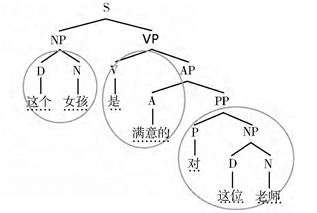
Source: Cui and Li (2015)
Figure 2.
Post-edited sentences
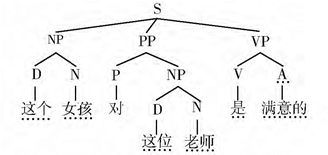
Source: Cui and Li (2015)
Given current information technology development, grammatical and spelling errors in machine translation-generated translations can be said to be very limited. However, since high-quality translations are not merely linguistic transformations and simple correspondence of related content, through post-editing, students can better discover current machine translation shortcomings. At the same time, through analysis of these details, students can better understand standards for high-quality translation.
In Figure 1 of secondary competence descriptions by Gao and Hu (2024, 109), we see the complexity of the translation talent cultivation process. This also provides us with a reference framework for machine translation post-editing training from another perspective. In Figure 1, we see requirements related to machine translation technology. This also reflects from another perspective the importance of information technology capabilities in cultivating translation competence (such as instrumental sub-competence) in the information age (see Beeby et al., 2009). At the same time, O’Brien (2002) points out that post-editing competence should include: language, computer technology, terminology management, controlled language writing, etc., and should maintain an optimistic and tolerant attitude toward machine translation.
However, for translation learners or professional translators, we do not require them to master very high levels of information technology; we place more emphasis on how translators, on the basis of understanding basic information technology principles, revise machine-generated translations according to machine translation’s inherent characteristics and existing translation standards. This revision is not merely a superficial textual modification of the original text, but a modification based on client needs and combined with the translator’s background knowledge. The translator competence requirements proposed by Gao and Hu (2024), when compared with the results of the market cultivation analysis, exhibit many similarities with the translation framework of Beeby et al. (2009), particularly with regard to instrumental subcompetence and strategic subcompetence. To make training content more accessible, we need to understand the relevant content of post-editing translation quality assessment standards.
So how can we conduct high-quality machine translation post-editing? Besides existing translation textbooks and translation industry norms, what other reference content exists? This study tends to believe that translation competence can serve as our cultivation standard for machine translation post-editing.
RESULTS
Construction of professional post-editing quality standard system in the machine translation era
To make post-editing training effects more intuitive, we next prepare to use post-editing quality assessment standards as a breakthrough. Through analysis of post-editing quality assessment, we can more clearly understand how to plan machine translation post-editing training from a translation competence perspective.
In machine translation quality assessment, various factors are involved, such as cognitive level, translation accuracy, and fluency (Vieira, 2014; Wang & Jalalian Daghigh, 2023). According to Krüger’s (2016) contextualized translation model, psychosocial factors include work environment, professional status, as well as variables such as time pressure and motivation. These factors are not only key elements affecting translators’ cognitive processing but also profoundly affect translation task execution.
Pragmatic accuracy: a core dimension of translation quality beyond language fluency
Another dimension of translation quality assessment is often overlooked, namely, the accuracy of translation content and the ultimate purpose of translation. For the general public, the view that machine translation can replace human translation is mainly based on translation language fluency. Currently, the vast majority of text generated by machine translation has very few obvious grammatical and lexical errors. Even if there are individual grammatical and lexical errors, they may be difficult for ordinary users to detect. Furthermore, in some fields, even with such errors, there is no major impact for ordinary users, because obtaining relevant information or effective communication can basically be completed in this situation. However, the final communication effect or other possible risks do not attract people’s attention.
However, translation services provide not only textual content but also information in many other aspects besides language, such as related cultural information (Dimitriu, 2015)in just a couple of decades, and in view of the interdisciplinary nature of Translation Studies, the key notion of context has become increasingly broader and diversified within this area of research, allowing for complex analyses of the translators’ activities and decisions, of translation processes and, ultimately, of what accounts for the meaning(s. The ultimate purpose of translation is to help users solve problems. This also reminds users to verify the information conveyed by the content itself, rather than focusing only on the form of linguistic text.
Taking the slogan of the American Burger King fast food restaurant as an example, the English slogan is “Have it your way.” DeepL gives the Chinese translation as “随你喜欢” (as you like), while Baidu Translate provides multiple translations according to different contexts, respectively:
• 随你的便 (neutral-negative) “Fine, have it your way!” → “好吧,随你的便!” (implying disagreement but giving up the argument)
• 按你说的办 (neutral) “If you insist, we’ll have it your way.” → “既然你坚持,就按你说的办。” (more formal compromise expression)
• 你高兴就好 (teasing/sarcastic) “Oh sure, have it your way...” → “哦行啊,你高兴就好...” (commonly used in intimate relationships or sarcastic scenarios)
• 听你的 (positive compromise) “Let’s have it your way this time.” → “这次听你的吧。”(used for friendly concession)
The above examples directly show that with the development of science and technology, the translation content provided by machine translation has changed significantly. The translation given by DeepL can be considered to have a certain reference value, especially using the common Chinese four-character phrase format. In addition, “随你喜欢” allows readers to directly understand the meaning of the English original text. However, “随你喜欢” does not give Chinese people the feeling of a “customer-centered” concept. Among the translations given by Baidu Translate, there are many example sentences for reference, but unfortunately, there are no suitable advertising slogans. Burger King China uses the slogan “我选我味” (I choose my taste). This translation, while close to the original English meaning, also places customers at the center. This point is worthy of affirmation.
More specifically, after the above discussion of machine translation, this paper proposes that another dimension of translation quality assessment is often overlooked, namely the accuracy of translation content and the ultimate purpose of translation. This point may be difficult for those without systematic translation training to detect; as professional translators, after checking at the linguistic level, special attention should be paid to examining the accuracy of meaning behind linguistic text. This process requires combining one’s own linguistic knowledge and background knowledge, while invoking knowledge from other fields, such as pragmatics, to modify seemingly fluent and smooth text to achieve the purpose of translation articles.
Regarding methods of translation quality assessment, scholars have proposed relevant viewpoints and established corresponding models. For example, Jia et al. (2019) elaborate on translation quality assessment from two dimensions of language fluency and language accuracy in their rating scale and operational definition table. This table mainly processes translation standards into four levels from the linguistic textual level and the meaning level, clearly and concisely expressing basic requirements for translation quality assessment.
The inspiration for this table for post-editing is that it enables translators to diagnose and quantitatively assess translation content more accurately; translators can prioritize content to be optimized based on statistical results and, if necessary, perform simple data analysis for necessary quality direction improvement of translation revision. All this allows translators to have a clearer grading and quantitative treatment of standards for their translation revision content.
Machine translation era: precise positioning of post-editing based on translation competence model
The PACTE translation competence model provides a principled basis for identifying the specific sub-competences that post-editing training should target. In fact, over the past decades, the construction of translation competence has attracted continued academic attention, among which PACTE’s empirical research results are representative (Beeby et al., 2009; Göpferich & Jääskeläinen, 2009; Pym, 2004)the design of our research project is described (hypothesis, experimental universe and sample, variables, data collection instruments. According to PACTE’s research, translation competence includes bilingual, extra-linguistic, translation knowledge, instrumental, and strategic as well as psycho-physiological sub-competences (Beeby et al., 2009).
After comparing China’s Standards of English Language Ability (National Education Examinations Authority & National Language Commission, 2018) and the translation competence model proposed by the Spanish PACTE research group, it is not difficult to find close connections between the two (Beeby et al., 2009). The most intuitive point is that translation talents need to consider not only linguistic competence in the translation process, but also many other factors, especially the use of descriptive styles in China’s Standards of English Language Ability (National Education Examinations Authority & National Language Commission, 2018, 89), which further reflects the complex characteristics of the translation process. This also determines that the translation process may involve problem-solving and even creative factors, especially in specific translation fields, such as brand translation.
However, this does not mean that the role of machine translation, especially various translation machines driven by current big data models, will be weakened. In fact, with the continuous development of information technology, especially the continuous enhancement of data processing capabilities, in some fields, machine translation may be superior to human translation overall. This is because human querying of data, and in some specialized fields, translators have limited energy, and human cognitive abilities are also limited. This is an aspect where human translators cannot compare with machines in the big data era in terms of efficiency and breadth of knowledge. However, this situation also prompts us to reflect on how to improve translation quality within limited time and energy. This paper believes that to achieve the above goals, under the uidancee of the translation competence model, precise positioning of post-editing key points is crucial.
Post-editing training planning based on translation competence theory
In Gao and Hu’s research (2024, p. 109) regarding the comparison of primary competences between market demand and talent cultivation in translation recruitment, “professional and instrumental competence” is mentioned, with market demand accounting for 18.4% and talent cultivation accounting for 9.2%. Based on empirical analysis, the proportion in talent cultivation should be further increased. This is because post-editing is not merely proofreading machine translation at the linguistic level, but should comprehensively review and modify machine translation content according to translation standards, adding new content when necessary; demands for professional and instrumental competence should also be valued, which is conducive to translation personnel better responding to market competence demands after training completion. In addition, as post-editing personnel, one should always remain vigilant not to be disturbed by machine translation results, which can affect one’s own judgment, especially when adhering to the meaning the original text wants to convey.
Although in terms of content modification length, machine translation post-editing may feel somewhat less compared to previous human translation post-editing (especially for highly standardized text translation types, such as scientific and technical translation), the standard process for translation proofreading procedures and standards remains unchanged, except that, according to different translation text types, translators will have different focuses in the machine translation post-editing process. For example, sometimes the translation generated by machine translation may differ greatly from what clients want in language structure and language style, which means translators need to invest more energy in modifying machine translation-generated translations. This different focus may be one of the primary characteristics of differences in pre-translation strategy formulation between machine translation post-editing and human translation post-editing. Strategic sub-competence is one of the important sub-competences in translation competence. Therefore, from the above example, we can see that translation competence has guiding significance for machine translation post-editing.
Current status of post-editing talent cultivation
According to surveys (Zhong & Shu, 2020, pp. 87-88), world-renowned universities such as City University of London, as well as TAUS and other organizations, have incorporated post-editing into their curriculum systems. However, in China, post-editing courses are still in the preliminary exploration stage.
Three-stage post-editing training system
Referring to the grading format in China’s Standards of English Language Ability (National Education Examinations Authority & National Language Commission, 2018) for competence level division, we also consider grading the post-editing training objective system. Our grading standard is mainly designed from the perspective of the competence level division.
Elementary stage
This study believes that in the elementary stage of post-editing training, instrumental sub-competence should be the primary focus of student cultivation. First, this competence is one of the core competencies post-editing needs to master; at the same time, instrumental sub-competence is also one of the key competencies in translation cultivation. This can provide students with a more natural transition; it can also allow students to experience how to invoke instrumental competence under machine participation in learning post-editing background tool usage methods, such as how to assess post-editing quality.
Intermediate stage
After systematic training in instrumental sub-competence, we will further strengthen bilingual sub-competence and strategic sub-competence. These two sub-competences are listed as intermediate stage post-editing cultivation scope because bilingual sub-competence is the foundation of translation, and the intermediate stage has numerous translation practice operations. On the basis of proficient tool use, for problems machines cannot solve, such as individual cultural differences and untranslatability between languages, translators need to use their bilingual sub-competence to solve problems machines cannot solve at this stage. In this process, translators will, of course, also invoke other sub-competences, such as strategic sub-competence. Given post-editing’s unique characteristics, such as adjustment of sentence structure, translators’ strategic invocation ability particularly deserves focused attention.
Advanced stage
After training through elementary and intermediate stages, students’ post-editing basic competence is consolidated and improved. To further improve machine translation content quality to the level of human translation style, translators also need to further optimize translation content combined with client needs (here mainly referring to students’ background knowledge of translation cases) and market norms. In specific fields, translators also need to innovatively process translations according to client needs within the scope that clients allow. This process exceeds what machine translation can provide (for example, some information is not entered into machine translation, so machine translation cannot fully provide content aligned with client requirements).
This process can actually be preliminarily reflected in Elbaz’s (2025) teaching practice process. Elbaz’s (2025) research shows that in students’ cooperation with experts in translation terminology, learning to handle disagreements with experts not only enhances students’ analytical abilities but also shapes their self-perception and positioning as language experts. This finding’s inspiration for post-editing advanced stage cultivation is that teachers should not only cultivate translation skills but also focus on cultivating students’ critical thinking, and on the basis of combining customer needs, actively seek expert support, which is conducive to improving one’s extra-linguistic competence. Plus, this emphasis on critical engagement also aligns with the strategic sub-competence in the PACTE model, which requires translators to monitor, evaluate, and adjust their own translation decisions, a capacity that project-based learning is particularly suited to develop (Beeby et al., 2009). Moreover, this also forms complementarity to some extent with the “pragmatic accuracy” quality assessment dimension emphasized by Jones (2025), jointly constituting core standards for high-quality post-editing.
Teaching objective system and curriculum implementation path planning
The overall goal of machine translation post-editing is to cultivate post-editing professionals with critical thinking, technological adaptability, and market sensitivity. It requires training subjects to efficiently complete machine translation post-editing work in different fields according to different client needs, achieving an optimal balance between translation efficiency and translation quality.
According to the translation competence framework (PACTE, 2008), China’s Standards of English Language Ability (National Education Examinations Authority & National Language Commission, 2018), and the overall design ideas of current Chinese university foreign language cultivation programs, our course module design for post-editing course arrangements is as follows:
Figure 3.
Post-editing training curriculum structure
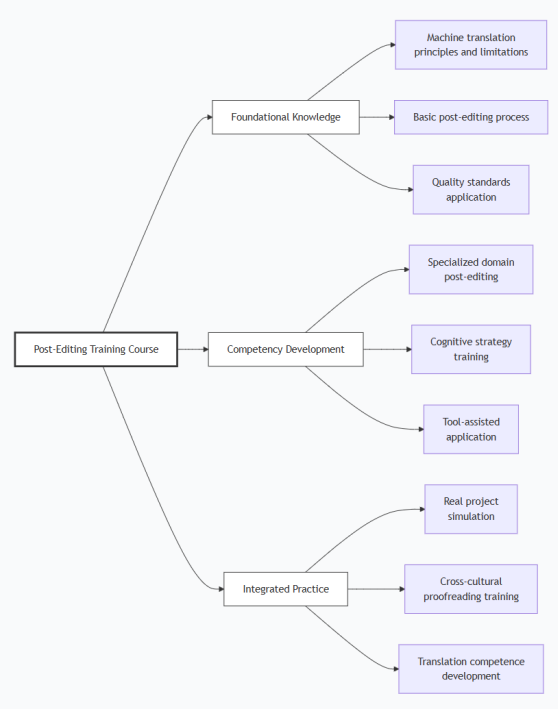
Source: own elaboration
This paper’s analysis believes that the above modular training design for post-editing oriented toward translation competence is a dynamic cultivation program for students’ technological adaptability and market-oriented competence under the academic-practical cultivation path. This research program mainly includes three stages of the training process: “theory-case-practice”.
In terms of technological adaptability, it mainly follows the cultivation path of “technology learning-technology detection-technology application-competence updating”, while cultivating technological critical thinking. Because of translation’s own characteristics, it also trains students’ emotional mechanisms (mainly through psycho-physiological sub-competence under the translation competence framework (see Beeby et al., 2009). At the same time, based on the translation client’s orientation, market-oriented cultivation is also within this cultivation design’s consideration, mainly including training in demand analysis, cross-cultural communication skills, and other aspects.
Teaching method design
Pedagogical approaches
Based on the modular teaching architecture above, this study believes that, at the specific teaching method level, teachers can consider adding information technology teaching approaches by combining traditional foreign language teaching models, such as conducting online teaching. This teaching method is conducive to improving students’ learning efficiency (students at this stage already have a certain foreign language foundation, so the necessity of offline face-to-face teaching is reduced). Through methods like screen sharing, teachers can better communicate with students, such as collaborating with students through relevant platforms and software. Collaboration methods are also diverse, such as through case comparison analysis.
In addition to case comparison analysis, teachers can also consider using project-based teaching methods in the intermediate stage’s later period and the advanced stage. Project-based learning can enable students to immerse themselves more deeply by understanding the practical application of learned content in real-world work scenarios through specific projects. At the same time, students should also actively conduct self-study after class, which not only further strengthens bilingual sub-competence and strategic sub-competence but also allows students to further consolidate learned content within limited classroom time. Students’ after-class self-study approaches can include writing translation learning logs, peer assessment, and dialogue with experts.
Assessment design
Assessment in the proposed program combines formative and summative evaluation to reflect both the process-oriented nature of post-editing learning and the outcome-driven demands of professional practice.
In course assessment, teachers can combine formative assessment with summative assessment, because for post-editing, students’ subjective initiative should be particularly valued, especially for translation learning itself. Specifically, students can start from computer-assisted translation and transition to machine translation post-editing. Teachers can assign students a simple translation task (approximately 500 words), and students can use machine translation tools like Trados Studio with built-in machine translation engines enabled for translation. Afterward, students can compare translations of the same text, with comparison content including machine translation direct output, machine translation + post-editing content, and human translation content. Under teachers’ guidance, students can compare various aspects of translation content, such as linguistic level content (like terminology consistency and punctuation issues), error types (serious errors (affecting understanding), moderate errors (affecting fluency), and minor errors (format issues)); at the same time, students can use Language Quality Assessment (LQA) to score compared translation content one by one.
For formative assessment, there can be a higher proportion, such as 60%. Specific assessment content can include classroom participation and discussion, staged project assignments, and reflection logs. Summative assessment can account for 40%, with content including final comprehensive tests and project outcome presentations.
This study believes that the proportion of summative assessment should not be lower than 40% because translation is content that places great emphasis on final results. Whether translators can provide qualified translation results is a very important factor. On the basis of combining learning and translation’s own characteristics, we suggest that the formative assessment proportion should not exceed 60%, and the summative assessment proportion should not be lower than 40%. In fact, given that translation competence develops progressively across sub-competences (Beeby et al., 2009), a formative-weighted assessment structure is particularly appropriate, as it captures learners’ evolving decision-making rather than measuring only terminal performance.
In summary, it is necessary to analyze content produced by machine translation, understand the problems machine translation may produce at current technological levels in specific fields, and then provide better solutions according to translation professional knowledge and mobilizing translators’ initiative. In addition, the degree of post-editing training should be valued, especially after understanding and summarizing machine translation effects in different fields. Translators need to classify and summarize machine translation content in different fields, and with continuous updates of translation models, post-editing teachers should also timely update post-editing cultivation plans.
DISCUSSION
The present paper has proposed a three-stage post-editing training program theoretically grounded in the PACTE translation competence model. The coherence of this framework lies in its alignment between the progressive mastery of sub-competences and the staged pedagogical design. However, translating this theoretical architecture into effective classroom practice is not without challenges, and several aspects warrant further discussion to delineate the scope and limitations of the model.
First, while the three-stage model aligns with the progressive development of sub-competences in the PACTE framework, its implementation may vary significantly depending on institutional resources, teacher expertise, and students’ prior knowledge. In particular, the emphasis on instrumental and strategic sub-competences presupposes a certain level of technological infrastructure and instructor familiarity with MT tools, which may not be equally available across educational contexts.
Second, although this study highlights pragmatic accuracy as a key dimension distinguishing human post-editing from raw machine output, assessing such competence remains methodologically challenging, as pragmatic appropriateness often involves subjective judgment and context-sensitive interpretation.
Third, the proposed balance between formative and summative assessment (60/40) reflects an attempt to reconcile process-oriented learning with outcome-based evaluation. Nevertheless, further empirical validation is needed to determine whether this ratio optimally supports competence development across different learner profiles.
Finally, as machine translation technologies continue to evolve rapidly, the stability of training models based on current system limitations may be limited. This calls for a dynamic curriculum design that not only responds to technological change but also anticipates future shifts in the human–machine division of labor in translation. Therefore, future research could focus on longitudinal studies of learner development, cross-institutional comparisons, and the integration of emerging AI-assisted tools into post-editing pedagogy.
In summary, a key argument underpinning the proposed model is that PACTE’s multi-componential structure captures the very skills that differentiate human post-editing from raw machine output, particularly in the areas of pragmatic and cultural adaptation. By foregrounding strategic and extra-linguistic sub-competences in the intermediate and advanced stages, the program provides a principled response to the identified shortcomings of MT systems.
CONCLUSIONS
This study believes that post-editing training planning from a translation competence perspective is worth considering. The translation competence theoretical framework can not only help us build a bridge between human translators and machine translation, but also enable us to find complementary points in the comparison between the two fields, which can help human translation and post-editing training follow progressive and steady improvement goals. With the continuous development of information technology, machine translation use in some fields has become a tool that translators need to understand and master. This requirement is not only determined by external conditions, such as increased information volume, but also by the need to respond to demands for high-efficiency, high-quality translation.
For post-editing cultivation, it can be said to be an important link in translation teaching. This course is mainly for senior-year translation department students because senior translation students are more capable of identifying machine translation-generated content. After determining the student group for post-editing, post-editing can serve as a form of our translation content verification; at the same time, post-editing practice can also provide us with opportunities to discuss existing translations. In this process, this study believes that selecting post-editing guidance choices is crucial.
Given that current machine translation capabilities have significantly improved, this means that while machine translation improves translator work efficiency, it also brings challenges to translators’ more precise post-editing. This study believes that using the PACTE group’s translation competence model has inspirational significance for formulating post-editing curriculum cultivation. This is not only based on existing problems faced by post-editing and existing curriculum planning, but also because translation competence and post-editing have commonalities in individual aspects, such as strategy and principle issues. These commonalities all have important guiding significance for us to further optimize current post-editing. At the same time, we can also further improve the translation competence model in the post-editing process.
Currently, content on post-editing from a translation competence perspective is limited, especially in theoretical textbooks and practical training manuals. All this requires us to actively respond to challenges brought by machine translation post-editing while also summarizing and formulating systematic training systems and training materials based on past theoretical and practical experience, preparing for future industry talents to more quickly and efficiently master post-editing competence.
REFERENCES
Alibaba Cloud. (2025). What is machine translation? https://cn.aliyun.com/getting-started/what-is/what-is-machine-translation?from_alibabacloud=
Beeby, A., Fernández, M., Fox, O., Albir, A., Kozlova, I., Kuznik, A., Neunzig, W., Rodríguez, P., Romero, L., & Wimmer, S. (2009). Results of the validation of the PACTE translation competence model: Acceptability and decision making. Across Languages and Cultures, 10(2), 207–230. https://doi.org/10.1556/Acr.10.2009.2.3
Chen, Y., & Pan, L. (2023). Research on machine translation post-editing course design: An analysis based on demand, competence and content elements. Journal of Hunan University of Science and Engineering, 44(4), 121–124. https://oversea.cnki.net/kcms2/article/abstract?
Çeti̇Ner, C., & İşisağ, K. (2019). Undergraduate Level Translation Students’ Attitudes towards Machine Translation Post-Editing Training. International Journal of Languages’ Education, 7(1), 110–120. https://doi.org/10.18298/ijlet.3242
Cui, Q., & Li, W. (2015). Research on post-editing error types: Based on English-Chinese machine translation of scientific and technical texts. Chinese Science and Technology Translators Journal, 28(4), 19–22. https://www.scirp.org/reference/referencespapers?referenceid=2668151
Dimitriu, R. (2015). The Many Contexts of Translation (Studies). Linguaculture, 2015(1), 5–23. https://doi.org/10.1515/lincu-2015-0033
Elbaz, P. (2025). Quelle place et quelle modalité de relation aux experts dans un contexte d’apprentissage de la terminologie en master de traduction ? Syn-Thèses, 46-59 Pages. https://doi.org/10.26262/ST.V0I16.10651
Feng, Q., & Zhang, H. (2015). Research on post-editor cultivation in the context of global language service industry. Foreign Language World, (1), 65–72.
Gao, B., & Hu, P. (2024). Comparative study of translation competence market demand and MTI curriculum design in China. Chinese Translators Journal, 45(1), 108–116.
Göpferich, S., & Jääskeläinen, R. (2009). Process research into the development of translation competence: Where are we, and where do we need to go? Across Languages and Cultures, 10(2), 169–191. https://doi.org/10.1556/Acr.10.2009.2.1
Institute of Automation, Chinese Academy of Sciences. (2008). Machine translation: A new era of human-machine symbiotic translation. https://ia.cas.cn/kxcb/kpwz/200804/t20080414_2299218.html
Jia, Y., Carl, M., & Wang, X. (2019). Post-editing neural machine translation versus phrase-based machine translation for English–Chinese. Machine Translation, 33(1–2), 9–29. https://doi.org/10.1007/s10590-019-09229-6
Jones, E. R. (2025). Pragmatics. The Decision Lab. https://thedecisionlab.com/reference-guide/linguistics/pragmatics
Koponen, M. (2016). Is machine translation post-editing worth the effort? A survey of research into post-editing and effort. The Journal of Specialised Translation, (25), 131–148. https://jostrans.soap2.ch/issue25/art_koponen.pdf
Krüger, R. (2016). Situated LSP Translation from a Cognitive Translational Perspective. Lebende Sprachen, 61(2). https://doi.org/10.1515/les-2016-0014
Li, X., & Gao, C. (2024). Knowledge map and development trends of foreign machine translation research. Shanghai Journal of Translators, 175(2), 41–47. https://shjot2021.shu.edu.cn/CN/abstract/abstract405.shtml
National Education Examinations Authority & National Language Commission. (2018). China’s standards of English language ability (GF 0018-2018).
O’Brien, S. (2002). Teaching post-editing: A proposal for course content. Proceedings of the 6th EAMT workshop: Teaching machine translation. https://aclanthology.org/2002.eamt-1.11.pdf
PACTE. (2008). Building a translation competence model. In F. Alves (Ed.), Benjamins Translation Library (Vol. 45, pp. 43–66). John Benjamins.
Pym, A. (2004). Redefining Translation Competence in an Electronic Age. In Defence of a Minimalist Approach. Meta, 48(4), 481–497. https://doi.org/10.7202/008533ar
Shi, Q. (2023). Development of post-editing skills in machine translation. Region - Educational Research and Reviews, 5(3), 125. https://doi.org/10.32629/rerr.v5i3.1325
Su, W., & Li, D. (2023). The effectiveness of translation technology training: A mixed methods study. Humanities and Social Sciences Communications, 10(1), 595. https://doi.org/10.1057/s41599-023-02066-2
Vieira, L. N. (2014). Indices of cognitive effort in machine translation post-editing. Machine Translation, 28(3–4), 187–216. https://doi.org/10.1007/s10590-014-9156-x
Wang, C. (2023). Subtitle translation research of How to Get Away with Murder under «machine translation + post-editing» mode. Overseas English, (23), 11–13. http://overseaen.net/html/zzgg/index_2.asp
Wang, Y., & Jalalian Daghigh, A. (2023). Cognitive effort in human translation and machine translation post-editing processes: A holistic and phased view. FORUM. Revue Internationale d’interprétation et de Traduction / International Journal of Interpretation and Translation, 21(1), 139–162. https://doi.org/10.1075/forum.22009.wan
Zhong, W., & Shu, C. (2020). Post-editing competence structure and curriculum design: Based on frontier analysis of foreign post-editing courses. Technology Enhanced Foreign Language Education, (6), 86–91. https://qikan.cqvip.com/Qikan/Article/Detail?id=7104173319
FINANCING
The author received no funding for the development of this research.
CONFLICT OF INTEREST STATEMENT
None.
ACKNOWLEDGMENTS
The author acknowledges the support received from Dr. Pascale Elbaz, Prof. Daniela Cesiri, Prof. Rubén González Vallejo.
STATEMENT ON THE USE OF ARTIFICIAL INTELLIGENCE
AI was used in the preparation of this manuscript, as permitted by the journal’s guidelines.
AUTHORSHIP CONTRIBUTION:
Conceptualization: Xiang Zhang.
Data Curation: Xiang Zhang.
Formal analysis: Xiang Zhang.
Investigation: Xiang Zhang.
Methodology: Xiang Zhang.
Project administration: Xiang Zhang.
Resources: Xiang Zhang.
Software: Xiang Zhang.
Supervision: Xiang Zhang.
Validation: Xiang Zhang.
Visualization: Xiang Zhang.
Writing – Original Draft: Xiang Zhang.
Writing – proofreading and editing: Xiang Zhang.