doi: 10.58763/rc2026571
Review article
Desigualdad económica y el acceso a la educación: análisis bibliométrico de datos empíricos en Latinoamérica (Centroamérica y Honduras)
Economic inequality and access to education: A bibliometric analysis of empirical research in Latin America (Central America and Honduras)
Eder Jose Ramirez Guillen1  *,
Nelson Rafael Durón Bustamante1 *
*,
Nelson Rafael Durón Bustamante1 *
RESUMEN
Introducción: El estudio parte de reconocer la relación intrínseca entre estatus socioeconómico como un factor que condiciona el acceso a la educación.
Metodología: Esta investigación realizó una revisión bibliométrica de la producción científica que relacionó la desigualdad económica con el acceso a la educación en América Latina, a partir de Web of Science y Scopus (2000–2025). Se aplicaron las leyes de Lotka, Bradford y Zipf, junto con el índice Hirsch (índice h), para analizar patrones de autoría, impacto académico, concentración editorial y evolución temática.
Resultados: Los resultados evidenciaron crecimiento, aunque limitado, en las publicaciones sobre la forma en que la inequidad económica condiciona el ejercicio del derecho a la educación, especialmente en regiones con alta exclusión estructural como Centroamérica (particularmente en Honduras). Se identificaron clústeres en torno a la desigualdad, pobreza y brecha digital.
Conclusiones: La revisión precisó vacíos geográficos y metodológicos y aportó insumos empíricos para orientar agendas interdisciplinarias y el diseño de políticas públicas informadas por evidencia, con enfoque de justicia social y desarrollo humano.
Palabras clave: Centro América, desigualdad económica, educación, Honduras, Latinoamérica.
Clasificación JEL: D63, I24, I25.
ABSTRACT
Introduction: This study begins by acknowledging the intrinsic relationship between socioeconomic status and access to education.
Methodology: This research conducted a bibliometric review of scientific literature linking economic inequality to access to education in Latin America, using Web of Science and Scopus (2000–2025). Lotka’s, Bradford’s, and Zipf’s laws, along with the Hirsch index (h-index), were applied to analyze patterns of authorship, academic impact, publisher concentration, and thematic evolution.
Results: The results showed growth, albeit limited, in publications on how economic inequality conditions the exercise of the right to education, especially in regions with high structural exclusion such as Central America (particularly in Honduras). Clusters were identified around inequality, poverty, and the digital divide.
Conclusions: The review identified geographical and methodological gaps and provided empirical insights to guide interdisciplinary agendas and the design of evidence-informed public policies, with a focus on social justice and human development.
Keywords: Central America, economic inequality, education, Honduras, Latin America.
JEL Classification: D63, I24, I25.
Received: 22-07-2025 Revised: 10-10-2025 Accepted: 15-12-2025 Published: 02-01-2026
Editor: Alfredo
Javier Pérez Gamboa
1Universidad Nacional Autónoma de Honduras. Tegucigalpa, Honduras.
Cite as: Ramírez Guillen, E. J. y Durón Bustamante, N. R. (2026). Desigualdad económica y el acceso a la educación: análisis bibliométrico de datos empíricos en Latinoamérica (Centroamérica y Honduras). Región Científica, 5(1), 2026571. https://doi.org/10.58763/rc2026571
INTRODUCTION
Honduras faces profound economic inequality, which has created a structural barrier to equitable access to fundamental rights such as education (Landa-Blanco, 2025; Pineda Munguia, 2022). Despite experiencing average economic growth of 3,7 % over the last two decades, this growth is insufficient to drive sustainable human development; this is because much of the economic dynamism relies on private consumption—fueled primarily by remittances—rather than on sustained productive investment or improvements in job quality (Universidad Nacional Autónoma de Honduras, 2023).
Income distribution in Honduras is markedly unequal. According to the Permanent Multi-Purpose Household Survey (EPHPM), the average monthly per capita income stands at L4,246; however, this figure reveals stark disparities between the first and fifth quintiles: the poorest households earn a mere L596, while the wealthiest reach L11,172 (Instituto Nacional de Estadística, 2024a). This disparity deepens further depending on the educational level of the head of the household: while those with no formal schooling earn L2,617, those with higher education earn over L10,400. Furthermore, the national Gini coefficient hovers around 0,53, reflecting a critical concentration of income (Instituto Nacional de Estadística, 2024a).
Populations living in extreme poverty face barriers ranging from the inability to afford school supplies, internet connectivity, or transportation, to the necessity of sending children and adolescents into the informal labor market as a survival strategy (Universidad Nacional Autónoma de Honduras, 2025). Indeed, 68,9 % of wage earners earn less than the minimum wage; this highlights the deterioration of living conditions and the difficulty households face in allocating resources toward their children’s education (Universidad Nacional Autónoma de Honduras, 2024).
The situation is exacerbated in rural areas, where per capita income is nearly half that of urban areas, and educational coverage is more limited—both in terms of infrastructure and teacher availability. According to Paz-Maldonado et al. (2021), Honduras is one of the most unequal countries in Latin America, possessing a fragile educational system characterized by high rates of school dropout, low secondary school attendance, and precarious physical conditions in public schools.
In its studies, the Consejo Hondureño de la Empresa Privada (COHEP) highlights the existing disconnect between the educational system and the labor market—one of the primary reasons why Honduran children and youth do not view education as a viable path to accessing job opportunities that offer decent wages and social benefits capable of improving their structural living conditions (COHEP, 2025).
Stemming from this issue, the following research question is formulated: In what ways does economic inequality impact access to education, based on empirical data derived from scientific databases, with a specific emphasis on Latin America, Central America, and Honduras? Linked to this question, the general objective of this research is to analyze the impact of economic inequality on access to education in Honduras by examining empirical data on Latin America available in scientific databases.
For this reason, the structure of this document includes: an introduction; a literature review that frames the study and defines its purpose; a methodology section seeking to explain the research processes from a hermeneutic perspective; a results section presenting a review and analysis of empirical documents drawn from two of the world’s leading research databases; a discussion section; and, finally, a concluding section addressing conclusions, limitations, and implications.
Literature review
Educational gaps in the Latin American region
In Latin America, economic inequality constitutes one of the primary determinants of educational exclusion. Several regional studies have demonstrated that social segmentation and the unequal distribution of income directly impact educational trajectories, shaping a landscape in which access, retention, and educational achievement are mediated by one’s socioeconomic background (Blanco Bosco, 2023; Cuenca & Pérez, 2025; Sánchez-Castro et al., 2024). At the macro level—according to data estimated by the World Bank (2022) as of 2002—the Latin American region exhibits a Gini coefficient of 0,499, indicating high levels of inequality; this is reflected in significant gaps in schooling attainment and educational quality across different social groups.
This inequality translates into unequal access to educational resources, infrastructure, and learning conditions. As noted by Giraldo-Gallego et al. (2022), there is a significant concentration of educational opportunities in high-income urban contexts, while rural, indigenous, and Afro-descendant populations face greater structural barriers. Compounding this issue is limited public investment in education, which in many countries does not exceed 4 % of GDP—a situation that exacerbates the disparities between public and private school systems (World Bank, 2022).
Regional disparities within Latin American countries reflect patterns of educational segregation that stem from both economic factors and territorial dynamics (Carrillo, 2020). In the case of Colombia, Romero-Bolívar and Rincón-Chaparro (2025) demonstrate how the geographic location of educational institutions conditions students’ academic performance, and how departments with lower levels of educational investment exhibit higher rates of school dropout and academic lag. These findings can be extrapolated to Latin America as a whole—a region characterized by high levels of rurality, labor informality, and limited state coverage.
Educational gaps in Honduras
Evidence shows that lower-income families face not only economic barriers but also socio-cognitive ones—such as low parental educational attainment and a lack of cultural capital—which affect the educational performance and aspirations of children and youth (Chaverri Chaves, 2021; Marah et al., 2025). In Central America, structural conditions of poverty and inequality limit the effectiveness of educational systems in guaranteeing universal rights (Piñeiro Ruiz, 2025). Educational policies in El Salvador, Guatemala, and Honduras fail to meet the growing demand from children and youth, the majority of whom attend public schools characterized by precarious infrastructure, limited pedagogical resources, and a lack of adequate spatial and instructional planning to ensure a dignified education.
The educational reality in Honduras is alarming, as more than 68 % of the population lives in poverty. The public education system suffers from structural problems that result in low coverage, high dropout rates (particularly in the final cycle of basic education and the grades within secondary education), and a quality of education that is out of step with the needs of the productive sector (Paz-Maldonado et al., 2021).
The COVID-19 pandemic exacerbated educational challenges, as Honduras kept its schools closed for nearly three years (Mejia Elvir, 2021). Children attending public schools faced severe obstacles regarding access to education and pedagogical resources—particularly in the poorest households—as well as deficiencies in teachers’ technological proficiency for virtual instruction (Paz-Maldonado et al., 2021; Sánchez Lora, 2022).
Research by Giraldo-Gallego et al. (2022) indicates that parental educational attainment, income level, and household emotional stability are significant factors influencing children’s academic performance. The monthly per capita income in Honduran households headed by an individual with a higher education level is up to four times greater than that in households headed by individuals with no formal schooling (Instituto Nacional de Estadística, 2024a). Household income levels translate into greater opportunities for access to higher-quality schools, connectivity, private tutoring, and personalized academic support (Cooper & Stewart, 2021; Fernández et al., 2025).
Addressing the impact of economic inequality on access to education in Honduras must begin with a thorough examination of the structural, territorial, and familial dimensions that shape educational access in both urban and rural areas.
METHODOLOGY
The documents for this bibliometric analysis were reviewed in the Web of Science and Scopus databases to ensure the quality and reliability of the academic indexing of the research, as well as its comparability (Baier-Fuentes et al., 2019; Donthu et al., 2021). A qualitative approach was employed, applying techniques of documentary analysis. The search strategy was based on the Boolean operator “AND,” which allowed for the refinement of the obtained results. The search queries were formulated in English (as writing them in Spanish resulted in a reduced number of retrieved publications), utilizing keywords related to “Central America,” “economic inequality,” “education,” “Honduras,” and “Latin America,” limited to the period 2000–2025.
Searches within the databases were conducted independently, covering the period 2000–2025 and using the terms “economic inequality” AND “education.” In WoS, 252 records were initially identified; documents were included if they incorporated the terms “Latin America,” “Central America,” or “Honduras” in their title, abstract, or keywords, and were classified within the following fields of study: Business Economics, Sociology, Educational Research, Social Issues, Social Sciences, Public Administration, Behavioral Science, Development Studies, Anthropology, Family Studies, and Philosophy. Editorials, notes, book reviews, conference abstracts, records with incomplete metadata, and works lacking an explicit link between inequality and education were excluded. Following an exhaustive review, 171 records remained for Latin America, 39 for Central America, and 3 for Honduras. In Scopus, 238 records were initially found; documents were included if classified under Social Sciences, Economics, Econometrics and Finance, Arts and Humanities, Environmental Science, Psychology, Decision Sciences, or Multidisciplinary fields—subject to the same geographic and thematic criteria—while the same non-academic document types and incomplete records were excluded. This data cleaning process yielded 116 records for Latin America, 12 for Central America, and 6 for Honduras.
Information processing was carried out by combining the following software programs: Microsoft Excel, Bibliometrix, and VOSviewer. The latter two are specialized tools for the analysis and visualization of scientific networks, enabling the construction of keyword co-occurrence maps, co-authorship relationships, institutional networks, and country-level analyses (van Eck & Waltman, 2010). The bibliometric analysis was structured around five classic laws: (1) Price’s Law, which identifies literature growth by fitting exponential trends; (2) Lotka’s Law, used to determine author productivity; (3) Bradford’s Law, which analyzes the thematic dispersion of publications across scientific journals; (4) Hirsch’s H-index, which measures the impact of the most-cited documents; and (5) Zipf’s Law, employed to rank the most frequent keywords within the corpus (Moral-Muñoz et al., 2020).
The analysis was executed in several stages: (1) searching for and refining documents in WoS and Scopus; (2) exporting bibliographic records; (3) uploading and visualizing data in the software tools; (4) analyzing co-occurrence, co-authorship, and citation networks; and (5) synthesizing thematic findings. The methodology employed provides a solid foundation for understanding the academic evolution of the link between economic inequality and education; it generates important information to guide future research aimed at informing the formulation of public policies. At the Latin American level—and particularly in Honduras—there is an urgent need for collaboration among all stakeholders—the State, the private sector, educational institutions, and families—to build an educational system that meets the demands of the 21st century.
RESULTS
Public policies in most countries worldwide indicate that education serves as one of the key drivers enabling individuals to access better employment opportunities—including a living wage—and thereby ascend the social ladder. However, in Latin America—given its high degree of inequality (as demonstrated in the introduction by an average Gini coefficient of 0,499 since 2002)—it is crucial to recognize that socioeconomic factors (such as parental education levels, family income, cognitive stimulation during childhood, and emotional stability) significantly influence children’s access to education and their academic performance (Chaverri Chaves, 2021; Tene-Tenempaguay et al., 2024).
A clear link exists between economic inequality and access to education; accordingly, this research aims to determine whether there is a pattern of exponential growth in scientific output regarding economic inequality and education in Latin America. This analysis draws upon data extracted from the Web of Science (WoS) and Scopus, placing particular emphasis on a graphic and quantitative examination of annual publication trends.
Review of scientific production
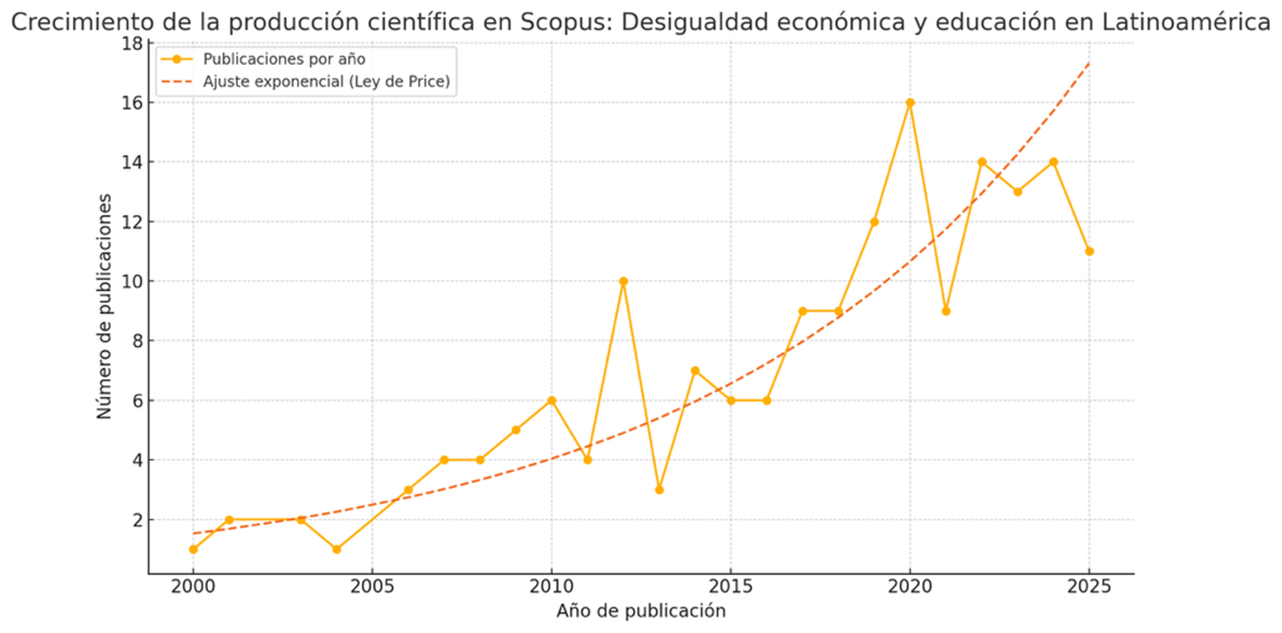
According to the bibliographic records analyzed from the WoS database, during the studied period, an exponential growth trend was identified in scientific output linked to economic inequality and education in Latin America, with an estimated average annual increase of 8,02 % (figure 1). This evolution aligns with Price’s Law, which states that scientific fields tend to grow exponentially during their initial phases of consolidation (Price, 1963).
Beginning in 2010, a significant turning point was observed in the growth of scientific output regarding this subject. An analysis conducted using the WoS database reveals that between 2000 and 2025, a total of 116 articles linked to these topics were published. The year 2020 marked the peak of academic production, possibly reflecting the impact of the COVID-19 pandemic as a catalyst for the study of structural inequalities in educational access. For Central America, 12 publications were identified, while for Honduras, 6 were found; it is important to note that these publications do not focus exclusively on the link between economic inequality and access to education, but rather connect with other fields of study, such as health and agricultural production.
|
Figure 1. Graph of exponential article growth: WoS data and Price’s Law |
|
|
|
Note: the figure appears in its original language. |
The analysis performed on the Scopus database (figure 2) reveals the same trend observed in WoS: scientific output on this topic in Latin America has grown exponentially, consistent with the tenets of Price’s Law (Price, 1963). An annual growth rate of 9,7 % indicates an accelerated pace. It provides evidence that a growing number of researchers and research centers are taking an interest in analyzing the structural conditions generated by inequality within the region’s educational systems (Dominguez-Fernandez, 2024; Giraldo-Gallego et al., 2022).
|
Figure 2. Exponential growth graph of articles: Scopus data and Price’s Law |
|
|
|
Note: the figure appears in its original language. |
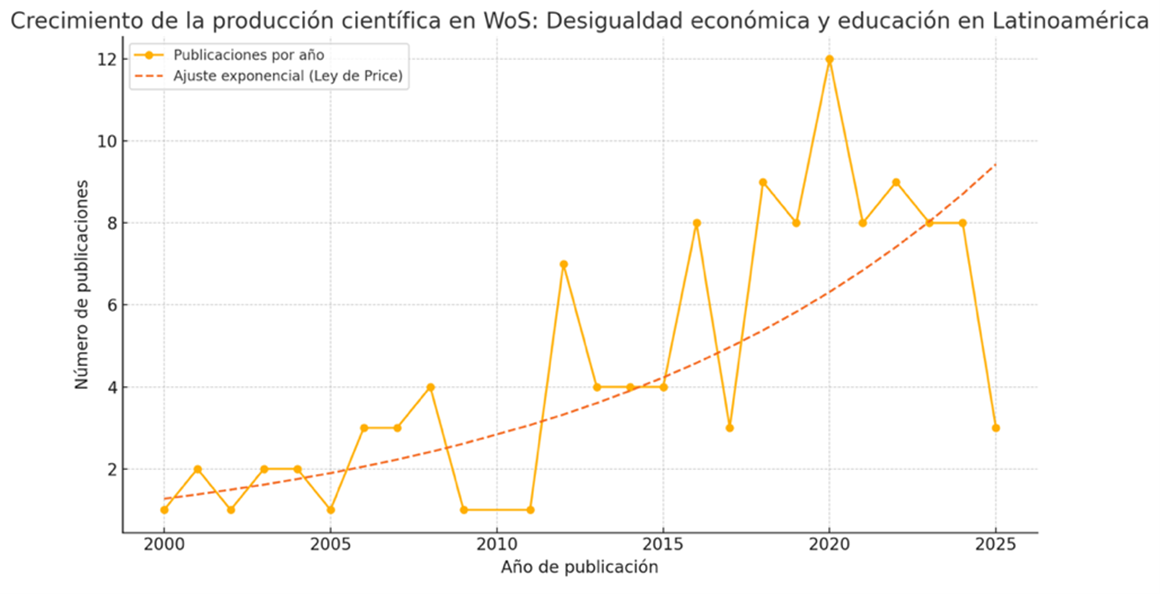
The year 2020 saw the highest volume of publications, reaffirming the impact of the COVID-19 pandemic on research analyzing the relationship between inequality and educational gaps (Giraldo-Gallego et al., 2022). Scopus lists 171 studies within the period under review; this figure can be attributed to the greater number of Latin American journals indexed in this database, which cover social science fields such as economics and education. Within the Central American region, 39 publications were produced, with Honduras contributing 3.
A comparison between the two databases suggests that academic interest in this topic has grown across all indexed sources; Scopus serves as a more representative repository of scientific output within the Latin American context. This highlights the importance of utilizing multiple databases to achieve a comprehensive and rigorous bibliometric characterization. Taken together, the findings demonstrate that the phenomenon of economic inequality—and its influence on access to education—is a subject of significant academic interest.
Academic productivity
An analysis of scientific productivity regarding economic inequality and access to education in Latin America—based on records from the Web of Science (WoS)—reveals a marked concentration of authorship that aligns with the tenets of Lotka’s Law. According to this law, the number of authors publishing *n* articles is proportional to 1/n²; that is, there is a high proportion of authors with only a single publication, alongside a small elite of prolific authors who account for the majority of scientific output (Lotka, 1926).
In this instance, four authors have surpassed the threshold of two publications (Table 1): Guido Neidhöfer (4 documents), and Mónica Mazariegos, Rebecca Simson, and Massy Mutumba (each with 2 documents)—collectively representing less than 4 % of the total authors analyzed. This distribution confirms the empirical validity of the law within the field under study.
|
Table 1. Prolific WoS authors (Lotka’s Law) |
|||
|
Author’s name |
Number of documents |
Citations |
Total link intensity |
|
Neidhöfer G |
4 |
117 |
4 |
|
Mazariegos M. |
2 |
49 |
2 |
|
Simson R. |
2 |
14 |
2 |
|
Mutumba M. |
2 |
10 |
2 |
|
Source: own elaboration using data from WoS. |
|||
Another important factor regarding these authors is their level of academic impact, measured in terms of cumulative citations. Guido Neidhöfer has garnered 117 citations across his four publications, followed by Mónica Mazariegos with 49; this suggests a high degree of intellectual influence within the specialized literature. For their part, Rebecca Simson and Massy Mutumba have accumulated 14 and 10 citations, respectively—figures that also reflect a significant level of visibility. Furthermore, total link intensity—understood as the frequency with which these authors appear as co-authors within the database—reinforces their role as active nodes within scientific collaboration networks. These findings lead to the conclusion that, although the field remains fragmented, there are authors with an established presence and structural influence on the regional research agenda—a pattern consistent with other bibliometric studies on author productivity (Moral-Muñoz et al., 2020).
The analysis of scientific productivity in Scopus (table 2) reveals a highly concentrated structure in terms of authorship, wherein only five authors exceed the threshold of two publications. The case of Neidhöfer G. stands out, with three documents and 100 citations; this positions him as the most influential author in this field within the Scopus repository, as well as the most prolific author within the WoS network. He is followed by Serrano J. and Gasparini L., both with two publications and 78 citations—figures that reflect significant academic relevance. This concentration, albeit limited in numerical scope, enables the identification of a network of researchers characterized by heightened visibility and thematic leadership.
|
Table 2. Prolific Scopus authors (Lotka’s Law) |
|||
|
Author’s name |
Number of documents |
Citations |
Total link intensity |
|
Neidhöfer G. |
3 |
100 |
3 |
|
Serrano J. |
2 |
78 |
2 |
|
Gasparini L. |
2 |
78 |
2 |
|
Tuncay V.B. |
2 |
1 |
2 |
|
Baten J. |
2 |
46 |
2 |
|
Carnoy M. |
2 |
2 |
2 |
|
Camou M.M. |
2 |
3 |
2 |
|
Maubrigades S. |
2 |
3 |
2 |
|
Thorp R. |
2 |
3 |
2 |
|
Source: own elaboration using data from Scopus. |
|||
Upon analyzing total link intensity, G. Neidhöfer exhibits an intensity of 3, whereas the other leading authors show an intensity of 2. These results suggest that, while a small group of authors demonstrates high productivity and impact, collaborative networks are not yet widely consolidated—a characteristic typical of scientific fields currently under construction. As noted by Moral-Muñoz et al. (2020), this type of analysis makes it possible to assess the degree of maturity of an academic domain, as well as the potential for consolidating more robust and stable research hubs centered on economic inequality and access to education.
|
Figure 3. Network of prolific authors and their working clusters. WoS data |
|
|
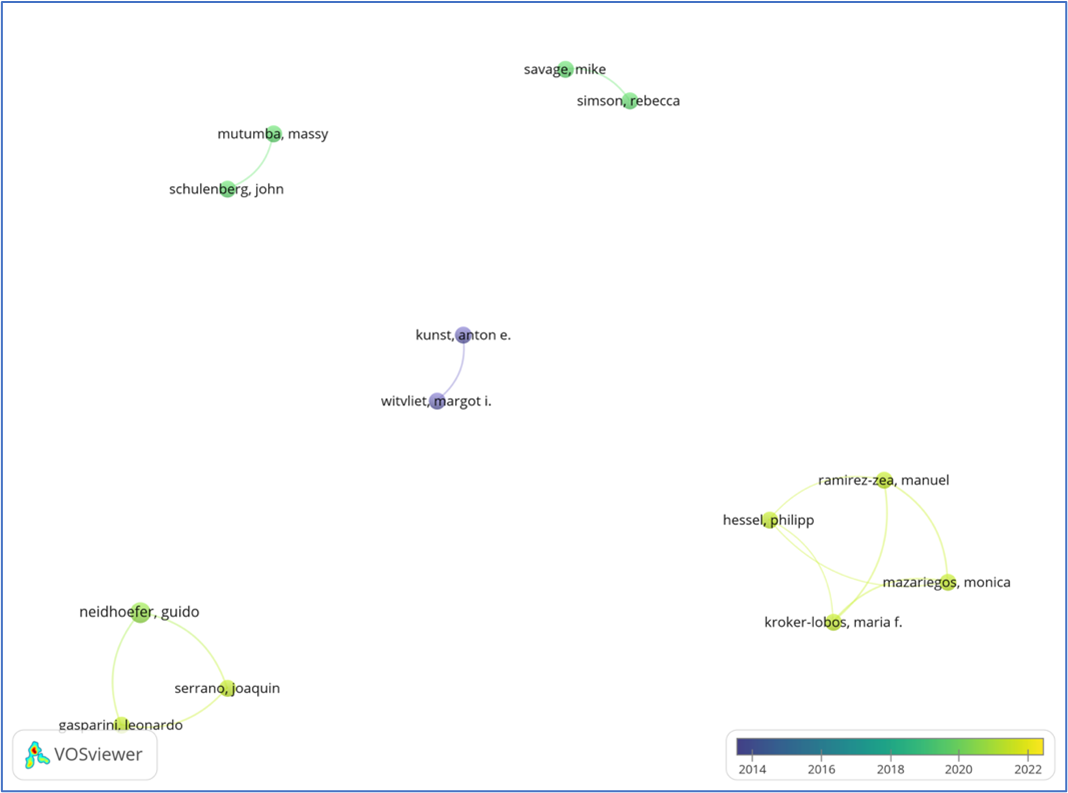
The mapping of the co-authorship network based on WoS data (figure 3) allows for the identification of a collaborative structure that is fragmented yet significant. The visualization reveals the existence of five independent clusters, each composed of pairs or trios of researchers who have produced co-authored work over the last decade. Prominent among these are the groups led by G. Neidhöfer—who actively collaborates with L. Gasparini and J. Serrano—as well as the cluster anchored by M. Mazariegos, featuring sustained co-authorships with Manuel Ramírez-Zea, Philipp Hessel, and María F. Kroker-Lobos.
These core groups exhibit moderate relational intensity, suggesting the existence of research lines that are thematically consolidated, albeit still limited in terms of geographic scope and the number of participating actors. As highlighted by Glänzel and Schubert (2005), co-authorship networks not only enable the visualization of the internal dynamics of science but also facilitate the identification of latent collaborative structures. Furthermore, studies such as those by Wagner and Leydesdorff (2005) indicate that the segmentation of these networks is a common feature in emerging fields of knowledge, where thematic specialization precedes the structural integration of the field.
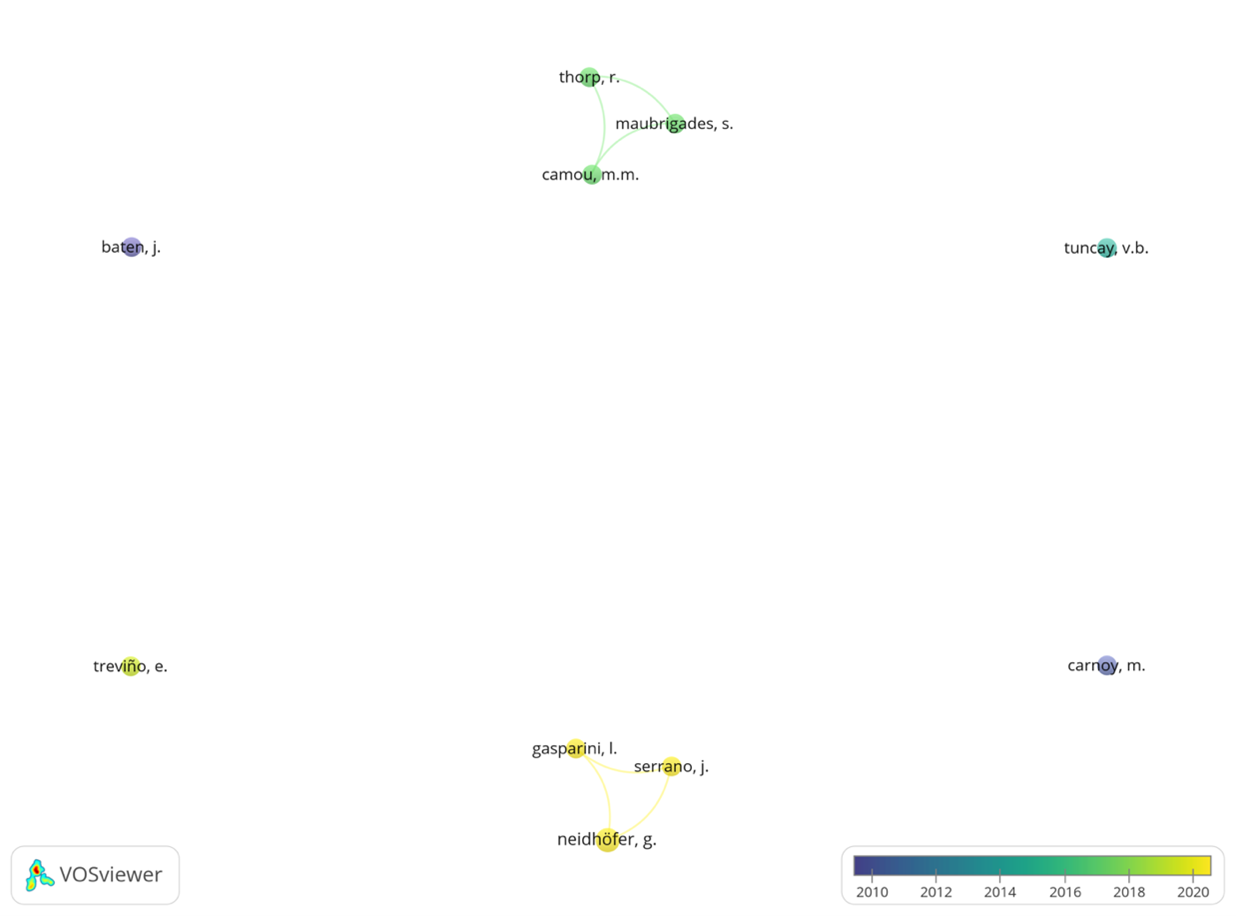
The analysis of the Scopus co-authorship network (figure 4) reveals a collaborative structure that is even more dispersed and atomized than that observed in WoS. Small collaborative clusters consisting of pairs or trios of researchers are identified—such as the group formed by Gasparini, L., Serrano, J., and Neidhöfer, G.—which exhibits relatively consistent interaction. Another active cluster comprises Camou, M.M., Maubrigades, S., and Thorp, R., who have established more recent collaborative ties, as suggested by the temporal scale. However, the remaining authors (such as Carnoy, M., Tuncay, V.B., or Baten, J.) appear completely isolated within the network, reflecting a low degree of structural connectivity. This fragmentation is common in emerging or highly specialized thematic fields, where institutional and geographical barriers hinder the consolidation of dense scientific communities (Börner, Maru, & Goldstone, 2004).
|
Figure 4. Network of prolific authors and their working clusters. Scopus data |
|
|
|
Table 3. Scientific production by country (WoS) |
||
|
Country |
Article |
% article |
|
USA |
38 |
32,75862069 |
|
Brazil |
10 |
8,620689655 |
|
United Kingdom |
9 |
7,75862069 |
|
Chile |
7 |
6,034482759 |
|
Germany |
6 |
5,172413793 |
|
Mexico |
5 |
4,310344828 |
|
China |
4 |
3,448275862 |
|
Spain |
4 |
3,448275862 |
|
Netherlands |
3 |
2,586206897 |
|
Argentina |
2 |
1,724137931 |
|
Canada |
2 |
1,724137931 |
|
Colombia |
2 |
1,724137931 |
|
Ecuador |
2 |
1,724137931 |
|
France |
2 |
1,724137931 |
|
Guatemala |
2 |
1,724137931 |
|
Peru |
2 |
1,724137931 |
|
Australia |
1 |
0,862068966 |
|
Austria |
1 |
0,862068966 |
|
Barbados |
1 |
0,862068966 |
|
Belgium |
1 |
0,862068966 |
|
Costa Rica |
1 |
0,862068966 |
|
Honduras |
1 |
0,862068966 |
|
Ireland |
1 |
0,862068966 |
|
Italy |
1 |
0,862068966 |
|
Panama |
1 |
0,862068966 |
|
Paraguay |
1 |
0,862068966 |
|
Russia |
1 |
0,862068966 |
|
Saudi Arabia |
1 |
0,862068966 |
|
Sweden |
1 |
0,862068966 |
|
Uruguay |
1 |
0,862068966 |
|
Source: own elaboration using data from Scopus |
||
An analysis of scientific output by country, based on WoS data (table 3), reveals an asymmetry in the authorship of research concerning economic inequality and access to education in Latin America. Although this topic falls within the scope of the region’s structural challenges, the majority of articles are produced in countries of the Global North—particularly the United States, the United Kingdom, Germany, and the Netherlands. This concentration reflects an epistemic and structural dependency of Latin American scientific systems upon global centers of knowledge production (UNESCO, 2021). According to this organization, Latin America accounts for a mere 4 % to 5 % of global scientific output, due in part to an investment in research and development (R&D) that hovers around 0,5 % of regional GDP—well below the global average of 2,4 %. This lag limits the capacity of local institutions to generate contextualized empirical evidence and to respond autonomously to their own socio-educational challenges.
|
Table 4. Scientific production by country (Scopus) |
||
|
Country |
Article |
% article |
|
USA |
21 |
12,28070175 |
|
Chile |
9 |
5,263157895 |
|
Spain |
9 |
5,263157895 |
|
Brazil |
8 |
4,678362573 |
|
Mexico |
7 |
4,093567251 |
|
Argentina |
6 |
3,50877193 |
|
Germany |
6 |
3,50877193 |
|
Colombia |
5 |
2,923976608 |
|
United Kingdom |
5 |
2,923976608 |
|
China |
3 |
1,754385965 |
|
France |
2 |
1,169590643 |
|
Netherlands |
2 |
1,169590643 |
|
Portugal |
2 |
1,169590643 |
|
Canada |
1 |
0,584795322 |
|
Costa Rica |
1 |
0,584795322 |
|
Ecuador |
1 |
0,584795322 |
|
India |
1 |
0,584795322 |
|
Italy |
1 |
0,584795322 |
|
Norway |
1 |
0,584795322 |
|
Peru |
1 |
0,584795322 |
|
Somalia |
1 |
0,584795322 |
|
Switzerland |
1 |
0,584795322 |
|
Turkey |
1 |
0,584795322 |
|
Uruguay |
1 |
0,584795322 |
|
Source: own elaboration using data from Scopus. |
||
The analysis of scientific output by country in Scopus (table 4) reveals a significant concentration of publications in countries such as Brazil, Chile, and Colombia. According to Urrunaga-Pastor et al. (2024), the concentration of research in a few countries indicates that scientific production is limited and centered on specific nations, thereby restricting the diversity of perspectives and approaches in regional research.
The data analyzed across both databases demonstrate limited participation from countries outside Latin America. This influences the visibility and impact of published articles, as integration into broader scientific networks is associated with wider dissemination and recognition of academic work (Arroyave-Cabrera & González-Pardo, 2022).
Most relevant publications
|
Table 5. Most relevant journals by number of articles (WoS) |
|||
|
Journal |
Number of articles |
Study area |
Bradford Zone |
|
Public Health Nutrition |
5 |
Public Health / Nutrition |
core |
|
Comparative Political Studies |
4 |
Political Science / Comparative Studies |
core |
|
Social Science & Medicine |
4 |
Social Sciences / Health |
core |
|
International journal for equity in health |
3 |
Health Equity / Public Health |
Zone 2 |
|
International journal of educational development |
3 |
Education / International Development |
Zone 2 |
|
World development |
3 |
Economics / International Development |
Zone 2 |
|
Sustainability |
3 |
Agriculture, Biology & Environmental Sciences (ABES), Social & Behavioral Sciences (SBS) |
Zone 3 |
|
Journal of economic inequality |
3 |
Social & Behavioral Sciences (SBS) |
Zone 3 |
|
Source: own elaboration using data from WoS |
|||
A review of the journals in which the majority of research on this topic is published in WoS (table 5) reveals a high concentration of scientific output within a small group of publications. Bradford’s Law posits that, within a specific subject area, a minority of journals contain the majority of relevant articles (Bradford, 1934). As previously noted, these publications adopt an interdisciplinary approach—encompassing public health, social sciences, comparative politics, education, economics, and sustainability—thereby demonstrating the multidimensional nature of the subject matter. Furthermore, editorial specialization in this field remains in its nascent stages, and this analysis should constitute a pivotal agenda item for policymakers tasked with improving the structural living conditions of the Latin American population—and, in particular, that of Honduras (Hoang, 2025).
|
Table 6. Most relevant journals in terms of number of articles (Scopus) |
|||
|
Journal |
Number of articles |
Study area |
Bradford Zone |
|
PLoS ONE |
5 |
Multidisciplinary / Life Sciences / Public Health |
Core |
|
Education Policy Analysis Archives |
5 |
Educational Policy / Comparative Education |
Core |
|
Foro de Educacion |
3 |
Education / Philosophy of Education |
Core |
|
Sustainability (Switzerland) |
3 |
Environmental Sciences / Sustainable Development |
Zone 2 |
|
World Development |
3 |
Economics / Development Studies |
Zone 2 |
|
Source: own elaboration using data from Scopus |
|||
The Scopus analysis (table 6) reveals a significant concentration of knowledge within a small group of publications, clearly demonstrating the diversity of approaches and the multidisciplinary nature required to produce scientific works that contribute to the subject of economic inequality and access to education. The application of Bradford’s Law enables the identification of the primary channels for the scientific dissemination of this topic (Bradford, 1934; Chaverri Chaves, 2021; Desai et al., 2018).
Applying Zipf’s Law criterion to analyze the WoS data (figure 5), the most frequent keywords in scientific publications addressing this subject were identified. As established by Zipf (1949), within a linguistic or thematic corpus, the frequency of a word’s usage is inversely proportional to its position in a ranked list: a few keywords dominate the field, while a long tail of terms appears with lower frequency. Words such as “inequality,” “education,” “poverty,” “Latin America,” and “social justice” emerge as central nodes within the semantic network, signaling their structuring role in the analyzed scientific output. These terms reflect not only the focus on the phenomenon of structural inequality but also an intersectional approach that articulates educational, economic, territorial, and gender dimensions.
Keywords/Key Terms
|
Figure 5. Keywords. WoS data |
|
|
|
Source: own elaboration using data from WoS |
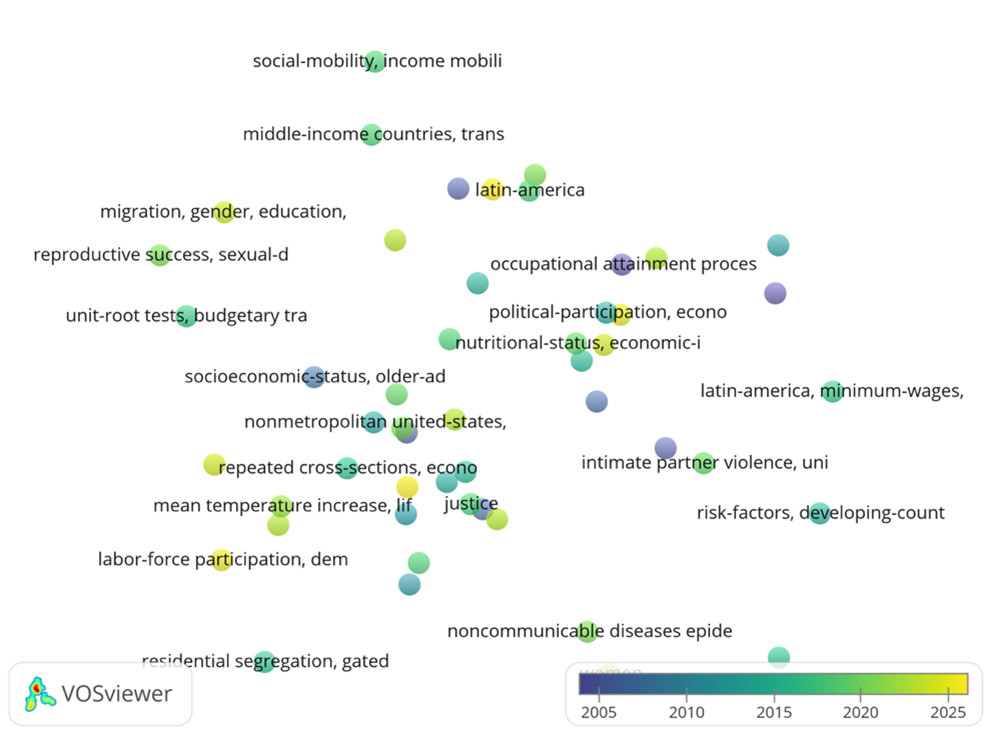
The visualization generated by VOSviewer displays interconnected thematic clusters revolving around issues such as political participation, residential segregation, intimate partner violence, and nutritional determinants, thereby confirming the interdisciplinary diversity of the field. The coloring of the nodes according to time suggests a chronological evolution of approaches: shifting from more classic structural analyses toward contemporary agendas centered on social mobility, reproductive health, climate change, and inclusive education. This thematic expansion—detected through the distribution of keywords—empirically validates the assertions of Lin et al. (2022), who argue that the analysis of co-occurring terms is a useful tool for mapping the cognitive evolution of a scientific field.
|
Figure 6. Keywords. Scopus data |
|
|
|
Source: own elaboration using data from Scopus |
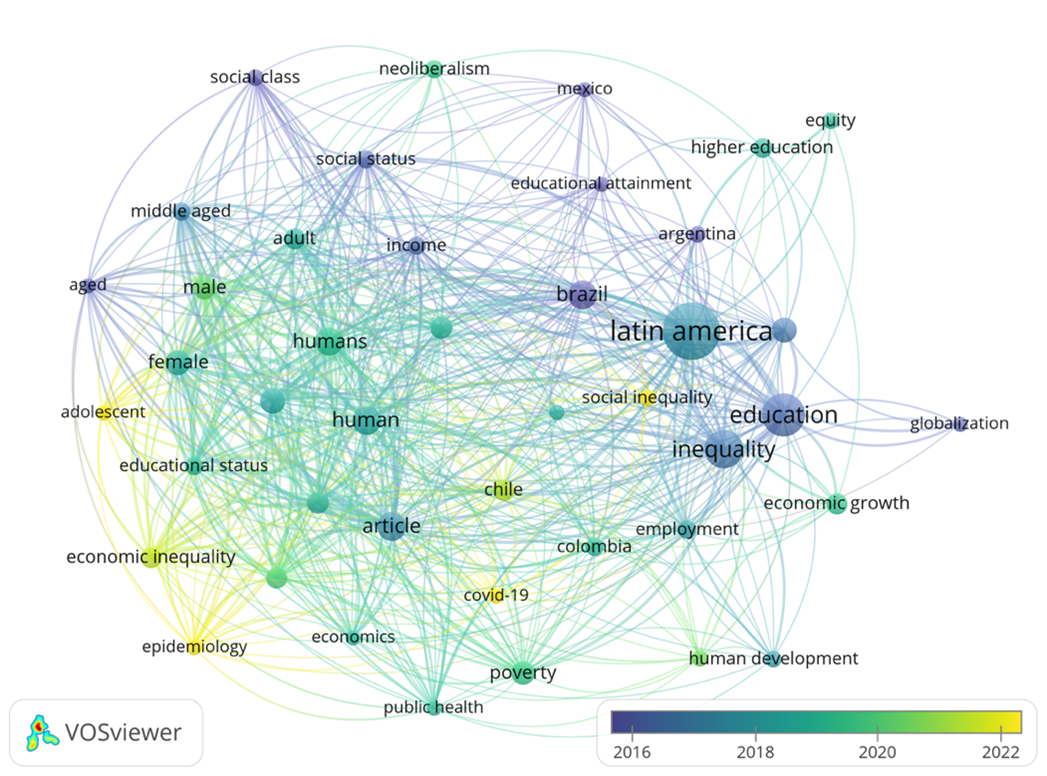
The word map generated using data from Scopus (Figure 6) confirms that a limited set of keywords dominates scientific output. At the same time, the remainder appear less frequently yet remain relevant to the thematic diversification of the field (Zipf, 1949). These keywords are similar to those found in WoS: “Latin America,” “inequality,” “education,” “poverty,” and “human development”; together, they constitute the most significant nodes of research over the past ten years. The review and analysis of terms based on frequency and co-occurrence serve as one of the pillars for identifying the cognitive trends and discursive priorities within a research field (Lim et al., 2024).
DISCUSSION
The distribution of scientific output regarding economic inequality and access to education in Latin America—as indexed in WoS and Scopus—exhibits a strong geographical concentration. The most prolific authors (in terms of publications, citations, and link intensity) hail from countries in the Global North. Within Latin America, countries such as Brazil, Mexico, Argentina, and Chile account for the vast majority of publications. In contrast, others—such as Honduras, Paraguay, and Guatemala—barely feature, contributing only one or two entries (Narayan et al., 2023). This pattern mirrors internal inequalities within the region, which are linked to disparities in state capacity, institutional weakness, and limited coordination among universities, governments, and productive sectors (Pradier et al., 2025).
Narayan et al. (2023) point out that this segmentation hinders the formation of regional scientific networks and restricts the circulation of knowledge produced in contexts characterized by high vulnerability. Bridging this gap entails not only increasing investment but also designing public policies that foster inter-institutional cooperation, strengthen regional academic journals, and promote open access to scientific information as a global public good.
The diversity of the fields of study represented by the various journals in which these scientific articles have been published underscores the interdisciplinary nature of research into educational inequality. This field spans everything from structural determinants to impacts on health and the environment (Quiroz-Varon & Leyva-Aguilar, 2025). The integration of these approaches suggests the need to address educational inequality not merely through the lens of school system access and quality, but rather through its multiple social intersections. This point has been reiterated in recent studies on educational justice and regional equity in Latin America (Giovine & Sorribas, 2021).
The case of Honduras serves as a paradigmatic example. Despite its high rates of poverty and inequality, the country lacks an integrated national strategy that effectively links economic policy with educational policy. Recent studies indicate that, in Honduras, educational coverage within the lowest three income quintiles has declined in rural areas and among indigenous communities; this decline is the result of the collapse of subsidy policies and a lack of coordination across different levels of government (Instituto Nacional de Estadística, 2024b). The rendering of these sectors invisible within research agendas and public policy instruments constitutes a form of structural violence, insofar as it denies large segments of the population access to a fundamental resource for social mobility—thereby transforming education into a market commodity rather than a fundamental right, as is stipulated in all international development treaties and programs (Delprato et al., 2022).
Overcoming this fragmentation between economic inequality and access to education demands an epistemological and political shift. From a scientific standpoint, there is an urgent need for increased production of empirical knowledge that elucidates the specific mechanisms through which poverty hinders educational access and success—including factors such as child labor, food insecurity, the digital divide, and the exclusion of girls and young women. From a political standpoint, it is necessary to design evidence-based, intersectoral policies—incorporating territorial, age-specific, and gender-sensitive approaches—that prioritize universal access to free, inclusive, and high-quality education as a tool for structural transformation.
CONCLUSIONS
This study has provided a comprehensive overview—drawn from the WoS and Scopus databases—of the current state of scientific production regarding the relationship between economic inequality and access to education in Latin America, with a particular emphasis on Central America and Honduras. Through the application of bibliometric techniques, patterns of authorship, key journals, semantic networks, and levels of academic impact that shape this field of study have been identified. The findings indicate that, while an emerging knowledge base exists, it remains limited in terms of volume, geographic concentration, and contextualized focus—particularly in countries with higher levels of structural exclusion, such as Honduras.
One of the most critical conclusions is the underrepresentation of research that explicitly articulates the effects of economic inequality on access to education, viewed both as a human right and as a driver of social mobility. The majority of the identified studies originate from institutions in the Global North or in Latin American countries with greater research capacities, such as Brazil, Mexico, and Argentina. In contrast, Central American countries (and Honduras in particular) are barely represented in the analyzed repositories, thereby highlighting a concerning disconnect between national scientific agendas and the structural challenges facing the region. This lack of alignment not only perpetuates epistemic inequalities but also hinders the design of public policies grounded in scientific evidence.
The limitations of this research stem primarily from its geographic scope, as the study focused specifically on Latin America, with an emphasis on Central America and, more narrowly, Honduras; to extrapolate these results to other regions, the analysis would need to be expanded to a global level. The review of articles was conducted exclusively within Web of Science and Scopus; consequently, regional journals that are not indexed in these databases (e.g., SciELO, Redalyc, Dialnet) may have been omitted. The search queries were formulated in English, as initial tests conducted in Spanish yielded a significantly smaller volume of articles; this methodological choice may have skewed the data collection toward research featuring English-language metadata or keywords, resulting in a relative underrepresentation of works published in Spanish or Portuguese. Furthermore, the collection of documents was restricted to the specific timeframe of 2000–2025. These limitations should be taken into account when interpreting the observed patterns.
In practical terms, the research supports the recommendation of these three lines of action: funding for empirical research situated within the Latin American region; the establishment of inter-institutional collaborative spaces to reduce co-authorship fragmentation and steer publications toward core journals (WoS/Scopus); and the design of policies that integrate the expansion of school connectivity with support for student retention in highly marginalized territories. These measures stem from the identified research clusters, the temporal evolution of terms linked to the research, and, finally, the geographical and methodological gaps highlighted in this study.
The implications of this study are:
1. It is urgent to establish research promotion programs that incentivize the structural study of social and educational inequality from an interdisciplinary perspective—one that takes into account geographic, ethnic, and age-related variables. Without a greater generation of local scientific output, countries will continue to rely on imported knowledge, thereby hindering the design of context-specific solutions.
2. Governments, multilateral cooperation agencies, NGOs, and other Civil Society Organizations (CSOs) must recognize that, without a deep and scientific understanding of the relationship between poverty, educational exclusion, and human development, it will be difficult to design holistic strategies capable of overcoming the structural problems affecting millions of people in the region. Countries require intersectoral policies that integrate education with social development, health, transportation, information technologies, and employability.
3. Economic inequality is multifactorial; it generates multidimensional problems and transforms fundamental rights—such as education—into market commodities. Through systematic and constructive scientific output, the academic community must serve as the primary proactive force in the formulation of public policies aimed at transforming the structural living conditions of Honduran households by means of a transformative educational system.
REFERENCES
Arroyave-Cabrera, J., & Gonzalez-Pardo, R. (2022). Investigación bibliométrica de comunicación en revistas científicas en América Latina (2009-2018). Comunicar, 30(70), 85-96. https://doi.org/10.3916/C70-2022-07
Baier-Fuentes, H., Merigó, J. M., Amorós, J. E., & Gaviria-Marin, M. (2019). International entrepreneurship: A bibliometric overview. International Entrepreneurship and Management Journal, 15(2), 385–429. https://doi.org/10.1007/s11365-017-0487-y
Banco Mundial. (2022). Informe estadístico América Latina. Grupo Banco Mundial. https://www.bancomundial.org/es/about/annual-report-2022#anchor-annual
Blanco Bosco, E. E. (2023). La desigualdad de oportunidades educativas en México: el efecto de los ingresos, la educación y la ocupación del hogar de origen. Revista mexicana de investigación educativa, 28(98), 809-836. http://www.scielo.org.mx/scielo.php?script=sci_arttext&pid=S1405-66662023000300809&lng=es&tlng=es
Börner, K., Maru, J. T., & Goldstone, R. L. (2004). The simultaneous evolution of author and paper networks. Proceedings of the National Academy of Sciences, 101(suppl_1), 5266–5273. https://doi.org/10.1073/pnas.0307625100
Bradford, S. C. (1934). Sources of information on specific subjects. Engineering: An Illustrated Weekly Journal, 137, 85-86.
Carrillo, S. (2020). La Segregación Escolar en América Latina. ¿Qué se Estudia y Cómo se Investiga? REICE. Revista Iberoamericana sobre Calidad, Eficacia y Cambio en Educación, 18(4), 345-362. https://doi.org/10.15366/reice2020.18.4.014
Chaverri Chaves, P. (2021). La educación en la pandemia: Ampliando las brechas preexistentes. Actualidades Investigativas en Educación, 21(3) 1-22. https://doi.org/10.15517/aie.v21i3.46725
COHEP, C. H. (2025). Boletín Laboral 2025 COHEP. Tegucigalpa: Consejo Hondureño de la Empresa Privada COHEP. https://www.cohep.org/wpfd_file/boletin-mercado-laboral-mayo-2025/
Cooper, K., & Stewart, K. (2021). Does Household Income Affect children’s Outcomes? A Systematic Review of the Evidence. Child Indicators Research, 14(3), 981–1005. https://doi.org/10.1007/s12187-020-09782-0
Cuenca, R., & Pérez, A. (2025). Desigualdades de los aprendizajes en América Latina: Una exploración comparada a partir del ERCE. magis, Revista Internacional de Investigación en Educación, 18, 1-27. https://doi.org/10.11144/Javeriana.m18.daal
Delprato, M., Frola, A., & Antequera, G. (2022). Indigenous and non-Indigenous proficiency gaps for out-of-school and in-school populations: A machine learning approach. International Journal of Educational Development, 93, 102631. https://doi.org/10.1016/j.ijedudev.2022.102631
Desai, N., Veras, L., & Gosain, A. (2018). Using Bradford’s law of scattering to identify the core journals of pediatric surgery. Journal of Surgical Research, 229, 90-95. https://doi.org/10.1016/j.jss.2018.03.062
Dominguez-Fernandez, M. (2024). Análisis bibliométrico de la producción científica en agronegocios y exportaciones: tendencias actuales y crecimiento. Journal of Management & Business Studies, 6(1), 1–16. https://doi.org/10.32457/jmabs.v6i1.2441
Donthu, N., Kumar, S., Mukherjee, D., Pandey, N., & Lim, W. M. (2021). How to conduct a bibliometric analysis: An overview and guidelines. Journal of Business Research, 133, 285-296. https://doi.org/10.1016/j.jbusres.2021.04.070
Fernández, R., Pagés, C., Székely, M., & Acevedo, I. (2025). Education inequalities in Latin America and the Caribbean. Oxford Open Economics, 4(Supplement_1), i55-i76. https://doi.org/10.1093/ooec/odae013
Giovine, M. A., & Sorribas, P. M. (2021). Desigualdades Educativas y Políticas Públicas en América Latina y Europa durante el Siglo XXI. Foro de Educación, 19(2), 1-20. https://doi.org/10.14516/fde.975
Giraldo-Gallego, M., Lugo, L., & Buitrago, T. (2022). Revisión teórica de la investigación en Desigualdad y Educación. Revista de Ingenierías de Interfaces, 5(1), 1-22. https://dialnet.unirioja.es/servlet/articulo?codigo=8661445
Glänzel, W., & Schubert, A. (2005). Analysing scientific networks through co-authorship. En H. F. Moed, W. Glänzel, & U. Schmoch (Eds.), Handbook of Quantitative Science and Technology Research (pp. 257–276). Springer. https://doi.org/10.1007/1-4020-2755-9_12
Hoang, A.-D. (2025). Evaluating Bibliometrics Reviews: A Practical Guide for Peer Review and Critical Reading. Evaluation Review, 49(6), 1074-1102. https://doi.org/10.1177/0193841X251336839
Instituto Nacional de Estadística. (2024a). Desigualdad en la distribución del ingreso: EPHPM 2024. Tegucigalpa: INE Honduras. https://temp.ine.gob.hn/wp-content/uploads/2025/03/Desigualdad-Ingresos-2024.pdf
Instituto Nacional de Estadística. (2024b). Desigualdad en la distribución del ingreso 2024. Tegucigalpa: INE Honduras. https://ine.gob.hn/2024/12/16/desigualdad-en-la-distribucion-del-ingresos-2024/
Landa-Blanco, M. (2025). Schools caught in conflict: Lessons from Honduras on violence, vulnerability, and educational barriers. Frontiers in Psychology, 16, 1689812. https://doi.org/10.3389/fpsyg.2025.1689812
Lim, W. M., Kumar, S., & Donthu, N. (2024). How to combine and clean bibliometric data and use bibliometric tools synergistically: Guidelines using metaverse research. Journal of Business Research, 182, 114760. https://doi.org/10.1016/j.jbusres.2024.114760
Lin, T.-C., Tang, K.-Y., Lin, S.-S., Changlai, M.-L., & Hsu, Y.-S. (2022). A Co-word Analysis of Selected Science Education Literature: Identifying Research Trends of Scaffolding in Two Decades (2000–2019). Frontiers in Psychology, 13, 844425. https://doi.org/10.3389/fpsyg.2022.844425
López-Leyva, S. (2024). La educación de América Latina percibida desde el objetivo 4 de los objetivos del desarrollo sostenible (ODS). Información Tecnológica, 35(2), 23–36. https://doi.org/10.4067/s0718-07642024000200023
Lotka, A. J. (1926). The frequency distribution of scientific productivity. Journal of the Washington Academy of Sciences, 16(12), 317–323.
Marah, K., Fute, A., & Kangwa, D. (2025). Beyond the classroom: Examining the varied impact of family dynamics on students’ academic success. Acta Psychologica, 255, 104895. https://doi.org/10.1016/j.actpsy.2025.104895
Mejia Elvir, P. E. (2021). Reflexiones de la respuesta educativa ante la Covid-19, caso Honduras. Revista Latinoamericana de Estudios Educativos, 51(ESPECIAL), 293-312. https://doi.org/10.48102/rlee.2021.51.ESPECIAL.389
Moral-Muñoz, J. A., Herrera-Viedma, E., Santisteban-Espejo, A., & Cobo, M. J. (2020). Software tools for conducting bibliometric analysis in science: An up-to-date review. Profesional de la información, 29(1), e290103. https://doi.org/10.3145/epi.2020.ene.03
Narayan, A., Chogtu, B., Janodia, M., Radhakrishnan, R., & Venkata, S. K. (2023). A bibliometric analysis of publication output in selected South American countries. F1000Research, 12, 1239. https://doi.org/10.12688/f1000research.134574.1
Neidhöfer, G., Serrano, J., & Gasparini, L. (2018). Educational inequality and intergenerational mobility in Latin America: A new database. Journal of Development Economics, 134, 329-349. https://doi.org/10.1016/j.jdeveco.2018.05.016
Paz-Maldonado, E., Flores-Girón, H., & Silva-Peña, I. (2021). Education and social inequality: The impact of COVID-19 pandemic on the public education system in Honduras. Education Policy Analysis Archives, 29(August - December), 133. https://doi.org/10.14507/epaa.29.6290
Pineda Munguia, J. (2022). Digital Learning Measures in Honduras During the COVID-19 Pandemic. Current Issues in Comparative Education, 24(2). https://doi.org/10.52214/cice.v24i2.9474
Piñeiro Ruiz, M. (2025). Desafíos estructurales y brechas educativas en Centroamérica y el Caribe. Revista de Educación, (35.2). https://fh.mdp.edu.ar/revistas/index.php/r_educ/article/view/8875
Pradier, C., Kozlowski, D., Shokida, N. S., & Larivière, V. (2025). Science for whom? The influence of the regional academic circuit on gender inequalities in Latin America. Journal of the Association for Information Science and Technology, 76(5), 790-802. https://doi.org/10.1002/asi.24972
Price, D. J. (1963). Little Science, Big Science. En D. J. Price, Little Science, Big Science ...and Beyond. Nueva York.
Quiroz-Varon, C. J., & Leyva-Aguilar, N. A. (2025). Análisis bibliométrico de la producción científica en educación matemática en secundaria: Tendencias y desafíos. Perspectiva Educacional, 64(2), 151-177. https://doi.org/10.4151/07189729-Vol.64-Iss.2-Art.1544
Romero-Bolívar, F. L., & Rincón-Chaparro, V. A. (2025). Regional Inequality and Spatial Distribution in Secondary Education in Colombia 2019 and 2023. Apuntes Del Cenes, 44(79), 259-283. https://doi.org/10.19053/uptc.01203053.v44.n79.2025.18505
Sánchez Lora, J. C. (2022). Derecho a la educación en Latinoamérica ante la pandemia del covid-19: Principales obstáculos y desafíos. Estado & comunes, 1(14). https://doi.org/10.37228/estado_comunes.v1.n14.2022.250
Sánchez-Castro, J. C., Pilz González, L., Arias-Murcia, S. E., Mahecha-Bermeo, V. A., Stock, C., & Heinrichs, K. (2024). Mental health among adolescents exposed to social inequality in Latin America and the Caribbean: A scoping review. Frontiers in Public Health, 12, 1342361. https://doi.org/10.3389/fpubh.2024.1342361
Tene-Tenempaguay, T., Martínez-Abad, F., & Hernández-Ramos, J. P. (2024). Factores asociados al rendimiento académico de los estudiantes latinoamericanos: Una revisión sistemática. Profesorado, Revista de Currículum y Formación del Profesorado, 28(3), 215–236. https://doi.org/10.30827/profesorado.v28i3.29626
UNESCO. (2021). Science Report: The race against time for smarter development. United Nations Educational, Scientific and Cultural Organization.
Universidad Nacional Autónoma de Honduras. (2023). Boletín Oficial de la Universidad Nacional Autónoma de Honduras No. 041 (pp. 1-5). UNAH
Universidad Nacional Autónoma de Honduras. (2024). Boletín Oficial de la Universidad Nacional Autónoma de Honduras No. 050. Tegucigalpa: UNAH.
Universidad Nacional Autónoma de Honduras. (2025). Boletín Oficial de la Universidad Nacional Autónoma de Honduras No. 060. Tegucigalpa: UNAH.
Urrunaga-Pastor, D., Bendezu-Quispe, G., Dávila-Altamirano, D., Asmat, M. N., & Grau-Monge, J. (2024). Bibliometric analysis of scientific production on university social responsibility in Latin America and the Caribbean. F1000Research, 14,1340. https://doi.org/10.12688/f1000research.141987.2
van Eck, N. J., & Waltman, L. (2010). Software survey: VOSviewer, a computer program for bibliometric mapping. Scientometrics, 84, 523–538. https://doi.org/10.1007/s11192-009-0146-3
Wagner, C. S., & Leydesdorff, L. (2005). Network structure, self-organization, and the growth of international collaboration in science. Research Policy, 34(10), 1608–1618. https://doi.org/10.1016/j.respol.2005.08.002
Zipf, G. K. (1949). Human Behavior and the Principle of Least Effort: An Introduction to Human Ecology. Cambridge, MA: Addison-Wesley Press.
FINANCING
The authors did not receive funding for the development of the present research.
CONFLICT OF INTEREST STATEMENT
The authors did not receive funding for the development of the present research.
STATEMENT ON THE USE OF ARTIFICIAL INTELLIGENCE
No artificial intelligence was used in the development of the article.
AUTHORSHIP CONTRIBUTION
Conceptualization: Eder José Ramírez Guillén.
Data curation: Eder José Ramírez Guillén.
Formal analysis: Eder José Ramírez Guillén.
Investigation: Eder José Ramírez Guillén.
Methodology: Eder José Ramírez Guillén.
Project administration: Eder José Ramírez Guillén, Nelson Durón Bustamante.
Software: Eder José Ramírez Guillén, Nelson Durón Bustamante.
Supervision: Eder José Ramírez Guillén, Nelson Durón Bustamante.
Validation: Eder José Ramírez Guillén, Nelson Durón Bustamante.
Visualization: Eder José Ramírez Guillén.
Writing – original Draft: Eder José Ramírez Guillén.
Writing – proofreading & editing: Eder José Ramírez Guillén, Nelson Durón Bustamante.