doi: 10.58763/rc2026568
Scientific and technological research article
Enseñanza de la anatomía para estudiantes de secundaria. Una experiencia de extensión universitaria en el sur austral de Chile
Teaching anatomy to high school students. A university extension experience in southern Chile
José Ramón Urdaneta-Machado1  *, Ximena Cabezas-Oyarzun1 *, Sandra Bucarey1 *, Gonzalo Tiznado-Matzner1 *, Pía Urrutia1 *
RESUMEN
Introducción: Aunque la enseñanza de la Anatomía durante la enseñanza secundaria es clave para comprender la estructura y función del cuerpo humano, se evidencian deficiencias en su conocimiento. Se propuso evaluar el impacto de una intervención educativa sobre el aprendizaje anatómico de estudiantes de educación media; experiencia de extensión universitaria (EU) de la Universidad Austral de Chile (UACh).
Metodología: Investigación aplicada y descriptiva, donde participaron 45 estudiantes de cuarto año medio de un liceo rural, quienes recibieron sesiones de trabajos prácticos con muestras cadavéricas y estaciones de aprendizaje. Se aplicó una encuesta de satisfacción y prueba de conocimiento (pre y post-test), comparándose la cantidad de aciertos y errores.
Resultados: Hubo un aumento significativo en el puntaje promedio entre el pre-test (4,96±1,23) y el post-test (5,72±0,78; p=0,0007); siendo los contenidos con mayores avances los relacionados con la osteología (p=0,002). El 80 % evaluó globalmente la experiencia como “muy satisfactoria”, destacándose la calidad de instructores y su carácter interactivo.
Conclusiones: Esta experiencia de EU tuvo un impacto positivo y significativo en el aprendizaje anatómico de los estudiantes de educación media, permitiendo no solo fortalecer el aprendizaje en contextos reales, sino también aproximar a los estudiantes de enseñanza secundaria al entorno universitario.
Palabras clave: Anatomía, enseñanza secundaria, extensión universitaria, muestras cadavéricas, trabajos prácticos.
Clasificación JEL: I10, I20.
ABSTRACT
Introduction: Although the teaching of anatomy during secondary education is key to understanding the structure and function of the human body, deficiencies in this knowledge are evident. This study aimed to evaluate the impact of an educational intervention on the anatomical learning of secondary school students; a university extension program (EP) of the Universidad Austral de Chile (UACh).
Methodology: This applied and descriptive research involved 45 fourth-year secondary school students from a rural high school, who received practical work sessions with cadaveric specimens and learning stations. A satisfaction survey and a knowledge test (pre- and post-test) were administered, comparing the number of correct and incorrect answers.
Results: There was a significant increase in the average score between the pre-test (4,96 ± 1,23) and the post-test (5,72 ± 0,78; p = 0,0007); the areas with the greatest improvement were related to osteology (p = 0,002). Eighty percent of participants rated the overall experience as “very satisfactory,” highlighting the quality of the instructors and its interactive nature.
Conclusions: This EP experience had a positive and significant impact on the anatomical learning of secondary school students, not only strengthening their learning in real-world contexts but also introducing them to the university environment.
Keywords: Anatomy, Secondary education, University extension, Cadaveric samples, Practical work.
JEL Classification: H51; I2; I210.
Received: 07-07-2025 Revised: 12-10-2025 Accepted: 15-12-2025 Published: 02-01-2026
Editor:
Alfredo Javier Pérez Gamboa
1Universidad Austral de Chile. Valdivia, Chile.
Cite as: Urdaneta-Machado, J. R., Cabezas-Oyarzun, X., Bucarey, S., Tiznado-Matzner, G. y Urrutia, P. (2026). Enseñanza de la anatomía para estudiantes de secundaria. Una experiencia de extensión universitaria en el sur austral de Chile. Región Científica, 5(1), 2026568. https://doi.org/10.58763/rc2026568
INTRODUCTION
The incorporation of human anatomy into the secondary education curriculum is fundamental for students to grasp both the structure and function of the human body, while simultaneously laying the necessary groundwork for addressing topics related to health and well-being. Such knowledge not only fosters the development of critical thinking but also cultivates a deeper, more grounded sense of body awareness. Historically, the teaching of anatomy has been confined to the university setting and professional training programs within the health sciences. However, in recent decades, a pedagogical movement has emerged aimed at integrating basic anatomical concepts into Natural Sciences subjects at the secondary level (Giler-Medina et al., 2024). Currently, contemporary pedagogical models recognize that introducing this discipline at pre-university school levels serves as a key tool for promoting practices related to hygiene, self-care, and public health (Suárez-Escudero et al., 2020).
In Chilean secondary education, anatomy is included within the Ministry of Education’s curriculum, specifically as part of the Biology subject under the framework of the National Curricular Bases (MINEDUC, 2009). At the secondary level, laboratories frequently utilize plastic models or mannequins, anatomical charts, and virtual atlases as teaching aids, given that the use of actual biological tissues is uncommon. That said, educational institutions typically lack the infrastructure and resources required for the proper preservation and maintenance of human bodies (Baena-Extremera & Granero-Gallegos, 2013). Furthermore, this instruction is characterized by a specific peculiarity: while these materials are easily accessible—often at little to no cost—many of them offer students only limited opportunities for meaningful interaction with actual anatomical reality (López Albors et al., 2021).
Recent research has confirmed that secondary-level biology students face difficulties in identifying the organs and systems of the human body when these are presented at their actual, life-size scale (Abella & Rodríguez Malebrán, 2023). In light of this limitation—which hinders an embodied, experiential, and democratic understanding of anatomical knowledge—innovative didactic approaches based on gamification have been promoted within the pedagogy of Human Anatomy (García-Barrios et al., 2022). Prominent among these are strategies such as the use of digital technology, interactive anatomical models, and virtual simulations—resources designed not only to facilitate learning but also to spark genuine interest among students (González La Nuez & Suárez Surí, 2018).
Along these lines, an experiment conducted in Colombia and Chile by Abella and Rodríguez Malebrán (2023) demonstrated that the use of an augmented reality application successfully brought students closer to the actual scale of the body’s systems, although they still struggled to explain these systems using short-form digital media. Similarly, Cantero Ariza and Contreras Álvarez (2023) found that implementing a flipped classroom model—based on interactive simulators for teaching the skeletal system—yielded positive results, as students reported greater motivation, interest, participation, and enjoyment when using technological tools both inside and outside the classroom.
Some studies have determined that the use of ICTs—particularly through LMS platforms—contributes significantly to the acquisition of anatomical content among secondary education students (Granero-Gallegos & Baena-Extremera, 2015). Likewise, active learning methodologies—such as concept mapping or project-based learning—have proven effective for teaching anatomy at this educational level (Baena-Extremera & Granero-Gallegos, 2012). Nevertheless, these strategies do not replace the substantial contribution provided by cadaver dissection and prosection, which offer distinct advantages for the deep and situated learning of human anatomy (Urdaneta et al., 2024).
Furthermore, various experiences involving university extension programs related to Human Anatomy—aimed at secondary school students—demonstrate that, in addition to serving as effective educational strategies that foster dynamic and accessible learning and contribute to the humanistic formation of university students, these initiatives reaffirm the potential of university extension in promoting scientific knowledge and strengthening the bond between the university and society, thereby expanding the social role of higher education and disseminating health-related knowledge (Oening et al., 2025). Moreover, these extension activities not only provide secondary school students with an introduction to academia and professional training but also offer them exposure to various pedagogical approaches within the field of human anatomy. Additionally, they also offer academics the opportunity to deepen their studies in the field, gain practical experience in executing various anatomical techniques, and promote the academic space and the Human Anatomy laboratory—thereby transforming them into instruments for the democratization of knowledge and engagement with society (dos Santos et al., 2021).
For this reason, the linkage between universities—such as the Universidad Austral de Chile (UACh)—and the educational centers within their surrounding catchment areas is highly pertinent for improving the teaching of subjects like biology. Specifically, this applies to courses covering topics in Human Anatomy, enabling students to acquire general knowledge regarding the structure and function of the human body. This knowledge allows them to gain a better understanding of their own bodies and, in turn, facilitates the early recognition of diseases.
In this regard, University Extension (EU) constitutes an essential pillar in the relationship between universities and society. Through various practices and projects, universities succeed in bringing knowledge closer to communities, thereby contributing not only to academic development but also to social transformation. Particular emphasis is placed on aspects related to health extension. This area has demonstrated a significant impact on improving access to healthcare, enhancing quality of life, and fostering health promotion and education—thereby showcasing the true transformative power of University Extension far beyond the confines of the classroom (Sorrentino et al., 2024).
“Linkage with the Environment” (*Vinculación con el Medio*) within Chilean universities constitutes a fundamental pillar that demonstrates their commitment to society and is key to achieving institutional accreditation. Currently, the Chilean educational system acknowledges that universities fulfill social functions that transcend the traditional core activities of research and teaching inherent to their nature (Irarrázaval, 2020). In this regard, Law 21.091 (MINEDUC, 2018) incorporates “linkage with the environment” as a mandatory dimension within institutional accreditation processes. While the law does not establish detailed specifications regarding the specific content of this dimension, it defines it as a bidirectional, mutually beneficial interaction between the university and its relevant environment—including public, private, and social stakeholders. This process is undertaken with the specific aim of strengthening teaching and research activities, as well as contributing to the sustainable development of the country and its various regions.
Along these lines, López Albors et al. (2021) argue that teaching the human body in secondary education requires a broad and diverse array of educational materials that facilitate student interaction with anatomical reality. However, one of the primary challenges facing educators and institutions is the scarcity of laboratories and biological teaching aids—a shortage that is particularly acute in public schools—which severely restricts the implementation of traditional methodologies based on dissection or laboratory practicals (Jiménez Cabrera, 2025).
For this reason, the Instituto de Anatomía, Histología y Patología (IAHP) at the UACh welcomes secondary school students every year through collaborative agreements with educational institutions in the region. In this context, it is worth highlighting the University Extension (UE) activities developed by the Institute’s faculty; these initiatives not only bolster university teaching and research but also enable health science students participating in them to cultivate practical and attitudinal competencies.
Given this gap in resources and methodologies within secondary schools—particularly in rural high schools—establishing connections with local universities through UE activities offers a potential solution to the limitations currently facing these educational institutions. Therefore, this research aimed to determine the impact on learning in secondary school students of an educational intervention with a rural high school in the commune of San José de la Mariquina, in the Los Ríos region, Chile; a university extension activity developed by the IAHP of the UACh.
METHODOLOGY
Operating within a quantitative paradigm, a descriptive study utilizing a cross-sectional cohort design was conducted. This study evaluated a purposive or judgmental sample comprising 45 students enrolled in the fourth-year specialized Health track of a rural secondary school located in the town of San José de la Mariquina, within the Los Ríos Region of southern Chile. The sample included students who were actively enrolled at the institution, who had obtained parental or guardian authorization to participate in an institutional visit to the IAHP at the UACh, and who fully complied with the institutional protocol governing visits by minors to the anatomy laboratory. Students who failed to comply with the protocol or who lacked the requisite authorization from their parents and/or guardians were excluded from the study.
It should be noted that the research conducted posed no risk to, nor did it compromise the physical or psychological integrity of, the participating students. Strict adherence was maintained to the bioethical standards outlined in the Declaration of Helsinki regarding research involving human subjects; specifically, student participation was entirely voluntary and contingent upon the prior signing of informed consent forms and authorization from their legal representatives. Furthermore, the study received formal approval from the Bioethics Committee of the sponsoring institution.
The procedure carried out comprised the following phases:
(a) Pre-intervention Phase: Initially, the interested institution reached out to the IAHP. Dates for the visits were agreed upon, and the institution was informed of the documents required to comply with the institutional protocol regarding visits by external students and minors. Furthermore, the objectives of the intervention, the activities to be conducted during it, and the evaluation strategies to be applied were designed in consultation with the professor responsible for the Biology course at the visiting institution. This procedure was implemented to ensure that the objectives and activities were aligned with the topics and content of the instructional curriculum for said subject.
(b) Intervention Phase: At the commencement of the educational intervention, the students received an orientation regarding the rules and biological risk protection measures to be observed within the anatomy pavilion, as well as an overview of Human Anatomy. Additionally, they were required to complete a pre-test consisting of 10 true-or-false questions covering the content to be addressed during the intervention; this test was administered using the SOCRATIVE software. The pre-test yielded a raw score out of 10 points, which was then converted to a scale of 1 to 7 and assigned a weighting of 60 %, with 4 points considered the passing grade.
Three educational sessions were conducted on a weekly basis, covering the following content areas:
(1) First session: Musculoskeletal System
(2) Second session: Cardiovascular, Respiratory, and Digestive Systems
(3) Third session: Nervous, Urinary, and Reproductive Systems.
During each session, three student workstations were set up within the anatomy pavilion. In the first session, one station was dedicated to osteology, arthrology, and myology, respectively; in the subsequent sessions, one station was dedicated to each of the specific systems. The participants were divided into groups of 15 students and assigned to each of the stations, where they were required to remain for 20 minutes to receive instruction on the station’s content from a faculty member and/or a student assistant. Furthermore, they had the opportunity to interact with biological specimens and ask questions regarding the material discussed.
Upon completing a station, each group proceeded to the next; thus, by the end of the session, every student had completed the rotation through all three stations. In this manner, they were instructed on how to access digitized three-dimensional models of the various structures they had handled at each station via the institutional website (www.anatomiahumana3D.com), thereby enabling them to supplement their learning independently.
(c) Post-intervention Phase: One week following the conclusion of the three educational sessions, the students completed a satisfaction scale regarding the educational activity, which had been designed *ad hoc* to align with the objectives of the intervention. This scale was administered digitally using Google Forms and was completed anonymously by each participant, utilizing a 4-point Likert scale (very dissatisfied, dissatisfied, satisfied, and very satisfied).
Similarly, from their classroom—and with the collaboration of the instructor responsible for the Biology course—the students completed a 10-question post-test featuring questions similar to those in the pre-test in terms of difficulty level, question type, and content assessed. The test was administered digitally using SOCRATIVE® software (Showbie Inc., Canada).
Regarding the analysis of the data collected via the satisfaction scale and the pre- and post-tests, the data were organized and tabulated in a database and analyzed using SPSS Statistics 27.0 statistical software (IBM Corp, USA). Categorical variables are presented as absolute frequencies (F) and percentages (%), while continuous variables are presented as means ± standard deviations (SD).
To disaggregate the test results according to the specific content assessed, 2x2 contingency tables were constructed, displaying the number of correct and incorrect responses—both before and after the intervention—for each evaluated topic; these results were then compared using the Chi-squared (χ²) test with a significance level of p < 0,05. Furthermore, to compare the results of the pre- and post-intervention tests, an independent samples Student’s t-test was applied with a significance level of p < 0,05, while Cohen’s *d* was calculated to determine the effect size. Finally, the results were presented in frequency distribution tables.
RESULTS and DISCUSSION
To measure the impact of the educational intervention conducted, a satisfaction survey regarding the activity was administered, along with a general assessment administered both before and after the intervention, in which 45 students agreed to participate. As shown in table 1, the majority of participants were satisfied with the evaluated items, with a clear predominance of responses falling within the “Satisfied” and “Very Satisfied” categories. This result reflects a high level of acceptance and positive appraisal of the educational intervention on the part of the students.
|
Table 1. Student satisfaction with the educational intervention |
||||||||
|
Item |
very dissatisfied |
dissatisfied |
Satisfied |
Very Satisfied |
||||
|
F |
% |
F |
% |
F |
% |
F |
% |
|
|
1.Utility for identifying anatomical structures of the human body |
1 |
2,22 |
3 |
6,67 |
17 |
37,78 |
24 |
53,33 |
|
2.Improvement of the understanding of the structure and function of the human body |
- |
|
2 |
4,44 |
16 |
35,56 |
27 |
60,00 |
|
3.Improvement in learning the composition of the human body |
2 |
4,44 |
1 |
2,22 |
21 |
46,67 |
21 |
46,67 |
|
4.Interactive Activity |
- |
|
1 |
2,22 |
9 |
20,00 |
35 |
77,78 |
|
5.Quality of the Instructors |
- |
|
2 |
4,44 |
10 |
22,23 |
33 |
73,33 |
|
6.Overall Assessment of the Intervention |
- |
|
3 |
6,67 |
6 |
13,33 |
36 |
80,00 |
|
n= 45 |
||||||||
91,11 % of the participants agreed regarding the utility of the intervention for recognizing anatomical structures; thus, it proved highly effective in supporting anatomical identification—a fundamental objective in anatomy courses. Furthermore, the implemented educational strategy appears to facilitate an integrative understanding of form and function—a key aspect of meaningful learning—given that the majority of students (95,56 %) provided a positive assessment. Concomitantly, students perceived a clear strengthening in their acquisition of descriptive and structural knowledge, reflected in a 93,34 % satisfaction rate among the student body.
For their part, the items labeled “Interactive Activity,” “Pedagogical Quality,” and “Overall Assessment” garnered the highest percentages, suggesting that the intervention was particularly effective regarding active participation, general pedagogical quality, and its impact on the student experience. The interactive nature of the intervention was one of its most highly valued components, achieving a 97,78 % satisfaction rate. This finding indicates that the methodology employed boosted student motivation, participation, and engagement; likewise, 95,56 % of students attributed high instructional quality to the teaching team, thereby reinforcing the effectiveness of the educational process. The overall assessment was overwhelmingly positive, confirming that the intervention amply met its pedagogical expectations and objectives. Satisfaction levels exceeding 90 % across all evaluated domains indicate that the intervention successfully achieved its didactic goals and fostered a highly positive educational experience.
Regarding the assessment of learning outcomes based on the content delivered (Table 2), a slight increase was observed in the number of correct answers obtained on osteology questions—a result that proved statistically significant (p < 0,05). This result implies that the intervention had a tangible effect, even if the percentage increase appears modest. As for the remaining content areas—although most showed relative increases in the number of correct answers—they did not demonstrate statistically significant differences between the pre- and post-tests. Nevertheless, they collectively provide evidence of a generally positive effect stemming from the educational process, reflecting enhanced content comprehension and a reduction in errors.
|
Table 2. Assessment of learning based on content |
|||||||||
|
Contents |
Pre-test |
Pos-test |
p* |
||||||
|
Correct answers |
Errors |
Correct answers |
Errors |
||||||
|
f |
% |
f |
% |
f |
% |
f |
% |
||
|
Osteology |
34 |
75,56 |
11 |
24,44 |
35 |
77,78 |
10 |
22,22 |
0,002 |
|
Arthrology |
26 |
57,78 |
19 |
42,22 |
29 |
64,44 |
16 |
35,56 |
0,516 |
|
Myology |
35 |
77,78 |
10 |
22,23 |
39 |
86,67 |
6 |
13,33 |
0,270 |
|
Cardiovascular System |
14 |
31,11 |
31 |
68,89 |
21 |
46,67 |
24 |
53,33 |
0,130 |
|
Respiratory System |
19 |
42,22 |
26 |
57,78 |
22 |
48,89 |
23 |
51,11 |
0,525 |
|
Digestive System |
27 |
60,00 |
18 |
40,00 |
29 |
64,44 |
16 |
35,56 |
0,663 |
|
Nervous System |
12 |
26,67 |
33 |
73,33 |
17 |
37,78 |
28 |
62,22 |
0,259 |
|
Urinary System |
29 |
64,44 |
16 |
35,56 |
32 |
71,11 |
13 |
28,89 |
0,158 |
|
Reproductive System |
33 |
73,33 |
12 |
26,67 |
36 |
80,00 |
9 |
20,00 |
0,454 |
|
n= 45 |
|||||||||
The overall assessment of learning outcomes resulting from the educational intervention revealed a significant increase in the scores achieved before and after the intervention (4,96 ± 1,231 vs. 5,72 ± 0,784; p = 0,0007). The distribution demonstrates a clear improvement in performance following the educational intervention, evidenced by an absolute gain of 0,76 points. Furthermore, the increase in the standard deviation in the post-test indicates varying degrees of content mastery among the students. Moreover, the p-value of <0,001 suggests that the observed difference is not attributable to chance; consequently, the null hypothesis is rejected, confirming that the educational intervention had a statistically significant effect on the level of knowledge and demonstrating the effectiveness of the pedagogical strategy employed (table 3).
|
Table 3. Evaluación global de aprendizajes |
||
|
Statistics |
Pre-test Evaluation |
Pos-test Evaluation |
|
Mean |
4,96 |
5,72 |
|
Standard Deviation (±) |
0,123 |
0,784 |
|
SEM |
0,184 |
0,117 |
|
n= 45 Student’s T test = p= 0,0007 t= 3,493 df= 88 SE= 0,218 |
||
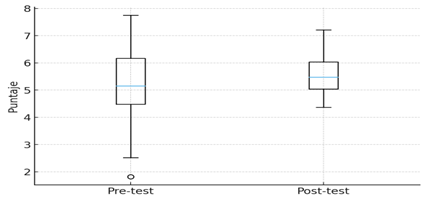
As can be observed in figure 1, prior to the intervention, there was greater dispersion (median = 5,15), given that the scores were more heterogeneous and included students with considerably low performance levels. In contrast, following the intervention, a decrease in dispersion is evident, accompanied by a complete shift toward higher scores (median = 5,48). That is, there was reduced variability, resulting in more uniform performance and generally higher scores—an indication that the methodology employed enhanced learning, strengthened content comprehension, and helped to standardize academic achievement within the group. Upon calculating the effect size (Cohen’s d), the result was 0,74; this corresponds to a MEDIUM-TO-LARGE effect, falling very close to the threshold for a large effect (>0,8). This implies that the effect was not only statistically significant (*p* < 0,05) but also educationally significant, demonstrating a robust effect size.
|
Figure 1. Comprehensive assessment of learning |
|
|
|
Note: the figure appears in its original language |
Engagement with the wider community is an integral part of Chile’s National Higher Education Quality Assurance System and constitutes a university activity with a specific and measurable impact (Irarrázaval, 2020). In this regard, engagement activities—such as those undertaken by the UACh’s IAHP with schools and high schools within the university’s catchment areas—enable the university to contribute to the local development of these territories. The UACh is the only academic institution in the entire southern Chilean territory—comprising the regions of Los Ríos, Los Lagos, Aysén, and Magallanes—that possesses biological specimens for the teaching of Human Anatomy (Urdaneta et al., 2024).
Therefore, the opportunity for high school students to experience observing and handling cadaveric specimens—resources not available in their own schools—represents a unique opportunity to enhance the teaching of Anatomy. In this way, it is expected that they will gain a deeper understanding of the composition of the human body, particularly within a university setting that prepares them for their future years as tertiary-level students. These findings align with the results of a study conducted in the United States, in which the authors argue that outreach programs provide high school students with the opportunity to interact directly—in a close and informal manner—with medical students and highly qualified professionals, an experience that is novel for the majority of them (Zhang et al., 2016).
In this regard, Vallabhajosyula et al. (2024) note that structured outreach activities offer high school students unique opportunities to experience a preclinical learning environment within a medical school, deepen their understanding of the structure and function of the human body, and boost their motivation and interest in science. Furthermore, these outreach programs can lay the groundwork for prospective students to pursue training in the health professions. Zhang et al. concur with this view. (2016), who found that outreach programs offered by medical schools provide local high school students with the opportunity to learn about science, life, and medical education, helping them not only to enhance their learning but also to model professionalism by providing role models and encouraging them to consider opportunities in the health professions.
For their part, Lampert and Russo (2019) state that this type of intervention is highly motivating for students, who often tend to show resistance toward the study of Biology. Furthermore, curricular content regarding Anatomy and Physiology must be adequately developed within high school Biology courses, given that understanding both bodily structures and their functions is vital for students to gain awareness of what occurs within the organism in response to various situations, thereby providing them with a more solid foundation for navigating daily life.
Knowledge of anatomy provides high school students not only with an understanding of their own bodies—a fundamental aspect for recognizing the changes that occur over time—but also with an awareness of specific changes resulting from shifts in dietary habits or lifestyles, the diverse possibilities of pleasure and desire, as well as the various forms of intervention that enable structural changes (Pinheiro de Oliveira et al., 2024).
Much like in Chile, in countries such as Spain, Anatomy is integrated as a mandatory subject within secondary education; moreover, the curriculum includes aspects related to developing proficiency in the use of information and communication technologies, scientific research processes, and collaborative investigative work (Vázquez-Alonso & Manassero-Mas, 2017). Within the context of science education at the secondary level—where anatomy is typically approached with curiosity and enthusiasm—didactic tools play a fundamental role in fostering broader, more visual, and more universally accessible engagement with anatomical knowledge (Pinheiro de Oliveira et al., 2024).
Mirroring the findings of the present study, research conducted by Fernández-Laso (2023) involving Spanish secondary school students revealed that—through the application of active learning methodologies such as problem-based learning—the results of knowledge assessments administered both before and after a workshop demonstrated a marked improvement in student competence following the completion of the pedagogical intervention. In general, although the students possessed a solid foundation in Human Anatomy—encountering no major difficulties in identifying skeletal elements—they successfully acquired new knowledge following the workshop and enhanced their proficiency in grasping the practical utility of these structures within forensic identification processes. Another aspect highly valued by the students was the functional significance of these structures; these results align with those of a Spanish study, which found that students’ perceptions emphasized aspects related to the ability to comprehend the importance of what they had learned and to recognize how they could utilize or apply it, thereby achieving meaningful learning (Fernández-Laso et al., 2023).
The fact that the practical sessions were interactive—allowing students to handle actual bones and cadaveric specimens—was highly appreciated by the students themselves and demonstrated a significant improvement in their grasp of content related to the skeletal system. These findings align with the results of a Colombian study that employed a flipped classroom strategy for teaching and learning the skeletal system; in that study, life-size bone models successfully captured students’ attention from the very outset, making them feel more enthusiastic and motivated to engage with something different from their usual routine (Cantero Ariza & Contreras Álvarez, 2023).
Similarly, a study conducted in Brazil found that secondary school students showed greater interest in topics related to the reproductive and locomotor systems, making these subjects easier for them to learn—in contrast to content regarding the endocrine or nervous systems, where students encountered greater difficulties. To a large extent, this disparity arose from the need to expand practical sessions, given that the latter topics are ones that either fail to generate immediate interest or cannot be as easily observed in everyday life (Pinheiro de Oliveira et al., 2024). This result mirrors the findings of the present study, in which the highest error rates on the administered assessments were observed in questions related to the nervous system.
Furthermore, it is well recognized that the teaching of anatomy is complicated by various limitations within the learning environment, as well as by the difficulty of tailoring educational content to students’ varying levels of preparation and the inherent complexity of the subject’s specific terminology and concepts (Satoh et al., 2023). According to Araujo-Cuauro (2025), one of the primary challenges facing educators who teach this subject is gaining a better understanding of the personal factors that influence individual student success within the classroom; in this context, motivation within the educational process serves as an essential component for achieving high-quality education, fostering effective learning, and promoting the holistic development of students.
Along these lines, García-Barrios et al. (2023) argue that new generations of “digital native” students have created a need to implement innovative teaching methodologies—such as gamification and game-based learning—in which the student becomes an active and participatory agent in their own learning process. This strategy would help address the lack of motivation observed among secondary education students or those in non-medical fields, where instructors often face student dissatisfaction because students perceive this subject as complex and lacking any significant relevance to them (Geribaldi-Doldán et al., 2023).
In the case of this specific intervention, real anatomical specimens were utilized; this provides students with a higher level of interaction and yields a positive impact, given the direct contact with anatomical reality. In this regard, Oening et al. (2025) report that the use of real anatomical specimens—facilitated by student mentors—fosters knowledge construction and sparks student interest in the health sciences, while simultaneously developing interpersonal skills and integrating adolescents into the university environment through anatomical instruction. Nevertheless, this type of material presents certain limitations, as its use requires strict adherence to personal protective measures, given that it exposes students to biological and chemical hazards (López Albors et al., 2021).
Furthermore, the use of educational resources has become imperative for science instruction in secondary education; in this regard, forging links between the educational sector and universities would make it possible to provide schools with educational resources for their teachers to incorporate into the teaching-learning process. These resources should facilitate content comprehension, stimulate creativity, and foster active student participation, while simultaneously enabling teachers to diversify and complement their pedagogical strategies—including the adoption of active learning methodologies (Delgado Ruiz et al., 2023).
In this specific context, the IAHP houses a digitization and 3D printing laboratory where anatomical models can be printed based on actual specimens; this facility allows for the creation of anatomical models suitable for use in a variety of instructional strategies (Urdaneta et al., 2024). These three-dimensional models are hosted on a website that functions as an Open Educational Resource (OER), which could also be integrated into the educational strategies employed in secondary education (Tiznado-Matzner et al., 2020).
As demonstrated, this type of university extension initiative—beyond merely fostering connections between the university and its surrounding environment—proves immensely enriching for both the university community and the secondary schools within its catchment area. This is because such initiatives facilitate the transfer of knowledge and allow students from rural communities—such as the one to which the study participants belong—to experience and engage firsthand with the academic work and culture of a university.
Moreover, by participating in this intervention, university students themselves derive significant benefits; the experience enriches their personal knowledge base, helps them develop interpersonal communication skills, fosters a heightened awareness of their social environment, and enhances their perspective on social responsibility. Ultimately, this translates into the acquisition of knowledge and skills that will prove invaluable during their future professional careers (Osorio-Cerda & Benavides-Simon, 2025). Nevertheless, the study had some limitations, such as the small sample size, the wide variation among the participating students, and the heterogeneity in the degree of difficulty of the content addressed.
CONCLUSIONS
The educational intervention conducted had a significant impact on the students, resulting in a high level of satisfaction with the program, as well as significantly improved scores on the post-intervention assessment—particularly regarding topics related to osteology. These results allow us to affirm that the educational intervention was highly effective and well-regarded by the students, both in terms of its academic utility—specifically regarding anatomical identification, comprehension, and the composition of bodily structures—and in terms of its instructional quality and interactivity.
Furthermore, given that community engagement is one of the core functions of universities, the IAHP at the UACh views its partnership with educational institutions within the Los Ríos region as a vital avenue for sharing academic knowledge with secondary school students. These students are required, under the national curriculum, to study human anatomy topics within their Biology courses. Moreover, this initiative presents an opportunity to forge alliances that could, in the future, lead to the establishment of permanent networking and engagement programs. Such programs would benefit both the educational institutions and the universities involved, while also facilitating the implementation of new educational strategies and innovations, as well as the provision of 3D-printed models and anatomical aids to bolster science laboratories in secondary schools.
Consequently, it is recommended that this study be continued, with an expanded sample size and a scope narrowed to specific areas of the discipline—such as the musculoskeletal system or the reproductive system—topics that tend to spark greater interest among students. Likewise, it would be valuable to replicate and implement this type of intervention on a larger scale, encompassing a greater number of educational institutions and students across the southern macro-zone of Chile—the region where the UACh maintains a presence. Such experiences could generate new knowledge and empirical evidence contributing to curricular renewal and transformation, ultimately fostering enhanced learning and the holistic development of students.
REFERENCES
Abella, S., & Rodríguez Malebrán, M. (2024). Sistemas del cuerpo humano: educación STEAM mediante el uso de la realidad aumentada con estudiantes de secundaria en Colombia y Chile. Bio-grafía, 16(Extraordinario). https://revistas.upn.edu.co/index.php/bio-grafia/article/view/21769/14063
Araujo-Cuauro, J. C. (2025). Anatomía humana: estudiantes desmotivados para estudiarla o docentes poco motivados para enseñarla. Revista Panamericana de Morfología, 3 (10), 96 – 109. https://sociedadmexicanadeanatomia.com/wp-content/uploads/2025/09/Anatomia-humana-estudiantes-desmotivados-para-estudiarla-o-docentes-poco-motivados-para-ensenarla.pdf
Baena-Extremera, A. & Granero-Gallegos, A. (2012). Los mapas conceptuales y el aprendizaje basado en problemas en el aprendizaje de contenidos anatómico-fisiológicos en opositores al cuerpo de profesores de educación secundaria. International Journal of Morphology, 30(1), 230 - 237. https://dx.doi.org/10.4067/S0717-95022012000100041
Baena-Extremera, A., & Granero-Gallegos, A. (2013). Using iBook in teaching anatomy content in secundary education. International Journal of Morphology, 31(2), 505-511. https://dx.doi.org/10.4067/S0717-95022013000200024
Cantero Ariza, J. D., & Contreras Álvarez, M. A. (2023). Flipped Classroom o Aula Invertida con simuladores interactivos para el aprendizaje de la biología en educación básica secundaria [Trabajo de grado de licenciatura, Universidad de Córdoba]. Repositorio Institucional Universidad de Córdoba. https://repositorio.unicordoba.edu.co/server/api/core/bitstreams/5e3074df-d013-40e7-832a-6ce4c1c7354a/content
Delgado Ruiz, M. C., Bernal Sánchez, R., López Albors, O. & Latorre-Reviriego, R. (2023). Órganos plastinados: recursos para una propuesta de innovación educativa STEM en educación secundaria. Revista Interuniversitaria de Investigación en Tecnología Educativa , 15, 103-119. https://doi.org/10.6018/riite.575831
dos Santos, F. S., Gonçalves, R. F. P., Moraes, T. C. M., Schwab, E. J., Tomalak, C., Strugal, D., & Ryzy, C. R. (2021). Projeto de extensão: Laboratório de anatomia humana como ferramenta de ensino e aprendizagem - Relato de Experiência. Brazilian Journal of Development, 7(12), 116083–116092. https://doi.org/10.34117/bjdv7n12-391
García-Barrios, A., Cisneros-Gimeno, A., Benito-Rodríguez, J., Luesma-Bartolome, M., Barrio-Ollero, E. & Whyte-Orozco J. (2022). Gamificación en la enseñanza de la Anatomía Humana. En: Ribera-Puchades, J. M.& Sáenz De Jubera-Ocón, M.M. (Eds.) La innovación como motor para la transformación de la enseñanza universitaria, 151-156. https://dialnet.unirioja.es/descarga/articulo/8527509.pdf
García-Barrios, A., Cisneros-Gimeno, A.I., Benito-Rodríguez, J., Latorre-Pellicer, A., & Whyte-Orozco, J. (2023). Nuevas formas de motivación en la enseñanza de la anatomía humana. FEM: Revista de la Fundación Educación Médica, 26(6), 255-259. https://dx.doi.org/10.33588/fem.2606.1311
Geribaldi-Doldán, N., Verástegui-Escolano, C., Rosety-Rodríguez, I., Sánchez-Gomar, I., & Castro-González, C. (2023). Nuevas técnicas docentes en anatomía humana para estudiantes de ciencias de la actividad física y deporte. Campus Virtuales, 12(1), 121-131. https://doi.org/10.54988/cv.2023.1.1114
Giler-Medina P., Giler-Medina C. & Medina-Gorozabel G. (2024). Uso del atlas 3D en el aprendizaje de la anatomía humana en estudiantes de bachillerato. Revista Sociedad & Tecnología, 7(2), 146-162. https://doi.org/10.51247/st.v7i2.421
González La Nuez O. & Suárez Surí G. (2018). Los medios de enseñanza en la didáctica especial de la disciplina anatomía humana. Revista Médica Electrónica, 40(4), 1126-1138. http://scielo.sld.cu/scielo.php?script=sci_arttext&pid=S1684-18242018000400018
Granero-Gallegos, A. & Baena-Extremera, A. (2015). Diseños de aprendizaje basados en las TIC (Moodle 2.0 y Mahara) para Contenidos de anatomía, fisiología y salud en las clases de educación física escolar. International Journal of Morphology, 33 (1), 375 - 381. https://dx.doi.org/10.4067/S0717-95022015000100059
Fernández-Laso, M. C., Amores, A. & Viciano, J. (2023). Aprendizaje basado en problemas para enseñar antropología forense en educación secundaria. ALTERIDAD. Revista de Educación, 18(2), 198-210. https://doi.org/10.17163/alt.v18n2.2023.04
Irarrázaval, I. (2020). La vinculación universitaria con el medio y los mecanismos de reconocimiento académico. Calidad en la educación, (52), 296 - 323. https://dx.doi.org/10.31619/caledu.n52.816
Jiménez Cabrera, B. D. (2025). Aprendizaje móvil y anatomía humana: ¿Una solución efectiva para la educación pública ecuatoriana?. Neosapiencia. 3(2), 69-93. https://doi.org/10.64018/neosapiencia.v3i2.41
Lampert D. & Russo M. Un enfoque CTS en el abordaje de anatomía y fisiología animal en la escuela secundaria. Indagatio Didactica, 11 (2), 727 - 735. https://doi.org/10.34624/id.v11i2.6676
López Albors, O., Gil Cano, F., & Latorre Reviriego, R. (2021). Órganos plastinados como recurso de innovación docente en biología de educación secundaria. EDUCA. Revista Internacional Para La Calidad Educativa, 2(1), 86-99. https://revistaeduca.org/educa/article/view/8
Ministerio de Educación, República de Chile (MINEDUC). (2009). Objetivos Fundamentales y Contenidos Mínimos Obligatorios de la Educación Básica y Media Actualización 2009. Unidad de Currículum y Evaluación. https://peib.mineduc.cl/wp-content/uploads/2018/05/Objetivos-fundamentales-y-contenidos-mi%CC%81nimos-obligatorios-de-la-educacio%CC%81n-Actualizacio%CC%81n-2009-.pdf
Ministerio de Educación, República de Chile (MINEDUC). (2018). Ley 21.091 sobre Educación Superior https://www.mineduc.cl/organigrama/edusup/normativas/Ley-21091_29-MAY-2018.pdf
Oening, M. I., Casadei, J. C. de O., Nasimoto, G. G., Sovierzoski, M. F. V., Jasinski, R. G., Aguiar, J. R. N. de, Oda, S. L., Teleginski, J. F., Rokiskei, L., Wung, S. C. Y., Santos, G. G. A. dos, & Monteiro, D. K. (2025). Educação em anatomia humana como estratégia de promoção de saúde: Relato de experiência em ações educativas para estudantes de ensino médio e técnico em um museu de anatomia universitário. Revista Foco, 18(7), e9125. https://doi.org/10.54751/revistafoco.v18n7-150
Osorio Cerda, J. M., & Benavides Simon, M. (2025). Experiencia de la Vinculación con el medio en las Instituciones de Educación Superior en Miami y su aplicabilidad en el contexto chileno. Revista TSup (Transformación Superior), 1(2), 94-105. https://doi.org/10.53382/issn.2810-7977.40
Pinheiro de Oliveira, C. S., Oliveira Brito, S. de, Ayala Giménez, C. E., & Ayala, R. (2024). La anatomía en la enseñanza de las ciencias: análisis y comprensión de la percepción de los estudiantes sobre la importancia del cuerpo humano. UNIDA Salud, 3(2), 34–38. https://doi.org/10.69940/sld.20240802
Satoh, M., Fujimura, A., & Miyagawa, S. (2023). Difficulties and innovations in teaching anatomy and physiology in nursing. Nurse education in practice, 67, 103551. https://doi.org/10.1016/j.nepr.2023.103551
Sorrentino, P., Wilke, V., Natta, P., Díaz, J., Romani, P., & Celis, L. (2024). Reflexión sobre la extensión universitaria y sus desafíos actuales. ExT: Revista de Extensión de la UNC, 18. https://revistas.unc.edu.ar/index.php/ext/article/view/47821
Suárez-Escudero, J., Posada-Jurado, M., Bedoya-Muñoz, L., Urbina-Sánchez, A., Ferreira-Morales, J., & Bohórquez-Gutiérrez, C. (2020). Enseñar y aprender anatomía: Modelos pedagógicos, historia, presente y tendencias. Acta Médica Colombiana, 45(4), 48-55. https://doi.org/10.36104/amc.2020.1898
Tiznado-Matzner, G., Bucarey-Arriagada, S., & Lizama-Pérez, R. (2020). Three-dimensional virtual models of 3d-scanned real cadaveric samples used as a complementary educational resource for the study of human anatomy: Undergraduate student’s perception of this new technology. International Journal of Morphology, 38(6), 1686-1692. https://dx.doi.org/10.4067/S0717-95022020000601686
Urdaneta, J. R., Bucarey, S., Tiznado Matzner, G. & cabezas Oyarzún, X. (2024). Estrategias didácticas para la enseñanza de la anatomía humana en la Universidad Austral de Chile. ARS MEDICA Revista De Ciencias Médicas, 49(1), 47–54. https://dx.doi.org/10.11565/arsmed.v49i1.2024
Vallabhajosyula, R., Perumal, V., Chandrasekaran, R., & Mogali, S. R. (2024). Preuniversity students’ perceptions and attitudes about an anatomy and physiology outreach program: Survey study and inductive thematic analysis. JMIR formative research, 8, e52533. https://doi.org/10.2196/52533
Vázquez-Alonso, A. & Manassero-Mas, M. A. (2017). Contenidos de naturaleza de la ciencia y la tecnología en los nuevos currículos básicos de educación secundaria. Profesorado. Revista de Currículum y Formación de Profesorado, 21 (1), 294-312. http://www.redalyc.org/articulo.oa?id=56750681014
Zhang, G., Fenderson, B. A., Veloski, J. J., Livesey, M., & Wojdon-Smith, T. (2016). Medical school anatomy and pathology workshops for high school students enhance learning and provide inspiration for careers in medicine. Academic pathology, 3, 2374289516685323. https://doi.org/10.1177/2374289516685323
FINANCING
The authors did not receive funding for the development of the present research.
CONFLICT OF INTEREST STATEMENT
The authors declare that there is no conflict of interest.
STATEMENT OF ARTIFICIAL INTELLIGENCE USE
AI was not used in the development of the article.
AUTHORSHIP CONTRIBUTION
Conceptualization: José Ramón Urdaneta.
Data curation: Ximena Cabezas-Oyarzun and Pía Urrutia.
Formal analysis: José Ramón Urdaneta and Ximena Cabezas-Oyarzun.
Investigation: José Ramón Urdaneta, Pía Urrutia, and Gonzalo Tiznado-Maztner.
Methodology: José Ramón Urdaneta and Sandra Bucarey.
Project administration: José Ramón Urdaneta and Sandra Bucarey.
Software: Ximena Cabezas-Oyarzun and Gonzalo Tiznado-Maztner.
Supervision: José Ramón Urdaneta.
Validation: José Ramón Urdaneta and Sandra Bucarey.
Visualization: Ximena Cabezas-Oyarzun and Sandra Bucarey Arriagada.
Writing – original draft: José Ramón Urdaneta and Sandra Bucarey.
Writing – proofreading and editing: José Ramón Urdaneta and Sandra Bucarey.