doi: 10.58763/rc2026565
Scientific and technological research article
TIHA: Un modelo para la inspiración y humanización del aprendizaje en la educación universitaria
TIHA: A Model for the Inspiration and Humanization of Learning in Higher Education
Mariluz Serrano-Ortiz1  *
*
RESUMEN
Introducción: El estudio tuvo como objetivo proponer y describir el modelo TIHA para humanizar el aprendizaje digital en educación superior.
Metodología: Se realizó una investigación cualitativa fenomenológica descriptiva con entrevistas semiestructuradas a docentes universitarios, analizadas mediante codificación temática y triangulación.
Resultados: Se identificaron tensiones entre eficiencia tecnológica y bienestar socioemocional, así como necesidades de personalización ética, acompañamiento y alfabetización crítica en IA; de estos hallazgos emergieron principios y componentes operativos del modelo.
Conclusiones: TIHA articuló inteligencia artificial, acompañamiento emocional y personalización ética como una estructura pedagógica replicable para diseñar experiencias significativas, inclusivas y responsables.
Aporte original: El modelo TIHA contribuyó al debate latinoamericano sobre la humanización de la educación digital al ofrecer una ruta práctica de implementación.
Palabras clave: Aprendizaje electrónico, educación superior, humanización, inteligencia artificial, tecnología educacional, transformación digital.
Clasificación JEL: I23, O3, O33.
ABSTRACT
Introduction: This study aimed to propose and describe the TIHA model for humanizing digital learning in higher education.
Methodology: A qualitative descriptive phenomenological design was employed, using semi-structured interviews with university educators; data was analyzed through thematic coding and triangulation.
Results: Findings revealed tensions between technological efficiency and socio-emotional well-being, and highlighted the need for ethical personalization, meaningful accompaniment, and critical AI literacy. These insights informed the model’s guiding principles and operational components.
Conclusions: TIHA integrates artificial intelligence, emotional accompaniment, and ethical personalization into a replicable pedagogical structure for designing meaningful, inclusive, and responsible learning experiences.
Original contribution: The TIHA model proposes a replicable pedagogical structure that connects artificial intelligence, emotional accompaniment, and ethical personalization, contributing to Latin American discussions on the humanization of digital education.
Keywords: Artificial intelligence, digital transformation, e-learning, educational technology, higher education, humanization.
JEL Classification: I23, O3, O33.
Received: 12-08-2025 Revised: 08-11-2025 Accepted: 15-12-2025 Published: 02-01-2026
Editor:
Alfredo Javier Pérez Gamboa
1Universidad de Puerto Rico Recinto de Río Piedras. San Juan, Puerto Rico
Cite as: Serrano-Ortiz, M. (2026). TIHA: Un modelo para la inspiración y humanización del aprendizaje en la educación universitaria. Región Científica, 5(1), 2026565. https://doi.org/10.58763/rc2026565
INTRODUCTION
The rapid digital transformation currently underway in higher education institutions across Latin America has underscored the need for pedagogical models that integrate emerging technologies without compromising the human dimension of learning. In this context, universities and training centers have faced tensions between technological efficiency, automation, and the holistic development of their student bodies, particularly in public institutions characterized by access gaps, resource scarcity, and deep socio-educational inequalities. Recent studies in the region warn that the integration of artificial intelligence (AI) into educational systems must be accompanied by ethical principles, support strategies, and person-centered approaches to avoid perpetuating existing inequities (Jardón Gallegos et al., 2024; UNESCO, 2023, 2024).
Against this backdrop, pedagogical models are emerging that seek to strike a balance between technological innovation and the humanization of learning. Among these, the Tecnologías para la Inspiración y Humanización del Aprendizaje (TIHA) [Technologies for the Inspiration and Humanization of Learning] framework stands as a Latin American proposal that integrates AI, emotional support, and didactic personalization from a critical perspective—one inspired by theories of meaningful learning, educational phenomenology, and humanistic pedagogy (Freire, 1970; Rogers, 1983; Moustakas, 1994). The TIHA model was developed to address the needs of first-generation students, diverse populations, and institutional contexts facing structural limitations, prioritizing well-being, autonomy, and the construction of emotionally meaningful educational experiences. The purpose of this article is to analyze the application of the TIHA model within university programs and institutional digital transformation processes across the Latin American public sector. To this end, the study examines the integration of an AI-driven conversational assistant ([1]BOT-TIHA) into university courses, student support activities, and academic guidance initiatives. This analysis is situated within the regional need to strengthen digital competencies, promote AI literacy, and develop pedagogical practices that combine technological innovation with humanistic approaches (Bolaño-García & Duarte-Acosta, 2024; Nivela Cornejo et al., 2024).
The scope of this research encompasses experiences developed within undergraduate and continuing education programs, as well as contributions generated in international academic forums related to AI ethics and digital education. The study’s relevance lies in the urgent need to generate replicable models that enable public institutions to incorporate technologies in an ethical, responsible, and human-centered manner, thereby fostering organizational cultures that are more inclusive and emotionally sustainable. Through this case study, the aim is to contribute to the academic discourse regarding how AI can be utilized to personalize learning without dehumanizing it—an objective aligned with the Sustainable Development Goals and with international recommendations for the ethical use of educational technologies (Banco Mundial, 2023; Icaza Ronquillo et al., 2024; Naciones Unidas, s.f.).
THEORETICAL FRAMEWORK
The educational practice of TIHA was implemented within the University of Puerto Rico (UPR), specifically in the School of Business Administration, in conjunction with teacher training projects in the public education system, as well as partnerships with private companies. This institutional framework facilitated a dialogue between academia, formal and informal education, and the emerging needs of various social sectors. The main purpose of the study was to offer a methodological model that integrates artificial intelligence (AI) in a humanistic and personalized manner, addressing both the quality of learning and the emotional and motivational well-being of students. Complementarily, the study also sought to validate the relevance of the TIHA practice in diverse settings, considering its impact on teacher training and its potential for application in hybrid and asynchronous contexts.
Recent literature provides evidence supporting this convergence. For example, it has been documented that educational chatbots promote personalized support, increase the sense of belonging, and improve learning in hybrid environments (López López, 2023). Likewise, the introduction of metacognitive strategies in blended learning environments supported by AI is associated with higher levels of participation and retention (Castillejos López, 2022). At the macro level, institutions such as the Banco Mundial (2023) highlight the relevance of inclusive and personalized pedagogical models in Latin America, especially in university contexts marked by diversity.
Under these premises, Serrano-Ortiz’s (2024) contribution constitutes a central reference point within this framework by proposing TIHA as a paradigm that seeks to balance technological innovation, humanistic education, and educational quality. This model does not conceive of AI solely as a tool for efficiency, but as a resource at the service of creativity, autonomy, and intrinsic motivation. Therefore, innovative educational practice is grounded in the conviction that humanizing educational technology means ensuring that digital tools support the construction of meaning, personal development, and the strengthening of learning communities. Consequently, the application of TIHA promotes adaptability, permeability, and inclusion, enabling diversity, widespread adoption, and the convergence of multiple institutions, populations, and educational settings.
From a theoretical perspective, this study is grounded in three main conceptual axes:
a) Educational artificial intelligence as a mediator of personalized learning.
b) Humanistic pedagogy, centered on the person, dialogue, and the meaning of learning (Freire, 1970; Rogers, 1983).
c) The humanization of digital learning, understood as the conscious integration of cognitive, emotional, and ethical dimensions within technology-mediated environments.
These key areas allow us to understand the TIHA model not only as a technological proposal, but also as a comprehensive pedagogical framework that guides the design, implementation, and evaluation of AI-mediated educational experiences, and that directly engages with the categories analyzed in the study’s findings.
METHODOLOGY
The study’s methodology was developed within a qualitative-interpretive framework, with the aim of gaining an in-depth understanding of the experiences, perceptions, and meanings attributed by teachers and students regarding the use of generative artificial intelligence based on the TIHA model. In line with this paradigm, educational reality is conceived as a social construction mediated by the meanings that actors attribute to their experiences, emphasizing subjectivity and the researcher’s immersion in the studied context (Vain, 2012). Likewise, a descriptive phenomenological approach based on Moustakas (1994) was adopted, derived, and adapted from the analytical procedures employed in the author’s doctoral research (Serrano-Ortiz, 2024). The research had a descriptive–interpretive scope and an applied research character, as it sought to address a specific issue in the Latin American university context: the need to integrate emerging technologies without dehumanizing learning processes.
Participants
The study was conducted at the Universidad de Puerto Rico, Recinto de Río Piedras, specifically in university courses and continuing education programs related to digital transformation and artificial intelligence literacy. Participants included university students and professionals enrolled in continuing education programs from five main academic fields:
1. Certification Course – New Technologies and Artificial Intelligence: Challenges and Opportunities in the Workplace: designed for professionals and employees from various sectors interested in understanding the impact of artificial intelligence on organizational processes, decision-making, and the development of digital skills for 21st-century work. This course also provided an opportunity to analyze the application of the TIHA model in non-strictly academic settings, expanding its scope to include workplace and continuing education contexts.
2. GEOF 4145 – Emerging Technologies (Division of Continuing Education, “Certify and Evolve” Program): Composed of public school teachers from the Puerto Rico Department of Education. These professionals analyzed the impact of the TIHA model within their respective fields of specialization, designing proposals for its application in hybrid school environments.
3. GEOF 4145 – Emerging Technologies (Faculty of Business Administration): Composed of undergraduate students in their third through fifth years, who explored the possibilities of TIHA as a framework for supporting creativity, productivity, and ethical leadership in business contexts.
4. INCO 4104 – Business Communication, Augmented Reality, and Webinars: Comprising third- through fifth-year university students who applied the principles of TIHA in the development of communication projects, digital presentations, and learning experiences mediated by artificial intelligence.
5. Course on Artificial Intelligence Applied to Project Management: aimed at professionals involved in the planning, coordination, and execution of projects. In this educational setting, the TIHA model was utilized to support processes related to management, problem-solving, work organization, and ethical reflection regarding the use of AI in managerial environments.
The sample was purposive, comprising approximately 98 participants selected based on their direct involvement in AI-mediated educational experiences and their active use of the TIHA model. The groups included first-generation university students, pre-service teachers, and participants with varying levels of digital literacy, which allowed for the observation of the model’s adaptability to heterogeneous profiles.
Inclusion and Exclusion Criteria
The inclusion criteria were as follows:
• Be enrolled in, or actively participating in, one of the courses or training programs in which the TIHA model was implemented.
• Have interacted with the BOT-TIHA during the course or training activity.
• Voluntarily agree to participate in the study through informed consent; in the case of academic reflections, explicitly authorize their use for research purposes.
Exclusion criteria included:
• Participants who did not complete the minimum activities required to interact with the BOT-TIHA assistant.
• Incomplete or inconsistent responses in the data collection instruments that precluded their analysis.
Data collection materials and instruments
Multiple data collection techniques were employed to facilitate triangulation and methodological rigor:
• Perception questionnaires, designed to gather qualitative and descriptive information regarding motivation, clarity of learning, emotional support, self-management, and ethical perceptions regarding the use of AI.
• Analysis of interactions with the BOT-TIHA, including usage logs, types of queries, generated feedback, and associated reflections.
• Written reflections on assigned tasks, produced by students as part of reflective academic activities linked to the use of the TIHA model and the BOT-TIHA. These reflections provided access to in-depth narratives regarding experiences of support, motivation, self-management, and ethical perceptions concerning the use of artificial intelligence within the learning process.
• Digital rubrics and academic products, utilized as complementary evidence of the learning process.
The instruments were specifically designed for this study and aligned with the theoretical dimensions of the TIHA mode.
Procedures and phases of the study
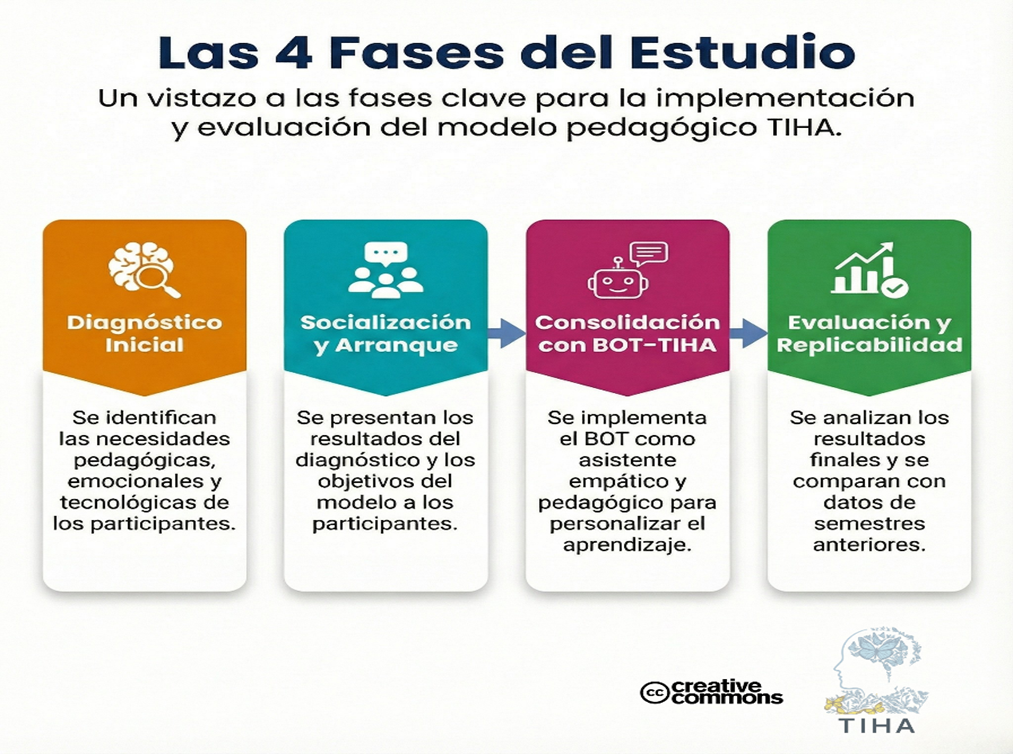
The study was conducted in four phases:
1. Initial Diagnosis: Administration of questionnaires, participatory observation, and documentation of teaching experiences to identify pedagogical, emotional, and technological needs.
2. Socialization and Initial Intervention: Presentation of diagnostic results and explanation of the TIHA model’s objectives to the participants.
3. Consolidation: Implementation of the BOT-TIHA as an empathetic and pedagogical assistant, integrating personalized activities and spaces for self-reflection.
4. Evaluation and Replicability: Collection of final perceptions, analysis of academic products, and descriptive comparison with data from previous semesters.
With the aim of visually synthesizing the methodological procedure, figure 1 presents the four phases of the study, which guided the implementation and evaluation of the TIHA pedagogical model across the various educational and continuing education contexts analyzed.
Although this study was not structured around a rigid methodological model designed specifically for this implementation, the analytical approach adopted is based on validated qualitative procedures previously used by the author in her doctoral research (Serrano-Ortiz, 2024). In this regard, the analysis was grounded in a contextual adaptation of the descriptive phenomenological approach, prioritizing epistemological coherence, interpretive depth, and consistency in the coding and triangulation processes, rather than the mechanical replication of a closed formal design. This methodological decision responds to the applied nature of the study and the need to capture real educational experiences in dynamic contexts of pedagogical innovation mediated by artificial intelligence.
|
Figure 1. The Four Phases of the Study for the Implementation and Evaluation of the TIHA Model |
|
|
|
Source: own elaboration. Infographic created based on the study’s methodological design. Generated with the assistance of NotebookLM and edited by the author in Canva Pro. Note: the figure appears in its original language. |
Methods and techniques of analysis
The qualitative data were analyzed using content analysis and thematic coding, inspired by the modified Stevick–Colaizzi–Keen method proposed by Moustakas (1994) and adapted to the contextual characteristics of this applied research. The process included the following stages:
1. A thorough review of the responses, participant observations, and interactions.
2. Identification of units of meaning.
3. Grouping into emerging categories (motivation, support, autonomy, trust, ethical perception).
4. Development of textual and structural descriptions of the phenomenon.
The written reflections produced as part of the assigned tasks were incorporated into the qualitative analysis corpus, treated as narrative documents, and analyzed using thematic coding. These narratives made it possible to identify units of meaning related to the participants’ subjective experience of interacting with the TIHA model and the BOT-TIHA, thereby enhancing the interpretive depth of the study.
Therefore, triangulation was achieved by integrating three main sources: teacher narratives, student perceptions, and interactions with the BOT-TIHA. In addition, basic descriptive analyses of quantitative data (frequencies and percentages) from the questionnaires were incorporated to reinforce the qualitative interpretation.
Ethical considerations
The academic reflections used for research purposes came exclusively from participants who voluntarily agreed to take part in the study by providing informed consent. It was ensured that these texts were used strictly for research purposes, that their use did not influence academic evaluation, and that the data were anonymized to protect the participants’ identities.
Likewise, transparency was maintained regarding the use of artificial intelligence tools, which were employed as pedagogical and organizational support. At the same time, the analysis, interpretation of data, and academic writing were the responsibility of the author.
RESULTS
Qualitative empirical evidence from the voices of the participants
An analysis of the open-ended responses to the questionnaire (n = 9), along with the written reflections and academic work produced in the GEOF 4145 and INCO 4104 courses and in the certification course, revealed consistent patterns regarding the impact of the TIHA model and the BOT-TIHA assistant.
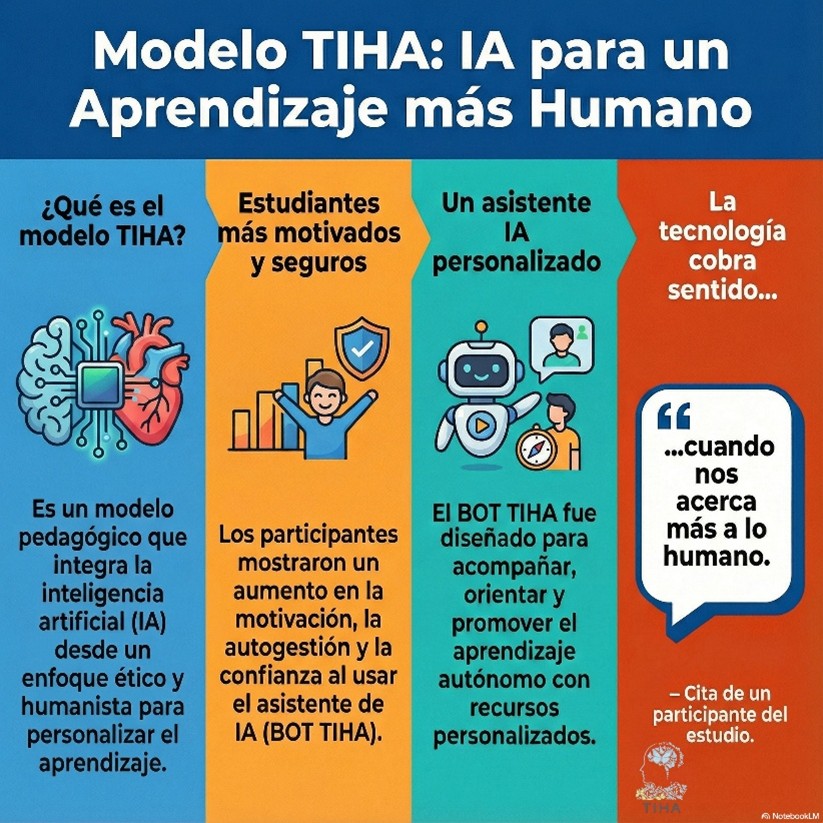
Regarding personalization and support for academic and professional performance, participants highlighted the usefulness of artificial intelligence as an everyday support resource. One student noted that “we can rely on AI to assist us in our daily tasks, inquiries, and searches” (Participant 3). At the same time, another stated that the BOT-TIHA allowed them to “make work easier, but always keeping ethics in mind when using it” (Participant 4). These statements demonstrate a conscious adoption of the technology, aligned with the ethical approach of the TIHA model. To visually synthesize the emerging findings and facilitate an integrated understanding of the TIHA model’s impact, Figure 2 presents a conceptual representation of humanized learning mediated by artificial intelligence. This infographic articulates the pedagogical and human dimensions identified in the participants’ narratives, highlighting how personalization, empathetic support, and the ethical mediation of AI converge to create more meaningful learning experiences.
|
Figure 2. TIHA Model: AI for more human-like learning |
|
|
|
Source: own elaboration. Infographic created based on the study’s findings. Generated with the assistance of NotebookLM and edited by the author in Canva Pro. Note: the figure appears in its original language. |
Likewise, a strong motivation for exploration and technological curiosity emerged, even among participants who initially expressed uncertainty about the use of AI. One participant stated: “AI creates a lot of uncertainty regarding its usefulness, but I was motivated to explore and use it to decide whether it is suitable for me and my work environment” (Participant 5). This finding confirms that pedagogical and emotional support fosters a willingness to learn and reduces initial resistance.
From a professional and pedagogical perspective, participating teachers recognized the transformative impact of AI on their practice. One teacher noted: “Recognizing and applying how the use of AI can improve and positively transform my work performance as a teacher” (Participant 6). Similarly, another participant highlighted the direct applicability of learning in both personal and professional contexts: “Applying what I’ve learned in my personal and professional life” (Participant 8).
The more extensive narrative reflections, developed as academic assignments, delved into the human and emotional dimensions of the TIHA model. One student noted that the BOT-TIHA “would humanize the processes, since there are things one learns and assimilates better when they are explained verbally and one is given the opportunity to question the topic more thoroughly,” highlighting the importance of dialogue, active listening, and adaptation to individual learning styles. Another participant stated that “technology makes sense when it brings us closer to what is human,” explicitly summarizing the central principle of the TIHA model.
Taken together, this empirical evidence confirms that the impact of the TIHA model transcends technical efficiency, positioning artificial intelligence as a mediator of personalized, ethical, and emotionally meaningful learning processes.
|
Table 1. Categories emerging from the qualitative analysis of reflections and questionnaires |
||
|
Category |
Subcategory |
Empirical evidence (representative quote) |
|
Personalization of learning |
Support for tasks and organization |
“We can rely on AI to assist us with our daily tasks, inquiries, and research.” |
|
Ethics in the use of AI |
Conscious and responsible use |
“It facilitates our work, yet we must always keep ethics in mind when using these tools.” |
|
Motivation and curiosity |
openness to exploring technologies |
“It motivated me to explore and experiment with them to determine whether they are suitable for me and my work environment.” |
|
Professional impact |
Improvement of teaching performance |
“The use of AI can enhance and positively transform my professional performance as a teacher.” |
|
Humanization of learning |
Emotional support and dialogue |
“Technology truly finds its purpose when it brings us closer to what is human.” |
|
Note: The quotes correspond to anonymized responses from participants in university courses and continuing education programs (n = 98 total; representative examples selected). |
||
CONCLUSIONS
This research demonstrated that integrating the TIHA model and using the BOT-TIHA constitutes a viable and relevant approach to humanizing AI-mediated educational processes. Based on the qualitative analysis conducted, the results confirm that it is possible to design learning experiences in which technology supports, accompanies, and complements educational processes, without replacing the essential role of the teacher as an ethical, emotional, and pedagogical mediator.
The findings indicate that students benefited from better-organized learning, continuous support, and educational pathways tailored to their needs, which strengthened their autonomy, motivation, and capacity for self-regulation. Similarly, it was found that the BOT-TIHA helped reduce the administrative burden on faculty, allowing them to devote more time to mentoring, qualitative feedback, and the design of learning environments with a greater human touch.
From a methodological perspective, the study highlights that the integration of artificial intelligence in education requires careful, ethical, and person-centered designs. When technology is implemented within humanizing frameworks, it can foster more meaningful, accessible, and personalized educational relationships. However, the results also highlight the need to continue developing more rigorous evaluation mechanisms that allow for more precise measurement of the impact of these models on variables such as academic performance, student retention, and emotional well-being.
In general terms, it is concluded that TIHA offers a replicable and adaptable framework for institutions seeking to incorporate emerging technologies without losing sight of the affective and relational dimensions of learning. Its transformative potential lies in its ability to balance technological innovation with pedagogical sensitivity, reaffirming that the future of education demands models where artificial intelligence and human intelligence operate in a complementary manner.
Finally, priority areas for future research are identified, including: the development of quantitative metrics on a larger scale; the expansion of the TIHA model to other professional fields; the analysis of its impact on vulnerable populations or those facing a digital divide; and the consolidation of institutional strategies that ensure an ethical, safe, and human-centered use of artificial intelligence in education. These projections will enable us to continue strengthening an educational approach that recognizes both the potential of technology and the irreplaceable centrality of the human being in learning processes.
REFERENCES
Banco Mundial. (2023). América Latina y el Caribe reitera su compromiso con el fortalecimiento y recuperación de los aprendizajes básicos. https://www.bancomundial.org/es/news/press-release/2023/03/22/america-latina-y-el-caribe-reitera-su-compromiso-con-el-fortalecimiento-y-recuperacion-de-los-aprendizajes-basicos
Bolaño-García, M., & Duarte-Acosta, N. (2024). Una revisión sistemática del uso de la inteligencia artificial en la educación. Revista Colombiana de Cirugía, 39(1), 51–63. https://doi.org/10.30944/20117582.2365
Castillejos López, B. (2022). Inteligencia artificial y entornos personales de aprendizaje: Atentos al uso adecuado de los recursos tecnológicos de los estudiantes universitarios. Educación, 31(60), 9–24. https://doi.org/10.18800/educacion.202201.001
Nivela Cornejo, M. A., González Suárez, G. E., & Pérez Barrera, H. M. (2024). Transformando la educación: El rol de la inteligencia artificial en la personalización del aprendizaje. Código Científico Revista de Investigación, 5(2), 1314–1338. https://doi.org/10.55813/gaea/ccri/v5/n2/629
Freire, P. (1970). Pedagogy of the oppressed. Continuum.
Icaza Ronquillo, S. T., Martinetti-Guerrero, I. K., & Zambrano-García, A. M. (2024). Impacto de la inteligencia artificial en la personalización del aprendizaje. Código Científico Revista de Investigación, 5(2), 1267–1286. https://doi.org/10.55813/gaea/ccri/v5/n2/627
Jardón Gallegos, M. del C., Allas Chisag, W. D., Zamora Valencia, D. A., & Cedeño Saltos, N. E. (2024). Impacto de la inteligencia artificial en la educación superior: Percepciones de alumnos y profesores sobre el uso de IA en el aprendizaje y la evaluación. Reincisol, 3(6), 7008–7033. https://doi.org/10.59282/reincisol.V3(6)7008-7033
López López, A. (2023). Estudio de un chatbot para entorno educativo como apoyo a alumnado con altas capacidades [Trabajo de fin de grado, Universitat Oberta de Catalunya]. Repositorio Institucional UOC. https://openaccess.uoc.edu/server/api/core/bitstreams/cbe98946-ea8c-46bc-abb5-8043c30ba42d/content
Moustakas, C. (1994). Phenomenological research methods. Sage.
Naciones Unidas. (s.f.). Objetivo 4: Garantizar una educación inclusiva, equitativa y de calidad. https://www.un.org/sustainabledevelopment/es/education/
Rogers, C. R. (1983). Freedom to learn for the 80’s. Charles E. Merrill.
Serrano-Ortiz, M. (2024). Un estudio fenomenológico descriptivo del docente digital del siglo XXI: Sé el profesor que quieres tener [Tesis doctoral, Universidad de Puerto Rico, Recinto de Río Piedras]. ProQuest Dissertations & Theses. https://uprrp.idm.oclc.org/login?url=https://www.proquest.com/dissertations-theses/un-estudiofenomenológico-descriptivo-del-docente/docview/3152816176/se-2
UNESCO. (2023). Global education monitoring report 2023: Technology in education – A tool on whose terms? https://www.unesco.at/en/education/education-2030/global-education-monitoring-gem-report/gem23
UNESCO. (2024). Qué necesita saber acerca del aprendizaje digital y la transformación de la educación. https://www.unesco.org/es/digital-education/need-know
Vain, P. D. (2012). El enfoque interpretativo en investigación educativa: Algunas consideraciones teórico-metodológicas. Revista de Educación, 4, 37–46. https://fh.mdp.edu.ar/revistas/index.php/r_educ/article/view/83
FINANCING
None.
CONFLICT OF INTEREST STATEMENT
The author declares that there is no conflict of interest.
ACKNOWLEDGMENTS
The author expresses her sincere gratitude to MSc. Enrique Corriols Mora, Coordinator of the Latin American Congress on Higher Education—Education with Meaning and Relevance—for his leadership, guidance, and commitment to the dissemination of academic knowledge in the region. Likewise, the support of the Congress’s organizing team is acknowledged; their technical, logistical, and editorial efforts made possible the presentation—and subsequent recommendation for publication—of this work. Their dedication and professionalism were fundamental to the successful completion of this academic process.
STATEMENT ON THE USE OF ARTIFICIAL INTELLIGENCE
The author declares that she utilized generative artificial intelligence tools (ChatGPT – OpenAI – Perplexity – Copilot – Claude) as editorial support for the organization of ideas, linguistic review, and preliminary structuring of the manuscript. These tools were not employed for data generation, results analysis, or the formulation of conclusions. The conceptualization of the study, analysis, interpretation, and final academic decisions remain the sole responsibility of the author.
AUTHORSHIP CONTRIBUTION
Conceptualization: Mariluz Serrano-Ortiz.
Data curation: Mariluz Serrano-Ortiz.
Formal analysis: Mariluz Serrano-Ortiz.
Investigation: Mariluz Serrano-Ortiz.
Methodology: Mariluz Serrano-Ortiz.
Project administration: Mariluz Serrano-Ortiz.
Resources: Mariluz Serrano-Ortiz.
Supervision: Mariluz Serrano-Ortiz.
Validation: Mariluz Serrano-Ortiz.
Visualization: Mariluz Serrano-Ortiz.
Writing – original draft: Mariluz Serrano-Ortiz.
Writing – proofreading and editing: Mariluz Serrano-Ortiz.