doi: 10.58763/rc2026563
Review Article
Optimización de la gestión de transferencias fiscales a municipalidades hondureñas: modelado de procesos y requisitos de software bajo un enfoque sistémico-restrictivo
Rosbym Mónico Padilla Ávila1  *,
José
Jairo Núñez Calix1 *
*,
José
Jairo Núñez Calix1 *
ABSTRACT
Introduction: Fiscal decentralization in Honduras, anchored in the constitutional mandate requiring the central government to transfer funds to the country's 298 municipalities, reveals structural dysfunctions that hinder public spending efficiency and inter-territorial equity. This research aims to model the current administrative process and outline the software requirements needed to enable its automated and transparent management.
Methodology: A qualitative approach was employed, integrating a systematic literature review and phenomenological analysis, framed by systems theory and the theory of constraints, to break down the institutional workflow, map interactions between agencies, and identify operational constraints affecting the budget cycle.
Results: Systems modeling revealed the interdependence of ten institutional actors across twenty-two critical phases, ranging from participatory community planning to the annual settlement of funds. The theory of constraints identified three recurring bottlenecks: delays in budget approval, a lack of digital file traceability, and sluggishness in intergovernmental validations. Preliminary functional requirements were formulated for an IT system designed to automate document workflows, standardize official exchanges, and ensure real-time financial monitoring.
Conclusions: Implementing this technology platform, conceived through a systems-based logic, would enhance the predictability of disbursements and the quality of municipal spending, while simultaneously strengthening transparency and citizen participation mechanisms. Thus, the proposed system transcends its instrumental role to become a catalyst for effective decentralization.
Keywords: Administration, Financial management, Local development, Technology transfer services.
JEL Classification: H72, H83, O21.
RESUMEN
Introducción: La descentralización fiscal en Honduras, anclada en el mandato constitucional que obliga al gobierno central a transferir capital a las 298 municipalidades, evidencia disfunciones estructurales que obstaculizan la eficiencia del gasto público y la equidad interterritorial. La presente investigación se orienta a modelar el proceso administrativo vigente y a delinear los requisitos de software que posibiliten su gestión automatizada y transparente.
Metodología: Mediante un enfoque cualitativo, se integraron la revisión de literatura y el análisis fenomenológico, articulados con el enfoque sistémico y la teoría de restricciones, lo cual permitió descomponer el flujo institucional, mapear las interacciones entre dependencias y detectar las limitantes operativas que afectan el ciclo presupuestario.
Resultados: El modelado sistémico evidenció la interdependencia de diez actores institucionales a lo largo de veintidós fases críticas, que abarcan desde la planificación participativa comunitaria hasta la liquidación anual de los fondos. La teoría de restricciones identificó tres cuellos de botella recurrentes: retrasos en la aprobación presupuestal, ausencia de trazabilidad digital de los expedientes y morosidad en las validaciones intergubernamentales. Se formularon requisitos funcionales preliminares para un sistema informático que automatice el flujo documental, estandarice los intercambios oficiales y garantice el monitoreo financiero en tiempo real.
Conclusiones: La implementación de esta plataforma tecnológica, concebida desde una lógica sistémica, fortalecería la predictibilidad de los desembolsos y la calidad del gasto municipal, al tiempo que consolidaría los mecanismos de transparencia y participación ciudadana. De este modo, el sistema propuesto trasciende su función instrumental para erigirse en un catalizador de la descentralización efectiva.
Palabras claves: Administración, Gestión financiera, Desarrollo local, Servicio de transferencia de tecnología.
Clasificación JEL: H72, H83, O21.
Received: 17-09-2025 Revised: 18-11-2025 Accepted: 15-12-2025 Published: 02-01-2026
Editor: Alfredo Javier Pérez Gamboa
1Universidad Nacional Autónoma de Honduras. La Paz, Honduras
Cite as: Padilla Ávila, R. M., & Núñez Calix, J. J. (2026). Optimización de la gestión de transferencias fiscales a municipalidades hondureñas: modelado de procesos y requisitos de software bajo un enfoque sistémico-restrictivo. Región Científica, 5(1), 2026563. https://doi.org/10.58763/rc2026563
INTRODUCTION
Although the Honduran constitutional framework mandates the transfer of fiscal resources from the central government to the country's 298 municipalities as a mechanism to balance territorial development, the effective implementation of these capital transfers continues to face structural barriers that limit their transformative potential. This paradox is not unique to the national context; across Latin America, recent research indicates that the effectiveness of fiscal decentralization processes depends not merely on the volume of funds mobilized, but on the robustness of institutional frameworks and the quality of accountability mechanisms (Pinilla-Rodríguez & Hernández-Medina, 2024). In settings characterized by lax regulations and high levels of corruption, the expected redistributive effect tends to be reversed, thereby exacerbating territorial disparities.
This situation is particularly evident in Honduras. Despite the fact that 48.449 billion lempiras were channeled through municipal transfers between 2006 and 2019, the majority of local governments exhibit significant organizational shortcomings regarding resource planning, financial execution, and final settlement (Instituto de Investigaciones Económicas y Sociales, 2020). These weaknesses stem largely from a lack of systematic continuous improvement processes and poor planning. However, they are also influenced—to a lesser extent—by factors attributable to the Ministry of Finance, such as uncertainty arising from changes in government administration or unforeseen regulatory adjustments.
The paradox lies in the fact that, despite the magnitude of these financial flows and official rhetoric favoring decentralization, the Honduran State retains a strongly centralist character. This structural trait results in a lack of substantial improvement regarding both the equity of resource allocation and the capacity of local governments to address the pressing economic and social demands of their populations (Instituto de Investigaciones Económicas y Sociales, 2020).
A lack of transparency and the exercise of discretion in the allocation of transfers have been identified as obstacles to effective decentralization. In response to these challenges, initiatives such as the Municipal Transparency Management Model in Honduras—developed with European Union support—have been implemented to improve transparency processes within municipalities (Unión Europea, 2020).
This study examines the administrative process of capital transfers from a comprehensive perspective, employing three interdependent levels of analysis. First, it maps the current operational flow and characterizes the institutional actors involved in each phase. Second, it formulates a process model grounded in the principles of the systems approach and the theory of constraints. Finally, it outlines the preliminary functional requirements for an information system designed to automate document workflows and standardize inter-institutional exchanges, thereby helping to strengthen transparency, democratic governance, and effective decentralization within the Honduran state.
Theoretical and conceptual framework
On Process Modeling
Current methods for deriving requirements models rely on gathering information via natural language, which leads to ambiguous specifications (Darif et al., 2026; Mokos et al., 2022; Necula et al., 2024). Al-Fedaghi (2025) proposes that a solution to this problem involves the application of complexity theory, transdisciplinarity, multidimensionality, and knowledge management. According to this author, the modeling method incorporates flowcharts illustrating the relationships between system components and values across various operating modes, as well as path graphs representing system behavior (Al-Fedaghi, 2025).
Acosta Tzin et al. (2022) view process modeling as a strategic tool designed to enhance decision-making and the holistic management of an entity, grounding it in the systems approach proposed by Katz and Kahn. From this perspective, modeling transcends mere graphic representation to become a mechanism for grasping the organization as a dynamic network of interrelated subsystems, where interactions determine the system's overall effectiveness. This viewpoint is particularly relevant in contexts of decentralized public management, where the coordination between levels of government and the synchronization of financial flows require a comprehensive understanding of institutional interdependencies (Bawa, 2026; Rodrigues et al., 2026; Tan et al., 2022).
Specialized literature has established a functional definition of modeling, describing it as a comprehensive representation of an organization's configuration. This encompasses everything from its hierarchical structure and activity flows to the allocation of human and material resources, operational inputs and outputs, and the various objectives and constraints shaping its performance (Annosi et al., 2025; Saporito & Mrad Georgis, 2025; Stanikzai & Mittal, 2025). Consistent with this perspective, the analytical breakdown of an organization into its core activities—following the logic of the value chain—is emphasized as a paramount methodological procedure.
This disaggregation facilitates the precise identification of competitive advantages and costs inherent to each process phase, clearly revealing the internal strengths and weaknesses that impact the system's overall efficiency (Barcaui & Monat, 2023; Lan & Ban, 2025; Le Roux et al., 2025). Thus, modeling does more than simply describe operational reality; it serves as a diagnostic tool that uncovers levers for improvement and critical points where interventions can be made (Chandrasekaran et al., 2023; Foussard, 2026).
Regarding software requirements
Ji et al. (2023) refer to the international systems and software standard ISO/IEC/IEEE 15288:2015, which establishes that the output of stakeholder needs and business or mission analysis technical processes is transformed into a technical view of the system through the system requirements definition process. In model-based systems engineering, functional needs can be represented using use-case diagrams. The expected outcomes of system requirements definition include the resolution of disagreements regarding requirements, explicit agreement among stakeholders, and traceability (Adams et al., 2026; Ji et al., 2023; Shoshany‐Tavory et al., 2023).
In the realm of software development, specialized literature has documented a wide variety of methodological proposals addressing different dimensions of the systems lifecycle (Dávila-Campos et al., 2024; Pinciroli et al., 2022). Among these, traditional approaches—predominantly focused on rigorous process control—have demonstrated their effectiveness and necessity in large-scale projects, where predictability and standardization are critical factors for success (Song & Lu, 2025; Umar & Lano, 2024).
At the same time, previous studies in the field of requirements engineering have emphasized that this discipline is not merely a set of isolated techniques but constitutes a systematic framework of methods, procedures, and tools designed to identify, develop, and maintain the functional and non-functional requirements of computer systems with an optimal degree of reproducibility and traceability (Alzayed, 2024; Oliveira et al., 2026). This framework is particularly relevant in the context of public management, where clarity in specifications and coherence in information flows are essential conditions for ensuring interoperability among institutions and transparency in the use of resources.
On the regulatory and operational framework for municipal transfers in Honduras
The Honduran constitutional framework establishes a territorial division of the country into departments and, subsequently, into autonomous municipalities administered directly by local governing bodies elected through popular vote (Asamblea Nacional Constituyente, 1982). This institutional design lays the groundwork for a decentralized governance model, although its effective implementation depends largely on the coordination between different levels of government and the clarity of intergovernmental financing mechanisms.
In this context, current budgetary regulations define their central purpose as regulating and harmonizing public sector financial administration, viewing it as a system comprising principles, norms, procedures, and subsystems aimed at achieving state objectives (Ley Orgánica del Presupuesto, Decreto No. 83-2004, 2004). These regulations extend to local governments to ensure the coordination of public finances and the integrity of the State's financial information. Furthermore, specific municipal legislation stipulates that local government budgets are governed by their own regulations and must be approved by the corresponding municipal deliberative body (Ley de Municipalidades, Decreto numero 134-90, 1995).
One of the central axes of this legal framework is the obligation of the central government to allocate annually, through quarterly installments, a fixed percentage of national tax revenues —equivalent to 5% of the general budget of income and expenses of the Republic— to the municipalities of the country (Ley de Municipalidades, Decreto numero 134-90, 1995). This allocation is executed through capital transfers distributed according to applicable regulations based on three objective criteria: an equal share for all municipalities, representing half of the total transferred amount; a component linked to each municipality's population size, calculated using official demographic projections; as well as a third factor determined by municipal poverty levels, measured using the Unmet Basic Needs method.
In theory, this distribution scheme seeks to balance territorial disparities and channel greater resources toward jurisdictions with the most significant structural deficiencies, although its actual effectiveness remains a subject of debate in the specialized literature on fiscal decentralization and local development. Regarding municipal budgets, Article 94 of the Municipalities Law stipulates that the budget must estimate expected revenues for the period—specifying the various sources—and Item 6 identifies capital transfers granted by the Executive Branch pursuant to the Municipalities Law as one such source (Ley de Municipalidades, Decreto numero 134-90, 1995).
On the systems approach and the theory of constraints
Literature specializing in systems theory has highlighted that the distinctive feature of this approach lies in viewing organizational reality as a complex whole—comprising interrelated and interdependent parts—in contrast to the analytical tradition that tends to fragment phenomena into isolated entities (Donaldson, 2026; Sdrolias et al., 2026). From this perspective, systems analysis makes it possible to move beyond the mere description of discrete components to grasp the interaction dynamics and information flows traversing the organization (Jalonen, 2025). This approach is particularly relevant when addressing processes involving multiple institutional actors and levels of government (Buntak, 2025).
In line with this perspective, the theory of constraints—originally conceived as a management methodology aimed at continuous improvement—has established itself as an analytical framework that enables organizations to achieve results logically by identifying and progressively eliminating the bottlenecks that limit their performance (Bilinovics-Sipos & Reicher, 2023; Janosz, 2018; Soesilo & Adelia Dwi Valentin, 2025). Previous studies have applied this approach in conjunction with the systems perspective to diagnose critical aspects such as operational constraints, process inputs and outputs, and dysfunctions affecting the flow of daily operations, demonstrating its utility in both the business sector and the context of public management (Bravo Sepúlveda et al., 2022; Bui & Galanou, 2022; Lewandowska-Ciszek et al., 2025).
One of the most influential developments in this line of thought is the model proposed by Katz and Kahn (1967); in their seminal work The Social Psychology of Organizations, they proposed applying the postulates of general systems theory to the organizational realm, conceptualizing institutions as open systems in constant exchange with their environment. This model, which integrates elements from both systems theory and the theory of constraints, has been widely adopted in subsequent literature (Ekleş & Ay Türkmen, 2022; Khubaev et al., 2026; Lewandowska-Ciszek et al., 2025).
Specifically, Chiavenato (2011) synthesizes its fundamental characteristics into ten distinctive features: (1) importation of inputs from the environment, (2) transformation of said inputs through internal processes, (3) exportation of products or services to the environment, (4) cyclical recurrence of these events, (5) capacity for negative entropy—that is, maintaining organizational vitality through the incorporation of new resources—, (6) information as a key input, accompanied by negative feedback and coding, (7) a state of dynamic equilibrium or homeostasis, (8) functional and structural differentiation, (9) equifinality—understood as the possibility of achieving the same ends through diverse pathways—, and (10) the delineation of boundaries separating the system from its environment. This conceptual framework proves particularly fruitful for addressing the management of intergovernmental transfers, as it allows the process to be viewed as a systemic flow of resources, information, and decisions articulated between the central government and municipalities.
METHODOLOGY
This research adopts a qualitative approach aimed at a comprehensive understanding of the administrative process governing capital transfers from the central government to Honduras's 298 municipalities. This methodological choice reflects the nature of the subject matter; the study addresses a complex phenomenon shaped by multiple institutional, regulatory, and relational dimensions, requiring an approach capable of capturing the sequence of events and procedures. Furthermore, this approach is appropriate because it allows for an understanding of the underlying rationales for action, the perceptions of the actors involved, and the systemic dynamics that shape the process's day-to-day operation.
Literature on social research methodology identifies the qualitative approach as the most suitable for addressing such issues, as it prioritizes "thick description" and the contextualized interpretation of phenomena. It employs methods and techniques derived from specific epistemological traditions, aiming fundamentally to uncover the meanings underlying institutional practices and the structures that frame them (Hernández-Sampieri & Mendoza, 2020; Lim, 2025). Consistent with this perspective, the chosen methodological design integrates analytical tools that facilitate a transition from observing the process's empirical manifestations—such as phases, actors, and document or financial flows—to understanding its underlying logic and the constraints affecting its effectiveness, thereby linking the descriptive level with the analytical-interpretative one.
A descriptive design was adopted, grounded in a narrative literature review and phenomenological analysis, and complemented by a systems approach and the theory of constraints as analytical frameworks. The review involved searching high-impact academic databases—including Scopus, Web of Science, SciELO, RedALyC, and Google Scholar—between January 2018 and January 2025. Keywords used included fiscal transfers, local governance, process modeling, software requirements, systems thinking, and theory of constraints, along with their Spanish equivalents.
To ensure the relevance and quality of the sources consulted, inclusion and exclusion criteria were defined to guide the review process. The inclusion criteria aimed to narrow the scope of the documentary material to contributions that—due to their methodological rigor, currency, and thematic relevance—could provide substantive insights for analyzing the transfer process and modeling requirements. Conversely, the exclusion criteria made it possible to discard documents that, owing to their formal characteristics or lack of connection to the subject of study, did not meet the necessary conditions for inclusion in the analytical corpus. Table 1 summarizes both sets of criteria:
|
Table 1. Criteria for defining the corpus |
|
|
Inclusion criteria |
Exclusion criteria |
|
Peer-reviewed articles |
Publications without full-text access |
|
Publications from 2018 to 2025 |
Non-scientific documents (opinions, editorials, press) |
|
Studies focused on Latin America, with an emphasis on contexts of fiscal decentralization |
Research with no explicit link to public management |
|
Research addressing methodological aspects of process modeling, software requirements, or the theory of constraints |
— |
|
Source: Own elaboration. |
|
The processing and interpretation of the collected information were structured around four analytical techniques, each serving a specific function within the methodological design. First, thematic analysis enabled the organization of findings according to the theoretical categories defining the study, facilitating the linkage between empirical data and conceptual frameworks. Second, phenomenological analysis focused on identifying recurring patterns and core meanings within the documented institutional experiences, paying particular attention to the perceptions and practices of the actors involved in managing transfers.
Third, the systems approach—operationalized using the Katz and Kahn (1967) model—allowed the process elements to be structured as interdependent components of an open system, making it possible to visualize the input, transformation, and output relationships characterizing the flow of resources and decisions. Finally, the theory of constraints was applied to identify bottlenecks, operational difficulties, and opportunities for improvement affecting the efficiency of the municipal budget cycle.
Integrating these four analytical approaches, alongside the triangulation of theoretical sources, conceptual frameworks, and qualitative data, consolidated a comprehensive approach to the phenomenon under study. This process of methodological comparison and convergence helped mitigate biases associated with a single analytical perspective and strengthened the inferences drawn, while ensuring that the study's conclusions were grounded in a coherent, multidimensional interpretive framework.
RESULTS
A review of the literature confirms that fiscal decentralization processes in Latin America present structural challenges similar to those documented in Honduras. Among these challenges, weak local institutions, fragmented multi-level governance mechanisms, and limited automation of administrative workflows emerge as recurring factors affecting the efficiency of intergovernmental transfers (Bello-Gómez et al., 2026; Miranda-Lescano et al., 2024; Pinilla-Rodriguez et al., 2024).
Conversely, evidence from specialized literature indicates that the adoption of information and communication technologies significantly contributes to improving transparency and traceability in the management of public processes (Gamarra, 2026; Jaramillo Valle & Melgar-Ojeda, 2026; Saldanha et al., 2022; Teixeira et al., 2025). Furthermore, previous research has demonstrated that administrative process modeling—a technique derived from software engineering—facilitates interoperability between institutions; this is particularly relevant in transfer systems involving multiple actors and government agencies. Both findings support the rationale behind this study’s central proposal: designing an information system that automates and standardizes capital transfer management can help overcome the limitations identified within the Honduran municipal context.
The phenomenological analysis focused on the experiences of the process stakeholders, such as municipalities and the Secretariat of Finance, among others. Uncertainty exists within the process—stemming from unpredictable disbursement schedules, bureaucracy, and institutional validation requirements—aligning with studies by Guariso et al. (2023) and Watkins et al. (2025), which suggest that budget execution processes create bottlenecks and reduce public spending effectiveness in global contexts.
The Katz and Kahn model (1967) made it possible to visualize the process as an open system comprising inputs, transformations, outputs, feedback, and recurring cycles. Ten interdependent institutional subsystems involved in the process were identified, ranging from participatory community planning to fund settlement and auditing. This approach aligns with findings from various studies arguing that effective governance processes require a holistic view of organizations as open systems, particularly in contexts of decentralization (Altamimi et al., 2023; Hidayat et al., 2025; Li & Chen, 2024).
Applying the theory of constraints revealed critical limitations in the process: 1. Delays in municipal budget approval; 2. Delays in the central government's verification of settlements; and 3. A lack of digital document traceability. These bottlenecks have been highlighted by various studies, which underscore the need for systemic interventions based on prioritizing key constraints and progressively eliminating them through technological, institutional, and regulatory solutions (Bilinovics-Sipos & Reicher, 2023; Lewandowska-Ciszek et al., 2025). Developing an IT system to automate document traceability and manage institutional response times would help reduce waiting periods, improve financial predictability, and enhance the quality of local public spending.
Application of the Katz and Kahn model to the process of capital transfers from the central government to municipalities
The Katz and Kahn model, based on open systems theory, was applied to the administrative process linking the central government—through the Secretariat of Finance—with municipal governments. This application made it possible to break down the management flow into its ten characteristic dimensions, as detailed below.
- Importation (inputs): The 298 municipalities receive capital transfers from the Secretariat of Finance; these act as energy inputs that fuel the municipal system. These resources fund the annual budget, which includes projects approved by the Municipal Corporation. Additionally, municipalities obtain funds from other sources, such as local tax collection and national or international cooperation.
- Transformation: Each municipality operates as an open system that converts received resources—its input energy—into public services and investment projects through technical and administrative processes aimed at meeting community needs and citizen demands.
- Exportation (outputs): The results of municipal processes—public works, services, and administrative actions—materialize as tangible benefits for individuals or legal entities, who serve as internal or external recipients of municipal activities.
- Repetitive cycles: Municipal operations unfold continuously and periodically, forming a recurring cycle that encompasses the phases of planning, approval, request, acquisition, execution, and settlement of transferred resources.
- Negative entropy: As open systems, municipalities must strive to constantly replenish resources to avoid the depletion of their operational capacity; this entails actively managing new funding sources to ensure the long-term sustainability of their organizational structure.
- Information as input, negative feedback, and coding: Quarterly capital transfers constitute a primary energy source for the municipal system. Through internal processes, these resources are transformed into services and projects that feed back into the cycle, generating information that allows for decision adjustments and the coding of experiences for future iterations.
- Steady state and homeostasis: The transfer process rests on a stable legal framework that lends predictability to the system. However, this framework is subject to modifications resulting from government policies, implying a dynamic of adaptive equilibrium—homeostasis—that seeks to preserve the continuity and sustainability of the financial flow.
- Differentiation: Municipalities, as dynamic systems, tend to differ from one another. The literature identifies at least four municipal segments, defined by their level of institutional effectiveness, population size, and other structural factors.
- Equifinality: Because municipal processes are linked to the organizational nature of each system, they can achieve their goals through diverse pathways. This property implies that there is no single route to achieving objectives; rather, each municipality can adapt its procedures to its specific characteristics.
- Boundaries: Managing transfers from a systems perspective requires recognizing that the municipal process is part of a larger system led by the Secretariat of Finance. Therefore, robust procedures are required to ensure compliance with regulations, schedules, standards, and indicators mandated by higher-level authorities, as well as the execution of the Annual Operational Plan in alignment with citizen expectations.
Institutional actors and their roles in the process
Process modeling made it possible to identify ten entities or units that actively participate in the capital transfer management cycle. Their specific roles are described below.
- Secretariat of Finance: Institution responsible for formulating, coordinating, executing, and evaluating the State's fiscal policies, as well as managing the General Budget of the Republic, public debt, and state investment planning, within the framework of current laws and with the aim of the country's comprehensive development.
- Secretariat of Governance, Justice, and Decentralization: Agency responsible for ensuring governability, access to justice, and decentralization, as well as fostering democratic culture, local development, and citizen legitimacy, in pursuit of the population's comprehensive well-being.
- Municipality: Autonomous entity whose mandate derives from the Constitution of the Republic. Its organization and operation are governed by the Municipalities Law and its amendments.
- Municipal Corporation: The highest deliberative and decision-making body at the local level, composed of the mayor, the deputy mayor, and the council members, all elected by direct popular vote.
- Municipal Mayor: Legal representative of the Municipal Corporation and the highest executive authority within the municipality.
- Administrative Management Office: Unit responsible for executing municipal administration through the coordination, planning, organization, and control of programs, projects, and activities carried out across all areas of local governance.
- Public Works Department: Unit responsible for planning, organizing, supervising, and providing technical oversight for the construction, operation, and maintenance of public infrastructure within the municipal territory.
- Community Development Department: Area dedicated to executing activities and programs aimed at fostering citizen participation and promoting the comprehensive development of communities across their various dimensions.
- Municipal Auditor: Public official responsible for supporting the Municipal Corporation in oversight and control tasks, with the aim of ensuring transparency in public management and compliance with legal and administrative regulations.
- Municipal Transparency Citizen Commission: A civil society representative body, composed of the Municipal Commissioner and the members of the Commission, whose function is to ensure compliance with the Municipalities Law and its regulations, as well as to oversee accountability and transparency in local administration.
Information traceability and information system requirements
The software requirements described below were developed following the modeling of the process for administering and managing capital transfers from the central government to municipalities.
Step No. 1: Community assemblies held by the Municipal Government's Development Department:
This body conducts community meetings to prioritize projects for the following year's municipal budget. The official records (minutes) from these activities—detailing the projects prioritized by each community—will serve as the means of verification and be entered into the software.
Step No. 2: Municipal Open Town Hall for project prioritization:
The Municipal Council, together with the Municipality's Community Development Department, leads the project prioritization process, using the minutes from the community assemblies as the primary input. The Open Town Hall is expected to yield a list of projects prioritized by each community; the information contained in this document will be entered into the software and serve as the main input for drafting the Municipal Budget to be presented to the Municipal Council for approval.
Step No. 3: Preparation of the preliminary Municipal Budget by Municipal Management:
This office prepares a preliminary municipal budget for the upcoming year, which must be submitted to the Municipal Council in September of the preceding year. The computer system must ensure that the projects included in this document are among those prioritized during the Open Town Hall.
Step No. 4: Approval of the Municipal Budget by the Municipal Council:
Using the preliminary municipal budget, the Municipal Council approves the Municipal Budget for the upcoming year. The Municipal Auditor must ensure the document complies with the legal framework and administrative regulations of the central government and other institutions. The software must ensure adherence to regulations regarding required percentages and policies.
Step No. 5: Approval of the Municipal Budget by the Secretariat of Finance and the Secretariat of Governance, Justice, and Decentralization:
The Mayor carries out the necessary procedures to obtain approval for the Municipal Budget from the Ministry of Finance and the Ministry of Governance, Justice, and Decentralization. The software must be capable of linking official communication with these secretariats to verify the submission of the request and the corresponding approval by officials from these institutions.
Step No. 6: Request for the first-quarter capital transfer by the municipal mayor:
The mayor digitally requests the corresponding capital transfer from the Ministry of Finance by submitting an official document detailing the relevant amounts and allocations. The system must be capable of facilitating the official exchange of information among the institutions involved in the process.
Step No. 7: Receipt of the first-quarter capital transfer by the Municipality from the Ministry of Finance:
The Ministry of Finance transfers the quarterly amount to the Municipality and issues official notification via a formal letter linked to the program and addressed to the Municipality's decision-makers. The software must be capable of linking the banking information of the official account where the central government deposits capital transfers and must automatically confirm receipt of incoming emails.
Step No. 8: Execution of the first-quarter capital transfer funds by the Municipality:
The Municipality executes the planned activities and the first-quarter funds through the Administrative Management Office and the Public Works Department. Compliance with the schedule and budget must be ensured. The auditor must issue a statement confirming that the funds were executed in accordance with established legal and technical protocols. The software must allow for the submission of PDF documents as evidence of the process and for the corresponding financial settlement.
Step No. 9: Settlement of the first-quarter capital transfer funds by the Municipality with the Ministry of Finance:
Once the funds have been executed, the Municipality proceeds to settle the quarterly transfer, ensuring it has the approval of the Municipal Auditor and the Municipal Transparency Commission. The Ministry of Finance reviews the settlement and approves it via an official letter. The software must be capable of facilitating the exchange of communications through official letters in PDF format.
Step No. 10: Request for the second-quarter capital transfer by the municipal mayor to the Ministry of Finance:
The municipal mayor submits a digital request to the Secretariat of Finance for the corresponding capital transfer, sending an official document detailing the relevant amounts and allocations. The system must be capable of facilitating the official exchange of information among the institutions involved in the process.
Step No. 11: Receipt of the second-quarter capital transfer by the Municipality from the Secretariat of Finance:
The Finance Office transfers the second-quarter amount to the Municipality and issues a formal notification linked to the program and the Municipality's decision-makers. The software must link the banking information of the official account where the central government deposits the transfers and automatically acknowledge receipt of every incoming email.
Step No. 12: Execution of the capital from the second-quarter transfer by the relevant municipal departments:
The Municipality proceeds to execute the second-quarter amount according to the plan, through the Administrative Management Office and the Public Works Department. Compliance with the schedule and budget must be ensured. The auditor must issue a certificate confirming that the funds were executed in compliance with established legal and technical protocols. The software must allow for the submission of PDF documents as evidence of the process and for the corresponding financial settlement.
Step No. 13: Settlement of capital funds from the second-quarter transfer by the Municipality to the Secretariat of Finance:
Once the funds have been executed, the Municipality proceeds to settle the transfer for the quarter, ensuring it has the approval of the Municipal Auditor and the Municipal Transparency Commission. The Secretariat of Finance reviews the settlement and approves it via an official letter. The software must be capable of facilitating communication exchanges through official letters in PDF format.
Step No. 14: Request for the third-quarter capital transfer by the Municipal Mayor to the Ministry of Finance:
The Municipal Mayor submits a digital request to the Ministry of Finance for the corresponding capital transfer, sending an official document detailing the relevant amounts and allocations. The system must be capable of facilitating the official exchange of information among the institutions involved in the process.
Step No. 15: Receipt of the third-quarter capital transfer by the Municipality from the Ministry of Finance:
The Ministry of Finance transfers the quarterly amount to the Municipality and issues an official notification—linked to the program—to the Municipality's decision-makers. The software must be able to link the banking information of the official account where the central government deposits capital transfers and must automatically confirm receipt of every incoming email.
Step No. 16: Execution of the third-quarter capital transfer by the relevant municipal departments:
The Municipality proceeds to execute the third-quarter funds in accordance with the plan, through the Administrative Management Office and the Public Works Department. Compliance with the schedule and budget must be ensured. The auditor must issue a statement confirming that the funds were executed in compliance with established legal and technical protocols. The software must allow for the submission of PDF documents as evidence of the process and for the corresponding financial settlement.
Step No. 17: Settlement of capital funds corresponding to the Municipality's third-quarter transfer to the Secretariat of Finance:
Once the funds have been utilized, the Municipality proceeds to settle the transfer funds for the quarter, ensuring approval from the Municipal Auditor and the Municipal Transparency Commission. The Secretariat of Finance reviews and approves the settlement via an official letter. The software must be capable of facilitating this exchange of official correspondence in PDF format.
Step No. 18: Request for the fourth-quarter capital transfer by the Municipal Mayor to the Minister of Finance:
The Municipal Mayor submits a digital request to the Secretariat of Finance for the corresponding capital transfer, sending an official document detailing the relevant amounts and allocations. The system must be capable of facilitating the official exchange of information between the institutions involved in the process.
Step No. 19: Receipt of the fourth-quarter capital transfer by the Municipality from the Ministry of Finance:
The Finance Office transfers the quarterly amount to the Municipality and provides official notification via a letter linked to the program and the Municipality's decision-makers. The software must be capable of linking the banking information for the official account where the central government deposits capital transfers and must automatically confirm receipt of incoming emails.
Step No. 20: Execution of the fourth-quarter capital transfer funds by the relevant municipal departments:
The Municipality proceeds to execute the fourth-quarter amount according to the plan, through the Administrative Management Office and the Public Works Department. Compliance with the schedule and budget must be ensured. The auditor must issue a statement confirming that the funds were executed in compliance with established legal and technical protocols. The software must allow for the submission of PDF documents as evidence of the process and for the corresponding settlement.
Step No. 21: Settlement of capital funds corresponding to the fourth-quarter transfer from the Municipality to the Secretariat of Finance:
Once the funds have been utilized, the Municipality proceeds to settle the transfer funds for the quarter, ensuring the approval of the Municipal Auditor and the Municipal Transparency Commission. The Secretariat of Finance reviews the settlement and approves it via an official letter. The software must be capable of facilitating this exchange of official correspondence in PDF format.
Step No. 22: Annual process closure:
The closure is carried out by the municipal manager. The system must be capable of providing summarized information on the process and maintaining a historical record that allows for comparative data analysis, thereby ensuring the continuity and improvement of the process.
Based on the findings, a refined model for managing fiscal transfers to municipalities was structured, integrating the process's systemic logic, the identification of key constraints, and the functional requirements for its digital support. The model reorganizes critical phases into a coherent sequence—comprising participatory planning, formulation and approval, quarterly execution, settlement, closure, and feedback—while incorporating cross-cutting mechanisms for traceability, validation, control, interoperability, and monitoring.
Thus, the proposal addresses the identified bottlenecks and synthesizes—within an integrated operational architecture—the opportunities for improvement derived from the analysis. Figure 1 illustrates this configuration, summarizing the results and serving as a foundation for the system's eventual technological implementation.
Figure 1.
Proposed systemic-restrictive management model
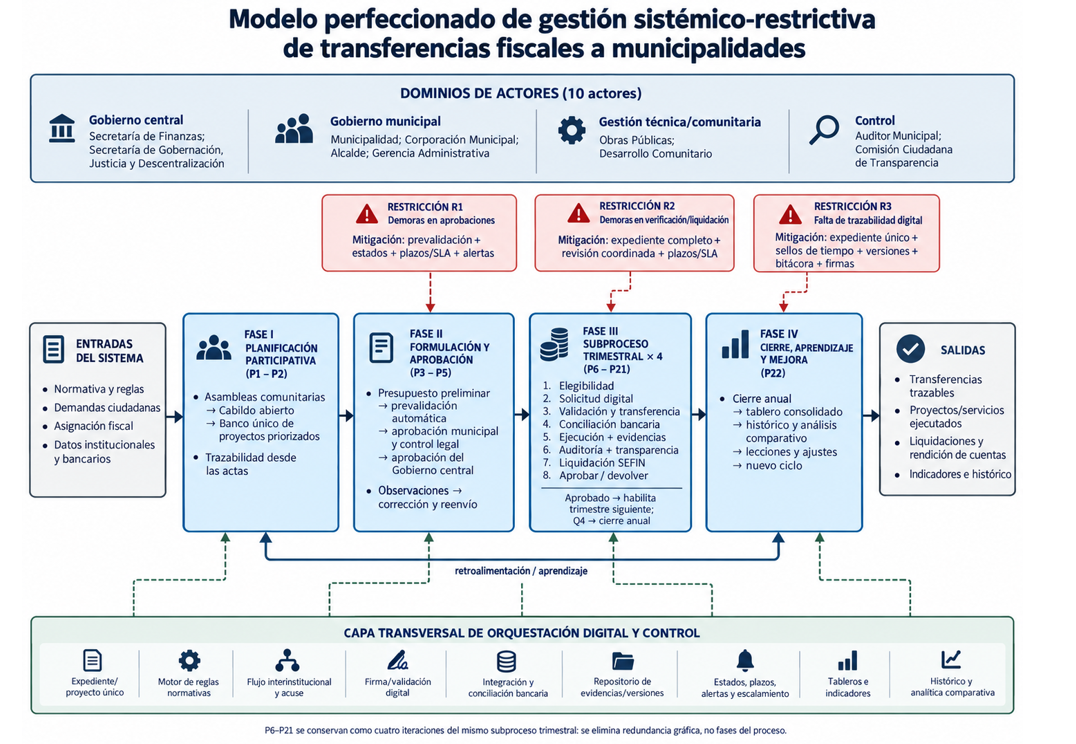
Source: Own elaboration. Graphic representation created with the assistance of a generative AI tool.
Note: The figure appears in its original language.
CONSLUSIONS
The analysis reveals that the current process for capital transfers to Honduran municipalities suffers from structural deficiencies affecting planning, execution, document traceability, and inter-institutional coordination. These limitations directly impact operational efficiency, the legitimacy of local institutions, and the quality of democratic governance at the municipal level.
Applying the Katz and Kahn model has made it possible to understand the transfer system as a network of interdependent subsystems, the synchronization of which is essential for proper functioning. Concurrently, the theory of constraints has enabled the identification of key bottlenecks—such as approval delays, a lack of digital traceability, and slow institutional responses—the resolution of which requires coordinated technological and organizational interventions. In this regard, developing an information system based on the identified functional requirements offers a viable solution for optimizing information flows, shortening budget cycle times, and strengthening transparency and accountability mechanisms.
From a disciplinary perspective, this research integrates concepts from process modeling, requirements engineering, and systems theory, applying them to the context of decentralized fiscal policy. The resulting proposal outlines a roadmap for the digital transformation of municipal management in Honduras, aligned with international open governance standards.
The software requirements and process modeling presented here serve as strategic inputs for designing a robust IT platform. Its implementation could improve the quality of local public spending, promote more equitable resource allocation, and reinforce decentralization as a cornerstone of state policy.
It is recommended that the Honduran State further develop this proposal by creating an information system that, rather than merely automating procedures, operates based on a comprehensive systemic approach. Such a tool should contribute to strengthening democratic governance, transparency, decentralization, and local development by meeting international indicators and standards. It would also enable real-time monitoring of progress at the national, departmental, and municipal levels and support the country’s commitments regarding the digital transformation of public administration.
REFERENCES
Acosta Tzin, J. V., Andino González, E. P., Aguilar Hernández, P. A., Raudales García, E. V., & Sarmiento Matute, R. E. (2022). Modelado de procesos en una empresa de manufactura en el sector de bebidas desde un enfoque sistémico. UMH - Sapientiae, 3(1), 21–36. https://doi.org/10.5377/umhs.v3i1.15298
Adams, K. MacG., Ibrahim, I., & Krahn, S. L. (2026). Engineering Systems with Standards and Digital Models: Specifying Stakeholder Needs and Capabilities—MGOS. Systems, 14(5), 458. https://doi.org/10.3390/systems14050458
Al-Fedaghi, S. (2025). Thinging Machines for Requirements Engineering: Superseding Flowchart-Based Modeling (Versión 1). arXiv. https://doi.org/10.48550/ARXIV.2501.16712
Altamimi, H., Liu, Q., & Jimenez, B. (2023). Not Too Much, Not Too Little: Centralization, Decentralization, and Organizational Change. Journal of Public Administration Research and Theory, 33(1), 170–185. https://doi.org/10.1093/jopart/muac016
Alzayed, A. (2024). Evaluating the Role of Requirements Engineering Practices in the Sustainability of Electronic Government Solutions. Sustainability, 16(1), 433. https://doi.org/10.3390/su16010433
Annosi, M. C., Cappa, F., Massa, S., Messeni Petruzzelli, A., & Peruffo, E. (2025). Managerial and organisational factors: Unravelling resource allocation choices in high-performing micro-firms. International Small Business Journal: Researching Entrepreneurship, 43(2), 152–186. https://doi.org/10.1177/02662426241290483
Asamblea Nacional Constituyente. (1982). Constitución de la República de Honduras. https://www.tsc.gob.hn/biblioteca/index.php/leyes/177-constitucion-de-la-republica-de-honduras
Barcaui, A., & Monat, A. (2023). Who is better in project planning?Generative artificial intelligence or project managers? Project Leadership and Society, 4, 100101. https://doi.org/10.1016/j.plas.2023.100101
Bawa, S. (2026). Emerging technologies and sustainable governance: Exploring efficiency and institutional inertia in China’s public sector ecosystem. Transforming Government: People, Process and Policy, 1–32. https://doi.org/10.1108/TG-10-2025-0337
Bello-Gómez, R. A., Lagos, N., & Avellaneda, C. N. (2026). Decentralization in Latin America: Assessing progress and future challenges. En C. N. Avellaneda, N. Méndez, & R. A. Bello-Gómez (Eds.), Handbook of Latin American Politics (pp. 632–646). Edward Elgar Publishing. https://doi.org/10.4337/9781035325559.00061
Bilinovics-Sipos, J., & Reicher, R. (2023). Overview of the concepts of bottleneck in the operation process. Scientific Papers of Silesian University of Technology. Organization and Management Series, 2023(170), 55–67. https://doi.org/10.29119/1641-3466.2023.170.3
Bravo Sepúlveda, M., Zapata Molina, C. E., & Gómez Salazar, E. A. (2022). Validity of the general systems theory for applications in management. Revista En-contexto, 11(18). https://doi.org/10.53995/23463279.1441
Bui, H. T. M., & Galanou, E. (2022). Translation of systems thinking to organizational goals: A systematic review. Journal of General Management, 47(4), 233–245. https://doi.org/10.1177/03063070211035749
Buntak, K. (2025). Developing a holistic organizational competence model based on general systems theory: the four-domain approach. International Journal for Quality Research, 19(3), 1027–1046. https://doi.org/10.24874/IJQR19.03-22
Chandrasekaran, A., Oliva, R., & Salvador, F. (2023). Intervention-based Research in Operations Management. Foundations and Trends® in Technology, Information and Operations Management, 17(1), 1–81. https://doi.org/10.1561/0200000104
Chiavenato, I. (2011). Administración de recursos humanos: El capital humano de las organizaciones. McGraw-Hill/Interamericana Editores.
Darif, I., El Boussaidi, G., Kpodjedo, S., & Politowski, C. (2026). Controlled Natural Language for Requirements Specification: A Systematic Literature Review. ACM Computing Surveys, 58(7), 1–36. https://doi.org/10.1145/3778169
Dávila-Campos, R., Mora, M., Reyes-Delgado, P. Y., Muñoz-Arteaga, J., & López-Torres, G. C. (2024). The Landscape of Rigorous and Agile Software Development Life Cycles (SDLCs) for BPMS: A Systematic Selective Literature Review. IEEE Access, 12, 57519–57547. https://doi.org/10.1109/ACCESS.2024.3386167
Donaldson, J. P. (2026). Why We Stay Stuck: A Complex Conceptual Systems Theory for Wicked Problems. Systems, 14(4), 431. https://doi.org/10.3390/systems14040431
Ekleş, E., & Ay Türkmen, M. (2022). Integrating the Theory of Constraints and Six Sigma: Process Improvement Implementation. Istanbul Business Research, 51(1), 123–147. https://doi.org/10.26650/ibr.2022.51.938481
Foussard, C. (2026). Representing what protects Us: From action to meaning in lockout-tagout procedures. Journal of Loss Prevention in the Process Industries, 100, 105871. https://doi.org/10.1016/j.jlp.2025.105871
Gamarra, E. (2026). Gobernanza participativa y transparencia institucional como motores en América Latina. Una revisión de literatura. Espacios, 47(2), 209–222. https://doi.org/10.48082/espacios-a26v47n02r01
Guariso, D., Castañeda, G., & Guerrero, O. A. (2023). Budgeting for SDGs: Quantitative methods to assess the potential impacts of public expenditure. Development Engineering, 8, 100113. https://doi.org/10.1016/j.deveng.2023.100113
Hernández-Sampieri, R., & Mendoza, C. (2020). Metodología de la investigación: Las rutas cuantitativa, cualitativa y mixta.
Hidayat, A. R., Hospes, O., & Termeer, C. J. A. M. (2025). Why Democratization and Decentralization in Indonesia Have Mixed Results on the Ground: A Systematic Literature Review. Public Administration and Development, 45(2), 159–172. https://doi.org/10.1002/pad.2095
Instituto de Investigaciones Económicas y Sociales. (2020). Honduras: Transferencias Municipales. https://iies.unah.edu.hn/assets/Uploads/PIEF-Transferencias-Municipales.pdf
Jalonen, H. (2025). A complexity theory perspective on politico-administrative systems: Insights from a systematic literature review. International Public Management Journal, 28(1), 1–21. https://doi.org/10.1080/10967494.2024.2333382
Janosz, M. (2018). The Theory of Constraints as a Method of Results Optimization in Complex Organization. Archives of Foundry Engineering, 59–64. https://doi.org/10.24425/afe.2018.125169
Jaramillo Valle, Y., & Melgar-Ojeda, K. A. (2026). Educación para la ciudadanía digital: Transparencia, rendición de cuentas y participación efectiva en gobernanza. Revista Simón Rodríguez, 6(12), 1–15. https://doi.org/10.62319/simonrodriguez.v.6i12.195
Ji, S., Dickerson, C. E., & Wilkinson, M. (2023). Requirements Rationalization and Synthesis Enabled by Model Synchronization. IEEE Open Journal of Systems Engineering, 1, 26–37. https://doi.org/10.1109/OJSE.2023.3249048
Katz, D., & Kahn, R. L. (1967). The social psychology of organizations. John Wiley & Sons Incorporated.
Khubaev, A., Bidov, T., & Marchenko, N. (2026). Optimizing the Performance of a Contracting Organization through Bottleneck Management. International Journal of Sustainability and Risk Control, 2(1), 23–28. https://doi.org/10.64599/HVNW6139
Lan, J., & Ban, Q. (2025). The Farm-Level Economic and Environmental Benefits of Precision Agriculture Technology Adoption: A Meta-Analysis of Global Evidence. Sustainability, 17(24), 11223. https://doi.org/10.3390/su172411223
Le Roux, R., Sepehri, M., Khaksar, S., & Murray, I. (2025). Slope Stability Monitoring Methods and Technologies for Open-Pit Mining: A Systematic Review. Mining, 5(2), 32. https://doi.org/10.3390/mining5020032
Lewandowska-Ciszek, A., Konecka, S., Leszczyński, C., & Szczypa, P. (2025). Integrating the theory of constraints and a flow balancing approach into intralogistics operations. Scientific Papers of Silesian University of Technology. Organization and Management Series, 2025(238), 387–401. https://doi.org/10.29119/1641-3466.2025.238.18
Ley de Municipalidades, Decreto número 134-90, DECRETO NUMERO 134-90 (1995).
Ley Orgánica del Presupuesto. Decreto No. 83-2004, Legislation No. Decreto No. 83-2004 (2004). https://www.tsc.gob.hn/web/leyes/Ley-Organica-del-Presupuesto.pdf
Li, S., & Chen, Y. (2024). Governing decentralized autonomous organizations as digital commons. Journal of Business Venturing Insights, 21, e00450. https://doi.org/10.1016/j.jbvi.2024.e00450
Lim, W. M. (2025). What Is Qualitative Research? An Overview and Guidelines. Australasian Marketing Journal, 33(2), 199–229. https://doi.org/10.1177/14413582241264619
Miranda-Lescano, R., Muinelo-Gallo, L., & Roca-Sagalés, O. (2024). Redistributive efficiency of fiscal policy: The role of decentralization and good governance. Regional & Federal Studies, 34(2), 189–216. https://doi.org/10.1080/13597566.2022.2092844
Mokos, K., Nestoridis, T., Katsaros, P., & Bassiliades, N. (2022). Semantic Modeling and Analysis of Natural Language System Requirements. IEEE Access, 10, 84094–84119. https://doi.org/10.1109/ACCESS.2022.3197281
Necula, S.-C., Dumitriu, F., & Greavu-Șerban, V. (2024). A Systematic Literature Review on Using Natural Language Processing in Software Requirements Engineering. Electronics, 13(11), 2055. https://doi.org/10.3390/electronics13112055
Oliveira, L., Souza, A., Silva, W., & Cordeiro, T. (2026). Requirements Engineering in E-Government Portal Development: A Systematic Mapping Study: Proceedings of the 28th International Conference on Enterprise Information Systems, 1641–1648. https://doi.org/10.5220/0014975600004018
Pinciroli, F., Barros Justo, J. L., & Forradellas, R. (2022). Systematic mapping study: On the coverage of aspect-oriented methodologies for the early phases of the software development life cycle. Journal of King Saud University - Computer and Information Sciences, 34(6), 2883–2896. https://doi.org/10.1016/j.jksuci.2020.10.029
Pinilla-Rodríguez, D. E., & Hernández-Medina, P. (2024). Governance and Fiscal Decentralisation in Latin America: An Empirical Approach. Economies, 12(8), 207. https://doi.org/10.3390/economies12080207
Pinilla-Rodriguez, D. E., Hernandez-Medina, P., & Ramirez-Torres, G. (2024). Descentralización fiscal y corrupción. Una comprobación empírica. Revista de Análisis Económico, 39(1), 59–72. https://doi.org/10.4067/S0718-88702024000100059
Rodrigues, C., Neto-Mendes, A., & Gouveia, A. (2026). Innovation or Reconfiguration? Educational Decentralization and the Changing Architectures of Public Management. Administrative Sciences, 16(7), 338. https://doi.org/10.3390/admsci16070338
Saldanha, D. M. F., Dias, C. N., & Guillaumon, S. (2022). Transparency and accountability in digital public services: Learning from the Brazilian cases. Government Information Quarterly, 39(2), 101680. https://doi.org/10.1016/j.giq.2022.101680
Saporito, A., & Mrad Georgis, B. (2025). The Strategic Impact of Organizational Charts: Structures, Functions, and Practical Applications. En A. Saporito & B. Mrad Georgis, Healthcare Services Management (pp. 197–205). Springer Nature Switzerland. https://doi.org/10.1007/978-3-032-12602-3_20
Sdrolias, L., Serdaris, P., Spinthiropoulos, K., Kalogiannidis, S., & Psarras, A. (2026). A Systems-Based Multi-Criteria Framework for Evaluating Organizational Competitiveness in Complex Organizations: Evidence from Elite Professional Football. Systems, 14(3), 265. https://doi.org/10.3390/systems14030265
Shoshany‐Tavory, S., Peleg, E., Zonnenshain, A., & Yudilevitch, G. (2023). Model‐based‐systems‐engineering for conceptual design: An integrative approach. Systems Engineering, 26(6), 783–799. https://doi.org/10.1002/sys.21688
Soesilo, R. & Adelia Dwi Valentin. (2025). Improving Energy Efficiency through Bottleneck Analysis in Food Manufacturing: A Theory of Constraints Approach. Jurnal Ilmiah Teknik Industri, 163–174. https://doi.org/10.23917/jiti.v24i02.12583
Song, X., & Lu, T. (2025). Research on factors affecting and strategies for objective control in large-scale international EPC projects. Scientific Reports, 15(1), 45213. https://doi.org/10.1038/s41598-025-29637-4
Stanikzai, M. E., & Mittal, E. (2025). Strategic alignment of organizational structure based on decisions for sustainable organizational performance: A bibliometric-systematic literature review. Cogent Business & Management, 12(1), 2560650. https://doi.org/10.1080/23311975.2025.2560650
Tan, E., Mahula, S., & Crompvoets, J. (2022). Blockchain governance in the public sector: A conceptual framework for public management. Government Information Quarterly, 39(1), 101625. https://doi.org/10.1016/j.giq.2021.101625
Teixeira, M. A. C., Zuccolotto, R., Spinelli, M. V. C., & Rodrigues, R. V. (2025). Transparency in Latin America: Argentina, Brazil, Colombia, and Mexico. En L. Secchi & C. N. Cruz-Rubio (Eds.), Handbook of Public Policy in Latin America (pp. 224–242). Edward Elgar Publishing. https://doi.org/10.4337/9781035310197.00023
Umar, M. A., & Lano, K. (2024). Advances in automated support for requirements engineering: A systematic literature review. Requirements Engineering, 29(2), 177–207. https://doi.org/10.1007/s00766-023-00411-0
Watkins, D. A., Danforth, K., Ahmed, S., Chisholm, D., Cieza, A., Iunes, R., Kumar, A., Kutzin, J., Luong, J., Meessen, B., Meheus, F., Metitiri, O., Muthee, T., Qamruddin, J., Savedoff, W., Schack, M., & Shibui, Y. (2025). Financing policies to sustain improved prevention, control, and management of non-communicable diseases and mental health conditions. The Lancet Global Health, 13(11), e1973–e1982. https://doi.org/10.1016/S2214-109X(25)00347-X
FINANCING
The authors received no funding for the development of this research.
CONFLICT OF INTEREST STATEMENT
The authors declare that there is no conflict of interest.
ARTIFICIAL INTELLIGENCE USE STATEMENT
ConsensusAI was used as an assistant to search for additional sources during the drafting of the article. Additionally, ChatGPT and Gemini were employed to develop and verify the model representation.
AUTHORSHIP CONTRIBUTION
Conceptualization: Rosbym Monico Padilla Ávila, José Jairo Núñez Calix.
Data curation: Rosbym Monico Padilla Ávila.
Formal analysis: Rosbym Monico Padilla Ávila.
Research: Rosbym Monico Padilla Ávila, José Jairo Núñez Calix.
Methodology: Rosbym Monico Padilla Ávila, José Jairo Núñez Calix.
Project management: Rosbym Monico Padilla Ávila.
Supervision: José Jairo Núñez Calix.
Validation: Rosbym Mónico Padilla Ávila.
Visualization: Rosbym Monico Padilla Ávila.
Writing—original draft: Rosbym Monico Padilla, José Jairo Núñez Calix.
Writing—proofreading and editing: Rosbym Monico Padilla Ávila.