doi: 10.58763/rc2026558
Scientific and Technological Research
Factors associated with the transition from upper secondary to higher education: The COLBACH–UAM case study
Factores asociados a la transición del nivel medio superior al superior: el caso COLBACH-UAM
René Rivera Huerta1  *, Cristina Pérez Trejo1 *
ABSTRACT
Introduction: In the metropolitan area of Mexico City, the Colegio de Bachilleres (COLBACH) has traditionally been the upper secondary institution with the highest proportion of applicants seeking admission to the Universidad Autónoma Metropolitana (UAM). However, its outcomes—measured through acceptance rates—are significantly lower compared to other high-school options.
Methodology: Considering this issue and using official UAM data for the year 2022 along with statistical analysis, this study examined the role of COLBACH and other associated factors in the performance of its graduates on the university’s admission exam.
Results: The evidence suggests that: (a) COLBACH-specific characteristics do have a negative effect on the probability of admission, and (b) this is a complex process in which economic and cultural variables—such as the home environment and students’ prior educational experiences—interact.
Conclusions: Finally, these findings aim to provide insights into designing actions that strengthen equity and educational quality in the region’s higher education system.
Keywords: Access to education; Upper secondary education; Higher education; Cultural inequality; Social inequality.
JEL Clasificación: I21; I24; I28.
RESUMEN
Introducción: En el área metropolitana de la Cd. de México, el Colegio de Bachilleres (COLBACH) ha sido tradicionalmente la institución de educación media superior con la mayor proporción de aspirantes a ingresar a la Universidad Autónoma Metropolitana (UAM). No obstante, sus resultados, medidos a través de índices de aceptación, son significativamente bajos respecto a otras opciones de bachillerato.
Metodología: De esta manera, utilizando datos oficiales correspondientes al año 2022 y aplicando análisis estadístico, el presente trabajo analizó el papel del COLBACH y de otros factores asociados en el desempeño de sus egresados en el examen de selección de la UAM.
Resultados: La evidencia sugiere que: a) las características del COLBACH sí tienen un efecto negativo en la probabilidad de ingreso, y b) este es un proceso complejo donde interactúan variables económicas y culturales, tales como el hogar de origen y la formación previa de los estudiantes.
Conclusiones: Estos resultados buscan contribuir con información para diseñar acciones que fortalezcan la equidad y la calidad en la educación superior de la región.
Palabras clave: Acceso a la educación; Educación media superior; Educación superior; Desigualdad cultural; Desigualdad social.
Clasificación JEL: I21; I24; I28.
Received: 01-07-2025 Revised: 12-09-2025 Accepted: 15-12-2025 Published: 02-01-2026
Editor: Alfredo Javier Pérez Gamboa
1 Universidad Autónoma Metropolitana-Xochimilco. Ciudad de México, México.
Cite as: Rivera Huerta, R., & Pérez Trejo, L. (2026). Factores asociados a la transición del nivel medio superior al superior: el caso COLBACH-UAM. Región Científica, 5(1)2026558. https://doi.org/10.58763/rc2026558
INTRODUCTION
The Colegio de Bachilleres (COLBACH) is the upper secondary education institution (IEMS) with the largest share of the general high school student population. However, unlike other IEMS—such as those affiliated with the Universidad Nacional Autónoma de México (UNAM), whose students enjoy automatic entry into their institution's higher education programs—COLBACH graduates must take a selection exam to gain admission to their preferred higher education institution (IES). In the absence of an institutional continuity mechanism, a significant proportion of these graduates seek admission to the Universidad Autónoma Metropolitana (UAM).
In 2022, only 13.9%[1] of COLBACH graduates who attempted to enter the UAM were accepted; this figure is far below the 31.2% acceptance rate for graduates of the Escuela Nacional Preparatoria (ENP)—an institution linked to UNAM—and even lower than the general average (15.1%). This low performance level among COLBACH students is evident not only in the transition from upper secondary to higher education but also in UAM completion rates, and it may be influencing the graduates' subsequent career success (UAM, 2023).
Given this situation, the central objective of this study is to analyze the role of COLBACH as a factor associated with its graduates' performance on the UAM selection exam, as well as to identify other correlated elements that influence their likelihood of admission. As previous literature has noted (Rivera Huerta & Pérez Trejo, 2025), the transition from upper secondary to higher education is a complex process best understood as the result of the interaction of various variables; therefore, this study also analyzes factors such as household background, educational history, and individual characteristics, among others. The methodological approach is essentially statistical and relies on various information sources provided by the UAM administration, including the General Student Archive (AGA) and the 2022 Socioeconomic Survey (ES).
Institutional background
COLBACH and UAM were established within the context of structural reforms to the Mexican education system during the 1970s. Although each institution serves a distinct purpose and function within the system, their creation shares a common root: expanding access to upper secondary and higher education in the Mexico City metropolitan area.
In the early 1970s, the Mexican education system faced rapidly growing demand and a critical shortage of places to accommodate it (Gómez, 2023). Driven by this influx of applicants for upper secondary education and the need for professional training, the process of creating COLBACH began; it was established as a decentralized state agency with its own legal identity and a mandate to provide both preparatory and technical-professional education.
The institution was formally established by a presidential decree published in the Diario Oficial de la Federación (Official Gazette of the Federation) on September 26, 1973. Consequently, COLBACH issued its first call for students and faculty in October 1973 and formally began classes in February 1974 with an initial enrollment of 13,500 students, quickly establishing itself as a leading upper secondary education institution (Gómez, 2023).
Concurrently, and as part of the same federal educational strategy, the creation of UAM was proposed. In May 1973, the Asociación Nacional de Universidades e Instituciones de Educación Superior (ANUIES) presented a proposal to the federal executive branch for a new public university designed to meet the rising demand for higher education (Alto López & Flores Romero, 2017). The Congress of the Union approved its creation and organic law in December of that same year, and its Board of Directors was formally installed in January 1974.
UAM was conceived not merely as a solution to meet demand, but also as an institutional experiment aimed at introducing new forms of academic and administrative organization (González et al., 2013). Its design incorporated decentralization into university units, an academic structure based on divisions and departments, a quarterly system, financial support for students, and the elimination of the professional examination as a graduation requirement.
This framework of institutional innovation and expansion created favorable conditions for an indirect yet persistent link between the two institutions. Although there is no automatic admission mechanism between COLBACH and UAM —until the exercise presented as UAM pass in 2025—as happens between ENP and UNAM, COLBACH graduates have historically identified UAM as a similar option to continue their professional training.
Thus, the bond between the UAM and COLBACH is rooted in a shared history and has evolved into a "functional" relationship over time. While there were no institutionalized mechanisms for student transition between these two educational levels—as discussed in the following section—interaction between them has grown in terms of student aspirations (demand) and acceptance rates.
THEORETICAL-CONCEPTUAL FRAMEWORK
Factors associated with the educational transition
Specialized literature agrees that the transition from upper secondary education (NMS) to higher education (NS) is a multidimensional process shaped by the interaction of structural, institutional, cultural, and individual factors. From this perspective, the present study draws upon the theoretical proposal of Rivera Huerta and Pérez Trejo (2025), which briefly outlines the various factors influencing students' transition from upper secondary to higher education. A list of these factors—derived from at least four fields of study (economics, sociology, psychology, and education)—is as follows:
● Educational quality. The educational quality of an upper secondary education (EMS) institution is understood as directly proportional to its capacity to equip students with the knowledge and skills necessary to lead their lives in a manner appropriate to their age (Rivera Huerta & Pérez Trejo, 2025).
● Cognitive skills. Understood as the set of capabilities that allow individuals to efficiently perform specific tasks and that are related to the reception, storage, and processing of information (Campos Vázquez, 2018).
● Non-cognitive skills. These capabilities are recognized as useful for individuals to interact with their environment, society, and themselves, and are often associated with character or personality traits.
● Motivation. In this study, motivation is understood as “the attribute that moves us to do or not do something” (Broussard & Garrison, 2004, p. 106). The importance of this factor lies in the fact that the more motivated students are, the more committed they tend to be to their education and the more likely they are to persevere despite challenges.
● Complex cognitive skills. Refers to cognitive skills that require working synergistically with non-cognitive skills to be executed. Examples include the ability to plan actions, create new knowledge, and critical thinking itself—the foundation of scientific thought (Heineck & Anger, 2010).
● Socioeconomic construct. The relationship between socioeconomic status and academic success is well established in the literature (Ghaleb et al., 2024; Muhammad et al., 2023; Sánchez-Almeida et al., 2021). However, the specific mechanisms explaining this relationship are not entirely clear (see Rivera Huerta & Pérez Trejo, 2025).
● Characteristics of the home of origin. Within this construct, it is important to include the concept of cultural capital, which encompasses the educational, cultural, and social resources transmitted by the student's family and social environment (Bourdieu, 1986; Cuenca & Pérez, 2025; Moreles-Vázquez, 2024; Tan, 2024).
It is hypothesized that these factors are correlated, but the degree and manner of this correlation depend on the temporal and cultural context as well as the idiosyncratic characteristics of the individuals. Thus, a successful transition to the higher level is explained by intrinsic and extrinsic factors, but also by the way in which they interact.
METHODOLOGY
The methodology is quantitative and relies on observational, cross-sectional data. Depending on the stage of analysis, various statistical techniques are employed—such as descriptive statistics, contingency tables, and linear regressions—details of which are provided in the section on methodological strategy.
The data come from three sources. The first is the UAM Statistical Yearbook (2023), which is publicly accessible. The second is the Socioeconomic Data Questionnaire (CDS); administered by the General Rector's Office and composed primarily of closed-ended questions, it is structured around information submitted by all applicants alongside their admission applications. This dataset allows for the distinction between accepted and rejected applicants; due to its collection method, it constitutes a census record rather than a survey. The CDS provides detailed information on sociodemographic and household characteristics—specifically, family income and material assets—as well as the applicant's educational background.
The third database is the General Student Archive (AGA), which contains personal and academic information on all UAM students since the university's founding. This information is organized into three main categories: 1. Background; 2. Identification; and 3. Performance. This record allows for the retrieval of data on the total number of accepted students and their classification by campus (unit), sex, academic division, or other characteristics. It also enables the retrieval of information regarding students enrolled in specific teaching-learning units (UEA)[2], as well as those not enrolled, graduates, and degree holders, among others.
The AGA is generated during the fourth week of classes—a time selected because, by then, grades for the previous term's comprehensive and remedial assessments have been recorded, and the processes for initial enrollment, re-enrollment, course additions and drops, and UEA changes for the current term have concluded. Like the CDS, the AGA is not derived from a sample but from a census-style data collection, capturing the institution's entire student population at a specific point in time. Both the AGA and the CDS were provided by the UAM General Rector's Office.
Methodological strategy
This section is divided into three stages. In the first stage, using information from the statistical yearbook, the relationship between COLBACH and UAM is examined through comparative indices regarding applicants, admitted students, and graduates, as well as the acceptance rate (IA) relative to other upper secondary education institutions (IEMS) (UAM, 2023). This initial approach makes it possible to identify relevant patterns in student participation and performance based on their school of origin, placing special emphasis on the dynamics of COLBACH.
In the second stage, using data from the CDS, the relationship between the average acceptance rate (IA)—categorized by the applicant's upper secondary education institution (IEMS) of origin—and various socioeconomic, cultural, and household indicators was analyzed[3]. Given the categorical nature of the variables used, this analysis was conducted using cross-tabulation or contingency tables. The database generated from the CDS comprises 87,734 application records; of these, 1,104 represented missing values that provided no information for the present study and were consequently excluded, accounting for 1.25% of the original total observations. Given the closed-ended nature of the questionnaire items, there were no extreme values or outliers requiring special handling. To obtain additional information and strengthen the study's statistical robustness, a third stage of analysis was carried out. In this phase, linear regressions were estimated using ordinary least squares (MCO), with the score obtained on the UAM entrance exam serving as the independent variable. The regressors included the higher education institution (IES) of origin as well as various socioeconomic, cultural, and household-of-origin indicators; this analysis was performed for each of the UAM's Academic Divisions: a) Basic Sciences and Engineering (CBI); b) Social Sciences and Humanities (CSH); c) Biological and Health Sciences (CBS); and d) Sciences and Arts for Design (CAD).[4].
For this stage, data were drawn from both the CDS—as previously mentioned—and the AGA. The AGA dataset, originally comprising 515,000 records, was restricted to students entering in 2022, resulting in a cross-sectional database of 11,871 observations used for the estimations. As with the CDS, the data from the AGA are based on closed-ended questions, meaning that outliers are not present.
The aim of these estimations is not to conduct a causal analysis of the variables, but rather to perform a controlled exploration of the statistical relationships between the dependent variable (score) and the other associated factors. In this regard, they serve a function similar to that of a partial correlation, yet offer the advantage of facilitating result interpretation by accounting for the categorical nature of the control variables.
The COLBACH-UAM relationship in numbers
This section draws on an initial analysis of data from UAM statistical yearbooks, examining three key dimensions: the number of applicants and accepted students, the admission rate relative to other upper secondary education institutions, and COLBACH’s representation within the university's total student body.
The analysis is comparative with other institutions; therefore, the following upper secondary education institutions (IEMS) are considered:
a) UNAM[5]: students coming from UNAM's IEMS
b) IPN[6]: students coming from IPN upper secondary schools
c) COLBACH: students from COLBACH upper secondary schools (IEMS)
d) INCORPORATED: students from private upper secondary schools (IEMS)
e) OTHER: Other upper secondary school (IEMS) categories not previously classified.
The data indicate that COLBACH is not only the upper secondary education institution (IEMS) providing the highest number of applicants among those considered, but also that the participation of students from this institution has been steadily rising. Specifically, COLBACH’s share of the total applicant pool grew from 35% in 2010 to nearly 44% in 2023. These figures are reflected in the proportion of COLBACH applicants admitted to the UAM, where an upward trend is also evident: in 2010, only 25.5% of students admitted to the UAM came from COLBACH, whereas by 2023, this figure had risen to 37.5%—an increase of 12 percentage points over thirteen years (Figure 1).
Figure 1.
Percentage of incoming students from COLBACH
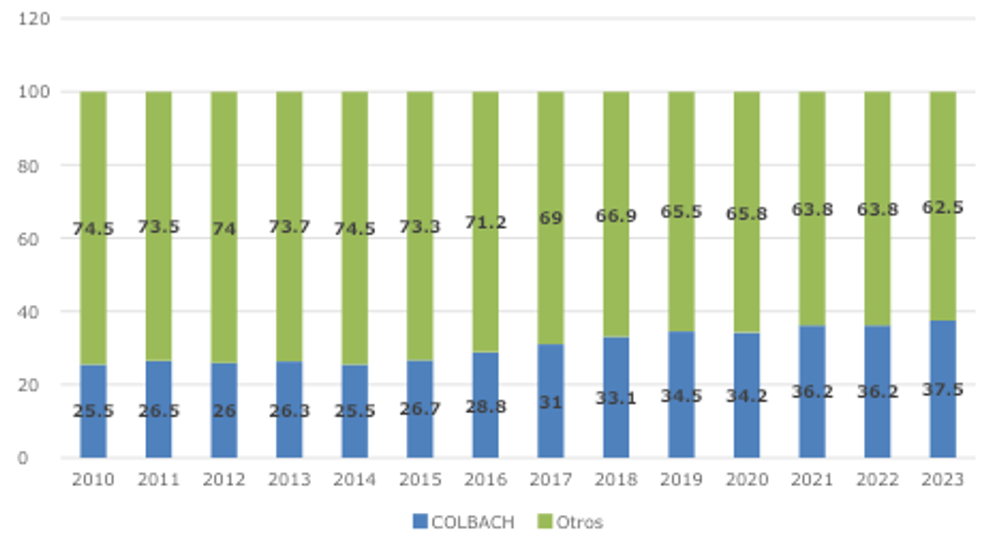
Source: UAM (2023)
Note: the figure appears in its original language.
On the other hand, some evidence suggests that the picture just outlined is not entirely positive. Indeed, it is worth noting that the acceptance rate (IA) of COLBACH is the lowest of all categories (along with Others) and is, in magnitude, less than half of the IA corresponding to the IEMS belonging to the UNAM or the IPN (UAM, 2023). Additionally, it is important to highlight that while COLBACH accounted for the largest share of applicants in 2023 (43.6%), this figure drops to 37.5% of total admissions and 26.1% of graduates (Table 1). In contrast, students from affiliated private institutions represent 17.9% of applicants but account for 20.9% of admissions and 25.1% of graduates. These data imply that, compared to the other IEMS categories considered, students from COLBACH demonstrate relatively less successful performance.
|
Table 1. Proportion of COLBACH students vs. other institutions |
|||
|
IEMS of origin |
Applicants |
Admission |
Graduates |
|
COLBACH |
43.6 |
37.5 |
26.1 |
|
Undefined |
10.8 |
11.6 |
21.8 |
|
Private (affiliated) |
17.9 |
20.9 |
25.1 |
|
Other (public) |
17.5 |
13.9 |
16.8 |
|
IPN |
7.1 |
10.6 |
4.5 |
|
UNAM |
2.9 |
5.4 |
5.7 |
|
Total |
100 |
100 |
100 |
|
Source: UAM (2023) |
|||
Acceptance rate and associated factors according to institution of origin
As expected, the acceptance rate (IA) varies according to the originating IEMS. Thus, high schools affiliated with UNAM—as previously noted—exhibit the highest AR values, more than double those associated with the COLBACH and "other" categories (Table 2b).
A preliminary conclusion might suggest that the differences in IA across the various institutions stem from the quality of the educational institution itself. However, such an inference might be premature. Indeed, a more detailed analysis reveals that the IA is associated with various characteristics of the students' home backgrounds. Note, for instance, that the ratio of students reporting family income in the top 15% is essentially twice as high among UNAM applicants compared to those from COLBACH (21.24/11.23). This information offers an initial overview of the vast socioeconomic and cultural diversity within the incoming student population, linked to their institutions of origin.
These inequalities are reflected in virtually every tabulated variable. Perhaps the most striking are those related to parental education levels (university education for the father or mother). Schools affiliated with UNAM have more than double the percentage of applicants with parents who have completed at least one year of higher education compared to those from COLBACH (34.78/16.54). These figures support the hypothesis that cultural environment correlates with economic status and that, together, they play a decisive role in student success upon university entry. These are certainly not the variables that show high values within the COLBACH student population.
Thus, the subject of study appears more complex than initially thought. Note, for example, that UNAM shows a positive difference of less than three points in terms of current family income percentages (specifically the 15% income bracket) compared to the "Affiliated High School" category; However, its IA is higher than 6 points. In contrast, the IPN shows an average IA only slightly lower than UNAM's, yet its family income levels and the percentage of parents with higher education (university-educated father or mother) are significantly lower than those of the affiliated—that is, private—high schools. Therefore, it is concluded that neither household income nor the household's cultural environment is the sole explanatory variable. In any case, the evidence just presented provides statistical support for the model proposed by Rivera Huerta and Pérez Trejo (2025), who state that success in university students' academic trajectories results from complex processes involving the interaction of multiple factors.
|
Table 2a. Variables extracted from the UAM Socioeconomic Data Questionnaire (2022) |
|
|
Name |
Description |
|
Acceptance rate (IA) |
Ratio of accepted applicants from the IEMS to the total number of applicants from that same IEMS. |
|
Admission 15% |
Proportion of applicants belonging to a family in the top 15% of current income (IC). |
|
Cultural Index |
Standardized composite index (0–100%) of the cultural and study environment of the home of origin, as reported by the applicant. |
|
Father's Education |
Proportion of students reporting that their father has completed some years of university education. |
|
Mother's Education |
Proportion of students reporting that their mother has completed some years of university education. |
|
Source: own elaboration using data from the CDS. |
|
|
Tabla 2b. Contingency tables using the variables described in Table 2a |
||||||
|
Institution |
Acceptance rate |
Admission 15% |
Cultural index |
Course |
Mother university |
Father university |
|
UNAM |
20.91 |
21.24 |
44.95 |
20.02 |
34.78 |
36.65 |
|
20.76 |
17.94 |
41.43 |
30.25 |
27.41 |
29.11 |
|
|
Incorporated High School |
14.7 |
18.31 |
42.83 |
24.31 |
27.78 |
29.34 |
|
COLBACH |
10.27 |
11.23 |
37.72 |
21.85 |
16.54 |
17.81 |
|
Other |
10.27 |
10.01 |
36.89 |
20.79 |
15.69 |
16.87 |
|
GPA |
10753 |
13.68 |
39.44 |
22.68 |
20.82 |
22.2 |
|
Source: own elaboration using data from the CDS |
||||||
Linear regression: effect of the IES of origin on the entrance score
To strengthen the analysis, the second stage described in the previous section is initiated. The description of the variables is provided in Table 3a. The results support some of the points derived from the earlier analysis and clarify others. Thus, the statistical significance of the upper secondary school of origin is reinforced; it is observed that coming from COLBACH implies having obtained, on average, nearly 13 points less than those from the "Affiliated High Schools" (Bachilleratos Incorporados) category[7]. However, this is not the factor most strongly associated with the dependent variable (score). In order of importance, these factors are: i) the higher average grade obtained in high school, ii) whether the applicant took preparatory courses, and iii) parental education levels. Nevertheless, two points must be highlighted: a) the weight of the independent variables relative to the dependent variable varies depending on the division studied, and b) in all regressions—that is, for all divisions—the variable related to family income lost all statistical significance (Table 3b).
The goodness-of-fit coefficient (R²) deserves special mention. Its low value—not unusual in cross-sectional regressions—could be attributed to population heterogeneity (idiosyncratic factors), the omission of variables due to a lack of data, and potential specification issues.
|
Tabla 3a. Description of the variables used in the linear regression |
|
|
Variable |
Description |
|
Score |
Selection exam score (452–959) |
|
UNAM |
Dummy variable equal to 1 if the student comes from a high school affiliated with UNAM, 0 otherwise. |
|
IPN |
Dummy variable equal to 1 if the student comes from a high school affiliated with IPN, 0 otherwise. |
|
COLBACH |
Dummy variable equal to 1 if the student comes from COLBACH, 0 otherwise. |
|
Incorporated |
Dummy variable equal to 1 if the student comes from a private high school, 0 otherwise. |
|
Others |
Dummy variable equal to 1 if the student comes from a high school classified as "other," 0 otherwise. |
|
Preparation |
Dummy variable equal to 1 if the student reports having taken preparatory courses, 0 otherwise. |
|
Ingreso_sup |
Dummy variable indicating whether the student reports income in the top 15%, 0 otherwise. |
|
Esc_pad |
Dummy variable equal to 1 if the father has completed at least one year of university study, 0 otherwise. |
|
Esc_mad |
Dummy variable equal to 1 if the mother has completed at least one year of university study, 0 otherwise. |
|
Female |
Dummy variable equal to 1 if the student is female, 0 otherwise. |
|
Prom_sup |
Dummy variable equal to 1 if the student's high school grade point average falls within the top 15%. |
|
Source: own elaboration using data from the AGA and CDS. |
|
|
Table 3b. Linear regression by splitting. Dependent variable: Score. |
||||
|
Independent variables |
CBI |
CSH |
CBS |
CAD |
|
UNAM |
9.326 |
26.624*** |
-14.639* |
2.867 |
|
IPN |
-3.37 |
3.871 |
-28.265*** |
-2.148 |
|
COLBACH |
-12.672*** |
-2.813 |
-5.08 |
-10.354* |
|
OTHERS |
-7.473* |
2.232 |
3.132 |
-8.7 |
|
preparation |
18.872*** |
26.448*** |
40.600*** |
21.198*** |
|
Ingreso_Sup |
0.974 |
5.652 |
-7.395 |
-1.256 |
|
esc_mad |
13.240*** |
13.532*** |
21.086*** |
6.999 |
|
esc_pad |
11.027*** |
9.332** |
4.218 |
-0.302 |
|
female |
-11.697*** |
-4.538* |
12.247*** |
0.063 |
|
prom_sup |
34.690*** |
24.931*** |
29.139*** |
11.946** |
|
_cons |
681.015*** |
683.943*** |
685.075*** |
721.823*** |
|
observations |
2,480 |
4,156 |
2,482 |
1,369 |
|
r2 |
0.092 |
0.066 |
0.118 |
0.049 |
|
rmse |
63.667 |
70.624 |
78.621 |
55.971 |
|
F |
24.907 |
29.091 |
32.9 |
7.062 |
|
Source: own elaboration using data from the AGA and CDS. |
||||
These results indicate scope for improving the estimates by strengthening the model's functional specification and incorporating variables not considered here due to a lack of data—such as cognitive and non-cognitive factors—which would also entail the use of new instruments and data collection. This may even involve considering new or different estimation techniques. Nevertheless, the statistical analysis conducted provides valuable insights into the factors influencing a successful transition from upper secondary to higher education in Mexico; the implications of these findings will be addressed in the subsequent conclusions section.
CONCLUSIONS
The relationship between COLBACH and UAM is almost natural, given the similarities in both institutions' origins and foundational objectives. The strength of this relationship is evident in the significant number of students at UAM who come from COLBACH. However, evidence from the acceptance rate and average score shows that applicants entering UAM from COLBACH do not have the best academic performance compared to applicants from other IEMS, for example, those belonging to UNAM.
Nevertheless, concluding that student performance is determined solely by the institution of origin would be both incomplete and premature. In fact, students from COLBACH rank second-lowest in two variables recognized by the literature as fundamental to academic success: socioeconomic status and—as the statistics in this study reveal to be equally or perhaps even more significant than the economic factor—the cultural environment of the home.
Additional insight is gained from entrance exam scores. Interestingly, the variable with the greatest explanatory power in this case is the grade point average achieved at the upper-secondary level. Once socioeconomic and cultural background factors are controlled for, this likely points to the importance of students' idiosyncratic skills—both cognitive and non-cognitive—in their academic trajectories. In summary, the evidence indicates that the characteristics of the upper-secondary institution of origin—in this case, COLBACH—do impact performance indicators. However, this result should not be analyzed in isolation; rather, it must be considered alongside all prior educational and developmental factors.
This research is expected to yield information that helps not only to understand the transition from upper-secondary to higher education but also to improve teaching and learning processes. Such improvements could help reduce dropout rates, facilitate the educational transition for less advantaged students, and enhance the social returns on education. An example of actions is those carried out by the IEMS dependent on the IPN, whose good results (the second highest IA among the categories considered) can be linked to a system of good quality preparation courses that this institution offers to its students at affordable prices. This strategy can be replicated by the UAM and, for this, communication with the IEMS can be fundamental. In this regard, the "regulated admission" system currently being implemented could serve as a first step in that direction.
More decisive interventions would involve creating courses designed to bridge gaps in the educational backgrounds of incoming students. As outlined in this study, these courses should be comprehensive in nature; rather than being limited—despite their importance—to academic and cognitive foundations, they should be structured to broaden students' cultural horizons and enable them to engage with diverse social realities. If successful, these measures would positively impact various indicators of the academic trajectories of UAM students and enhance the institution's overall standing.
The results of this study suggest the need for further analysis strengthened by the incorporation of new instruments and techniques, as well as variables often excluded from official university statistics—such as complex cognitive variables (critical thinking, creativity, and prospective thinking). These findings should serve to inform future decision-making and encourage similar studies at other higher education institutions, both within the country and across the region.
REFERENCES
Bourdieu, P. (1986). The forms of capital. En J. Richardson (Ed.), Handbook of theory and research for the sociology of education (pp. 241–258). Greenwood.
Broussard, S.C. and Garrison, M.E.B. (2004) The
Relationship between Classroom Motivation and Academic Achievement in
Elementary School-Aged Children. Family and Consumer Sciences Research
Journal, 33(2), 106-120.
https://doi.org/10.1177/1077727X04269573
Campos Vázquez, R. (2018). Movilidad social en México: la importancia de las habilidades y su transmisión intergeneracional. Mexico: Centro de Estudios Espinosa Yglesia.
Cuenca, R., & Pérez, A. (2025). Desigualdades de los aprendizajes en América Latina: Una exploración comparada a partir del ERCE. Magis, Revista Internacional de Investigación en Educación, 18, 1–27. https://doi.org/10.11144/Javeriana.m18.daal
Alto López, E., & Flores Romero, G. B. (2017). Nacimiento del diseño en la Universidad Autónoma Metropolitana. Fundamentos Teóricos Del Diseño. https://fundamentosteoricosdeldisenoblog.wordpress.com/2017/11/16/nacimiento-del-diseno-en-la-universidad-autonoma-metropolitana/
Ghaleb, A. M., Amrani, M. A., Al Selwi, R. A. M., Hebah, H. A., Saeed, M. A., & Mejjaouli, S. (2024). Socioeconomic status as a predictor of the academic achievement of engineering students in Taiz State, Yemen. Societies, 14(12), 246. https://doi.org/10.3390/soc14120246
Gómez, L. F. B. (2023). La filosofía en el Colegio de Bachilleres a 50 años de su creación.
González, S. T., Mendoza, M. C. C., Villava, C. S., & de León González, F. (2013). Preservar la pluralidad y la participación en la Universidad Autónoma Metropolitana (México): Una visión del observatorio universitario.
Heineck, G., & Anger, S. (2010). The returns to cognitive abilities and personality traits in Germany. Labour Economics, 17(3), 535–546. https://doi.org/10.1016/j.labeco.2009.06.001
Moreles-Vázquez, J. (2024). Desigualdad educativa y elementos que condicionan el logro académico en pruebas estandarizadas en México. Sinéctica, (62), e1624. https://doi.org/10.31391/s2007-7033(2024)0062-018
Muhammad, Y., Hassan, M. A., Almotairi, S., Farooq, K., Granelli, F., & Strážovská, Ľ. (2023). The role of socioeconomic factors in improving the performance of students based on intelligent computational approaches. Electronics, 12(9), 1982. https://doi.org/10.3390/electronics12091982
Rivera Huerta, R., & Pérez Trejo, C. (2025). Transición a la educación superior y su compleja relación con las características socioeconómicas del hogar de origen. Región Científica, 4(1), 2025440. https://doi.org/10.58763/rc2025440
Sánchez-Almeida, T., Naranjo, D., Gilar-Corbi, R., & Reina, J. (2021). Effects of socio-academic intervention on student performance in vulnerable groups. Sustainability, 13(14), 7673. https://doi.org/10.3390/su13147673
Tan, C. Y. (2024). Socioeconomic status and student learning: Insights from an umbrella review. Educational Psychology Review, 36, 100. https://doi.org/10.1007/s10648-024-09929-3
Universidad Autónoma Metropolitana (UAM). (2023). Anuario estadístico 2023 (pp. 1–316). https://transparencia.uam.mx/inforganos/anuarios/anuario2023/Anuario-Estadistico-2023.pdf
FINANCING
The authors received no funding for the development of this research.
CONFLICT OF INTEREST STATEMENT
The authors declare that there is no conflict of interest.
ACKNOWLEDGMENTS
We thank the UAM General Rectorate and, in particular, to La Dirección de Sistemas Escolares, for providing us with the databases from the Socioeconomic Data Questionnaire and the General Student Records—both corresponding to the year 2022.
STATEMENT ON THE USE OF ARTIFICIAL INTELLIGENCE
No AI was used in the development of the article.
AUTHORSHIP CONTRIBUTION
Conceptualization: René Rivera Huerta.
Data curation: René Rivera Huerta.
Formal analysis: René Rivera Huerta.
Research: René Rivera Huerta; Cristina Pérez Trejo.
Methodology: Cristina Pérez Trejo.
Resources: Cristina Pérez Trejo.
Supervision: René Rivera Huerta.
Validation: René Rivera Huerta.
Visualization: Cristina Pérez Trejo.
Writing – original draft: René Rivera Huerta; Cristina Pérez Trejo.
Writing – proofreading and editing: Cristina Pérez Trejo.