doi: 10.58763/rc2026551
Review Article
Prácticas de Políticas Públicas en Defensa de la Ética de Gobierno Durante los años 2002 - 2018. Un acercamiento desde el Estado del Arte
Public Policy Practices in Defense of Government Ethics During the Years 2002–2018. A State-of-the-Art Approach
Jasleidy
Astrid Prada Segura1  *
*
RESUMEN
Introducción: Este artículo se enfoca en documentar a través del estado del arte, la gestión de las políticas públicas en Colombia en relación con la ética gubernamental durante el período 2002-2018.
Metodología: La investigación se llevó a cabo mediante un enfoque cualitativo y un alcance descriptivo, utilizando la técnica de análisis de contenido aplicada a 32 documentos oficiales y reportes gubernamentales seleccionados por su relevancia para las variables de estudio: gobernanza, ética y corrupción.
Resultados: Los resultados evidencian que las políticas públicas en materia de tributación, gobernanza y desarrollo de infraestructura varían significativamente en función del ciclo político y del nivel de compromiso ético de cada administración, lo que refleja inconsistencias en la continuidad de estándares éticos entre gobiernos.
Conclusión: Se concluye que la escasez de recursos para atender necesidades sociales, financieras y administrativas se ve agravada por la falta de prácticas de gobernanza sostenibles y por el grado de corrupción presente en cada periodo gubernamental, afectando directamente la efectividad y legitimidad de las políticas públicas. Este estudio reafirma la influencia decisiva de los ciclos políticos sobre la ética gubernamental, destacando la necesidad de fortalecer mecanismos de rendición de cuentas y continuidad en las políticas públicas para consolidar una gobernabilidad ética y efectiva en Colombia.
Palabras clave: Corrupción, ética, gobernanza, política pública.
Clasificación JEL: D73, R38, R48.
ABSTRACT
Introduction: This article focuses on documenting, through the state of the art, the management of public policies in Colombia related to government ethics during the period 2002-2018.
Methodology: The research was conducted using a qualitative approach and a descriptive scope, using the content analysis technique applied to 32 official documents and government reports selected for their relevance to the study variables: governance, ethics, and corruption.
Results: The results show that public policies regarding taxation, governance, and infrastructure development vary significantly depending on the political cycle and the level of ethical commitment of each administration, reflecting inconsistencies in the continuity of ethical standards between governments.
Conclusions: It is concluded that the scarcity of resources to address social, financial, and administrative needs is exacerbated by the lack of sustainable governance practices and the level of corruption present in each government period, directly affecting the effectiveness and legitimacy of public policies. This study reaffirms the decisive influence of political cycles on government ethics, highlighting the need to strengthen accountability mechanisms and continuity in public policies to consolidate ethical and effective governance in Colombia.
Keywords: Corruption, ethics, governance, public policy.
JEL Classification: D73, R38, R48.
Received: 10-10-2025 Revised: 09-12-2025 Accepted: 15-12-2025 Published: 02-01-2026
Editor:
Alfredo Javier Pérez Gamboa
1Corporación Unificada Nacional de Educación Superior. Bogotá, Colombia.
Cite as: Prada Segura, J. A. (2026). Prácticas de Políticas Públicas en Defensa de la Ética de Gobierno Durante los años 2002 - 2018. Un Acercamiento Desde el Estado del Arte. Región Científica, 5(1), 2026551. https://doi.org/10.58763/rc2026551
INTRODUCTION
Public policies constitute the set of deliberate actions undertaken by the State to respond in a structured and sustainable manner to the priority needs of society through programs, projects, and intervention strategies (Jones et al., 2023; Maor, 2021). These policies have become essential tools for governments to guide the use of state resources and channel efforts towards collective well-being. However, in practice, the implementation of public policies in numerous Latin American and Caribbean countries has been compromised by the diversion of resources to private interests, a phenomenon that fuels corruption dynamics and undermines the original objectives of equity and social development (Centro Latinoamericano de Administración para el Desarrollo - CLAD, 2008).
Corruption problems tend to be concentrated at the highest levels of political and administrative power, where the capture of the state apparatus by private economic interests and the existence of rigid and hierarchical bureaucratic structures hinder transparency and facilitate illicit practices (Mugellini et al., 2021). This scenario makes the State a system vulnerable to systemic corruption, weakening its capacity to meet social demands effectively. It should be noted that the root of the problem is not limited exclusively to the state apparatus; it also arises at the margins of institutional frameworks, where public and private actors converge and instrumentalize public management for private purposes (Meyer et al., 2025). This phenomenon has intensified in recent decades with the expansion of privatization trends that have permeated the administration of public affairs, modifying the relationship between the State, the market, and society (Comunidad de Estados Latinoamericanos y Caribeños - CELAC, 2020).
On the other hand, the accelerated transformation of the global and local environment—characterized by the constant evolution of digital technologies, population growth, economic openness, and changes in mobility systems—imposes new challenges to traditional models of state management (Peng, 2022). These dynamics reinforce the widely accepted premise that effective governance is an essential engine for sustainable development. Studies on the diminishing marginal returns of governance suggest that, in developing countries, even marginal improvements in the quality of institutions can generate significantly greater impacts on attracting Foreign Direct Investment (FDI) than in already developed economies, thus contributing to strengthening competitiveness and macroeconomic stability (Altomonte & Sánchez, 2016).
According to Salazar Vargas (2009), public policy is articulated through the interaction of three interdependent systems: the political system, where regulatory frameworks are defined, and strategic decisions are made; the administrative system, responsible for implementing and managing the planned actions; and the social system, which represents the citizenry and its demands. In the social sphere, public policies seek to mitigate inequalities and address needs in education, health, and basic services, among others (Cairney et al., 2022). In the political system, decisions are often conditioned by partisan dynamics and power interests. Meanwhile, in the administrative system, the management and execution of these policies are exposed to risks of institutional capture when particular interests are prioritized over the common good (Béland et al., 2022).
This last aspect is especially evident in the frequent changes that occur whenever a new government takes power, as public policies are often modified or reoriented according to the convenience of the incoming ruler, prioritizing immediate political benefits over the structural needs of the population. The constant adjustments and reconfigurations of policies, along with the way power is distributed and accessed, constitute determining factors that shape the particularities of public policies in each country, affecting governability, the efficiency of the State, and citizens’ perception of the legitimacy of their institutions.
When formulating public policies in a state, various interests converge, involving not only the State itself but also third parties seeking personal gain regardless of the potential budgetary consequences. This affects social interests and impacts significant areas of economic growth, development, and social investment. It can be argued that the term “good governance” cannot be associated with indicators of good government and compliance, as de Vries (2013) points out; compliance is only possible if the social effects of government actions are disregarded. This assertion is corroborated by Grindle (2004), who states that most good governance is based on an agenda that outlines what needs to be done to put political, administrative, and financial resources in order. This is evident in countries lacking the necessary financial and/or human resources, which not only have limited capacity to fulfill such commitments but are also caught in conflicts of interest while trying to do the right things and do them urgently.
These behaviors or actions involved in these matters differ from ethics, revealing a double standard, where policies are implemented that condition actions based on expediency, necessarily transforming the existing social environment. Effective planning that adequately addresses social needs requires a thorough assessment of the proposed public policies. Objectivity and clear direction in policy are fundamental to social programs and projects that benefit a community. To this end, strategies are sought that will achieve results and present new challenges in social policy, without neglecting the management required to engage with the various stakeholders involved. To address this issue, the following question is posed: How do public policies differ from governmental ethics and good governance?
METHODOLOGY
This research adopted a documentary design with a qualitative approach and descriptive scope, employing content analysis as the main technique. This methodology allowed for the exploration of the nature of the discourse present in official documents, academic literature, and recent studies on governance and public ethics in Colombia during the period 2002-2018.
Document selection criteria
Thirty-two official documents and reports from 2002 to 2018 were analyzed, selected based on the following criteria:
· Thematic relevance: documents and studies on public policies, governmental ethics, governance, corruption, and innovation in public management.
· Temporal coverage: representativeness of the presidential periods within the analyzed interval.
· Source: reports from state entities, multilateral organizations, indexed academic literature, and recent studies on global trends in governance and ethics.
· Accessibility and reliability: only complete, publicly available, and official documents were included to ensure validity.
Analysis procedure
The content analysis methodology developed by Porta and Silva (2019) was followed, which allows for the identification of both latent and manifest meanings in the analyzed texts. Zawacki-Richter et al. (2018) emphasize that this method makes it possible to derive valid inferences from the messages, which is essential for the study of ethical and political phenomena. The documents were organized, coded, and categorized according to key variables such as governance, ethics, corruption, political cycles, and institutional legitimacy, which facilitated triangulation and enhanced the validity of the findings.
|
Table 1. Document review |
||
|
Author |
Year |
A key contribution to the study |
|
Aguilar Villanueva, L. F. |
2015 |
Dimensions and levels of governance as a basis for the analysis of public management systems. |
|
Altomonte, H. & Sánchez, R. J. |
2016 |
Governance of natural resources and sustainable development in Latin America. |
|
Berman, E. P. |
2022 |
Critique of how efficiency displaced equality in U.S. public policy, relevant to ethical approaches. |
|
Bowman, J. S. & West, J. P. |
2021 |
Individual and institutional ethical responsibilities in public service. |
|
Canto Chac, M. |
2008 |
Citizen participation as an essential element of governance. |
|
Castillo-Cubillos, M. |
2017 |
The role of citizen participation in public policies from a governance perspective. |
|
CLAD |
2008 |
Proposal for new public management for Latin America. |
|
CELAC |
2020 |
Regional declaration on corruption prevention and ethical strengthening. |
|
Congreso de Colombia |
1993 |
Law 80, key to analyzing public procurement and corruption in Colombia. |
|
Corporación Latinobarómetro |
2018, 2023 |
Data on citizen perception and democratic recession in Latin America. |
|
Jaime, F. M., Dufour, G. A., Alessandro, M., & Amaya, P. |
2013 |
Practical and conceptual introduction to public policy analysis. |
|
Farazmand, A. |
2022 |
Global encyclopedia that systematizes knowledge on governance and public policies. |
|
Foucault, M. |
1991 |
Governmentality theory as a framework for understanding power relations and public management. |
|
Grindle, M. S. |
2004 |
The concept of “good enough governance” as a minimum threshold for governance in developing countries. |
|
Gutierrez Ruiz, L. |
2012 |
Reflection on the relationship between corruption and the accounting profession. |
|
Kant, I. |
1909 |
Ethical foundations of the categorical imperative as a basis for reflecting on governmental ethics. |
|
Malishev, M. |
2014 |
Review of Kantian ethics applied to public management. |
|
Portal Martínez, J. M. |
2016 |
Elements of internal control and integrity in public governance. |
|
Martínez Moreno, R. |
2011 |
Social innovation as a key element for the formulation of inclusive public policies. |
|
OECD |
2014, 2024 |
Global studies on governance, integrity, and auditing mechanisms in public institutions. |
|
Parada, J. J. |
2018 |
Industrialization and governance in Latin America as a historical context for public policies. |
|
Porta, L. & Silva, M. |
2003 |
Content analysis methodology in qualitative research. |
|
Rose-Ackerman, S. |
2021 |
Effects of corruption in the context of the COVID-19 pandemic on governmental legitimacy. |
|
Rosales, V. M., Jiménez, P. L. & Rosas Ferrusca, F. J. |
2019 |
Comparative analysis of urban governance models in Toluca Smart City. |
|
Salazar Vargas, C. |
2009 |
Tripartite model of public policy analysis: political, administrative, and social systems. |
|
Stivers, C. et al. |
2023 |
Debate on equity and social justice in contemporary public administration. |
|
Svara, J. H. |
2021 |
Ethical principles for public administrators in governments and non-profit organizations. |
|
van Noordt, C., Medaglia, R. & Tangi, L. |
2025 |
National strategies in Europe for governments enabled by artificial intelligence. |
|
Varela, E. |
2015 |
New roles of local governments in public policies and global competitiveness. Challenges of good governance in contexts of institutional reform and innovation. |
|
de Vries, M. |
2013 |
Application of content analysis to educational and public policy research. |
|
Zawacki-Richter, O., Bozkurt, A., Alturki, U. & Aldraiweesh, A. |
2018 |
Dimensions and levels of governance as a basis for the analysis of public management systems. |
RESULTS
Analysis of the state of the art
Governance and governability
The concept of governability refers to a government’s capacity to exercise authority and ensure that its decisions are legitimately followed, maintaining the effectiveness and stability of the political system. Governance, on the other hand, refers to the process of directing and coordinating actors, resources, and institutions for the formulation and implementation of public policies.
Since then, approaches have evolved towards broader notions of governance. In contemporary literature, governance is used broadly to encompass diverse modes of government and coordination, from public policy networks and public-private partnerships to collaborative management between the state, the private sector, and civil society. In fact, “the concept of governance still lacks a unified interpretation,” encompassing meanings ranging from the coordination of economic sectors to collaboration between public and private organizations (Farazmand, 2022, p. 697). This reflects the complexity of the term: governance is not synonymous with government, but rather a broader framework that includes non-state actors in decision-making (Farazmand, 2022).
In short, governability refers to the quality of the political structure to govern effectively and legitimately, while governance describes the processes and interactions through which that government is exercised. Michel Foucault (1991) introduced a historical perspective by noting that the modern “art of governing” no longer consists solely of ruling over a territory, but rather of guiding the conduct of populations through a complex set of institutions, analyses, reflections, calculations, and tactics. From this perspective, governance involves techniques of government (governmentality) that target the population and are based on knowledge such as political economy and security mechanisms (Foucault, 1991).
This suggests that the exercise of power in modern governance is dispersed across multiple levels and actors, and does not rest exclusively on the hierarchical authority of the state. In formal terms, there are institutional components that strengthen governability, such as an efficient bureaucracy, a professional public administration, and results-oriented public management. The Organisation for Economic Co-operation and Development (OECD) defines public governance as “the optimization of the processes and institutional arrangements through which the government develops, implements, and delivers policies, programs, and services for the benefit of society, ensuring that the mechanisms governing the policy cycle (formulation, implementation, monitoring, and evaluation) operate effectively, efficiently, and economically, underpinned by general principles such as the rule of law, transparency, integrity, and accountability” (OECD, 2014, p. 13). This definition emphasizes that the principles of integrity, transparency, and accountability are integral to the entire governance process. In other words, good governance implies not only decision-making capacity but also democratic legitimacy, openness, and citizen oversight.
Democratic innovations and participatory governance
In recent decades, new forms of citizen participation have emerged beyond traditional representative democracy, a phenomenon referred to as “democratic innovations” (Asenbaum, 2022). Among these, participatory governance stands out, understood as processes and structures of public decision-making that involve actors usually excluded from decision-making (Portal Martínez, 2016).
This type of governance opens channels for civil society, local communities, and other groups to influence the policies that affect them, complementing formal electoral mechanisms. Participatory governance represents a paradigm shift: from unidirectional government to networked governance, where multiple stakeholders deliberate and collaborate. Svara (2021) notes that, for contemporary public administrators, understanding and fostering responsible citizen participation is part of their ethical duties, as it strengthens the legitimacy of public decisions.
Through this approach, the State acts more as a facilitator and coordinator, integrating citizens’ knowledge and preferences into public management. Examples of participatory innovation include participatory budgeting and online public consultations, which expand citizen voice in budgetary and regulatory decisions, respectively (Bussu et al., 2022; Schugurensky & Mook, 2024). These practices, already common in various local governments, reflect a trend towards greater co-creation of policies with society. However, they involve implementation challenges, such as ensuring the inclusion of typically marginalized populations and translating citizen input into effective policies.
Recent studies on social justice in public administration warn that mere participatory openness does not guarantee fairer outcomes if structural inequalities are not addressed: “social equity focuses on ensuring equal opportunities, while social justice aims to transform the systems and structures of oppression that generate inequality” (Stivers et al., 2023, p. 231). This implies that participatory innovations must be accompanied by a commitment to social justice, so that traditionally excluded voices (ethnic minorities, women, and impoverished sectors) can genuinely influence decisions and historical inequalities can be rectified. Integrating a social justice perspective means that citizen participation not only seeks to improve the efficiency or acceptance of policies, but also to challenge and reform the conditions that perpetuate injustice (Stivers et al., 2023).
Institutional structures and public corporate governance
The term “corporate governance,” when applied to the public sector, refers to the management and control processes of a state’s public institutions and bodies (Ismail et al., 2023). This includes the rules, practices, and structures through which a public organization is directed and supervised, seeking to guarantee integrity, efficiency, and accountability in its management (Wendry et al., 2023).
Aguilar Villanueva (2015) distinguishes two complementary levels of governance in the state sphere: (1) the governance of the public sector as a whole (or governance of public administration), understood as “the process by which the government directs or governs the public sector or the administrative system in its entirety” (p. 20); and (2) public corporate governance, which refers to the process by which the government manages its specific organizations (ministries, agencies, state-owned enterprises), applying principles of strategic management, internal control, and transparency characteristic of corporate management.
In the Colombian context, for example, the structure of the State encompasses multiple levels (national, departmental, municipal, etc.) and diverse entities (ministries, public establishments, state-owned industrial and commercial enterprises, mixed-economy companies with majority state participation, among others), as defined by Law 80 of 1993 (Congreso de Colombia, 1993). Each public entity must be governed corporately so that its internal processes (planning, financial management, personnel management, control systems) respond to the principles of good administration and service to the public interest.
Several key elements are recognized for adequate public governance, including: strategic planning, efficient resource management, robust internal control systems, the promotion of ethics and integrity within the institution, risk management, evaluation using performance indicators, transparency in operations, and accountability to citizens (Canto Chac, 2008). These components aim to ensure that public entities act with integrity and are results-oriented, strengthening public trust.
In fact, the OECD has emphasized that principles such as transparency, integrity, and accountability are pillars of institutional governance. Integrity, in particular, has become a central indicator: international organizations measure the robustness of integrity frameworks within institutions (e.g., the existence of codes of ethics, declarations of conflicts of interest, whistleblower protection, etc.) as a way of assessing the quality of public corporate governance (OECD, 2024).
Good institutional governance also requires balancing managerial flexibility with democratic control. Experience shows that granting greater managerial autonomy to public agencies can improve efficiency, but oversight and participation mechanisms must be simultaneously strengthened to prevent abuses. In this sense, institutional integrity is as important as, if not more important than, technical capacity. Public organizations need robust “ethical infrastructures”: codes of conduct, ethics committees, reporting systems, and, above all, leaders who model honest behavior. Only in this way can managerial discretion be exercised without falling into arbitrariness or corruption.
Public ethics and administrative responsibility
Ethics in the public sphere takes on extraordinary importance, as it is related to public trust and the legitimacy of the State. Etymologically, ethics comes from the Greek word ethos (character, way of being) and is linked to the idea of moral conduct. In public administration, ethics serves as a guide for public servants to act in accordance with the general interest, honesty, and justice, beyond what the law requires (Khanal et al., 2022).
As Immanuel Kant (1909) pointed out, there is a fundamental difference between moral imperatives and other imperatives: not everything legal is ethical, and not all obligations towards a person translate into authentic moral duties. Kant argued that only the categorical imperative (an unconditional moral command dictated by reason) constitutes a true ethical law, in contrast to hypothetical imperatives (conditioned by particular desires or ends). Consequently, in public service, it is not enough to comply with the law to the letter; moral judgment is required to act rightly in situations where the rules may be ambiguous or insufficient.
Modern public ethics emphasizes both the individual responsibilities of officials and the institutional responsibilities of government organizations. James S. Bowman and Jonathan West, in their work Public Service Ethics: Individual and Institutional Responsibilities, emphasize that ethical behavior in public service “demands much more than simply following the rules” and that ethics must be at the heart of effective and democratic governance (Bowman & West, 2021). This means that public servants, in addition to respecting the law, must cultivate virtues such as honesty, integrity, prudence, and impartiality. At the same time, institutions need structures that promote and reinforce these behaviors: clear codes of ethics, continuous training, committed leadership, and systems for controlling and sanctioning unethical conduct.
A valuable contribution in this field is that of Svara (2021), who offers an “ethics primer” for public administrators, aimed at aligning the personal values of the official with the ethical standards of public service. He proposes the “ethical triangle” model, which balances three approaches: personal virtues (virtue ethics), principles and obligations (deontological ethics), and the pursuit of positive outcomes for society (consequentialist ethics).
This framework “emphasizes virtue, principles, and the promotion of positive outcomes,” providing public servants with a multifaceted criterion for ethical decision-making (Svara, 2021). In this way, a public administrator, when faced with a decision, should ask: Is it consistent with the virtues and character that an exemplary public servant should possess? Does it respect legal and professional principles and duties? Does it lead to beneficial results for the public interest? Only when all three perspectives are considered can the action be considered ethically sound in a comprehensive way.
Another crucial aspect is professional responsibility and codes of ethics. Svara (2021) and Bowman and West (2021) agree that codes of ethics (such as the Code of Ethics of the American Society for Public Administration – ASPA, or that of the International City/County Management Association – ICMA) serve as guides for conduct and reflect key values: serving the public interest, respect for the Constitution and the law, commitment to democracy, integrity, compassion, fair treatment and equality, accountability, etc. However, both texts emphasize that codes must be translated into action: that is, ethics are demonstrated in daily decisions, often in dilemmas where values clash. For example, how to balance efficiency with equity, due obedience with individual moral conscience, or transparency with confidentiality when both are important.
In administrative practice, ethical dilemmas abound. A public servant may face pressure to falsify indicators (e.g., “fudging” results to meet targets), or witness the embezzlement of funds. This is where the figure of the whistleblower or informant comes in: individuals who, guided by ethical principles, dare to report acts of corruption or fraud in their institutions. Bowman and West (2021) document cases of whistleblowers and the importance of protecting them to foster a culture of transparency. They insist that public agencies establish secure reporting channels and that leaders should not repress the messenger, but rather correct the wrongdoing that has been reported. Institutional ethics requires systems that reward honesty and moral courage, and punish corruption.
In short, contemporary public ethics demands individual moral competence and ethical organizational systems. “Mastery of personal ethics is necessary but not sufficient,” since “individual behavior is affected by the institutional environment in which it occurs” (Bowman & West, 2021). Therefore, in addition to honest officials, we need institutions with a solid ethical infrastructure. Only the combination of both levels—individual and institution—guarantees sustained ethical behavior in the public sector.
Equity, efficiency and justice in public policies
Traditionally, public administration has had to balance values that are sometimes in tension, such as economic efficiency versus social equity. In the second half of the 20th century, especially under the influence of New Public Management, a managerial mindset focused on quantifiable results, cost-benefit analysis, and efficiency was often prioritized.
Berman (2022) analyzes this transformation in Thinking Like an Economist: How Efficiency Replaced Equality in U.S. Public Policy, showing how an “economic style of reasoning” became dominant in public policy formulation in the United States, displacing concerns about equality. Berman explains that this economic style of reasoning emphasizes values of efficiency, market incentives, and competition, and was widely adopted not only by economists but also by public policy professionals in general during the last decades of the 20th century.
As a result, many policy decisions came to be justified almost exclusively in terms of maximizing efficiency or economic growth, relegating criteria of distributive justice or rights to a secondary role. One consequence of this shift was that equality (for example, reducing social gaps, ensuring universal rights) lost its central importance compared to efficiency (achieving goals at the lowest possible cost). This is evident in environmental policies, where there was a shift from a moral approach that stigmatized polluters to one that conceives of pollution as an “externality” to be internalized through prices or carbon markets.
While seeking efficiency is not objectionable in itself, the problem arises when it becomes the predominant and almost exclusive criterion, since policies that are very efficient in terms of cost can simultaneously be inequitable or insensitive to the needs of vulnerable groups. Currently, there is growing recognition that efficiency and equity must be reconciled in policy design. Public policy strategists are beginning to argue that governmental effectiveness cannot be measured solely in economic terms, but also in terms of social impact.
This suggests that a shift in priorities may be underway, or at least a greater awareness of the social costs of the obsession with efficiency. In the field of public administration as a discipline, the value of social equity has been introduced as a normative pillar since the 1970s (Park, 2022).
Social equity implied that public agencies should be concerned with addressing existing inequalities and ensuring equal access to public services. In more recent years, a prominent group of scholars has advocated going “beyond equity” and explicitly discussing social justice in public administration. The difference is subtle but important: equity typically refers to distributing resources and opportunities proportionally to needs (giving more to those who need more) within the existing framework. At the same time, social justice involves transforming the structures that produce those unequal needs in the first place.
Stivers et al. (2023) argue that public administration should not be limited to mitigating inequalities, but also “address the underlying systems and structures of oppression that contribute to inequity and injustice” (p. 232). For example, an equity policy in education might allocate more funds to schools in poor areas (which is positive). However, a social justice approach would examine why such unequal schools exist (residential segregation, local funding through property taxes, etc.) and propose structural reforms to correct those causes. Incorporating social justice as a principle means that public administrators assume a more proactive role in promoting social change.
This may mean supporting community participation in the co-production of services, implementing distributive impact analyses of policies (who benefits or is harmed?), and advocating for legal reforms when existing rules perpetuate inequities. It also involves reflecting on diversity and inclusion within public organizations themselves: are governments incorporating diverse voices in their workforce and leadership? Are public programs effectively reaching all demographic groups, or are there implicit barriers for minorities, women, people with disabilities, etc.?
Social justice in public administration requires an introspective and transformative approach. In short, the state of the art on this topic shows us tensions but also convergences: after decades of economic technocracy, equity and justice are being revalued. Efficiency remains an important objective (resources will always be scarce), but today it is understood that a truly effective public policy must also be socially just.
An exclusive focus on efficiency leads to policies that are “optimal” in terms of cost but deficient in humanity; therefore, the idea is resurfacing that governmental success should be measured by the equitable well-being of citizens, not solely by GDP or macroeconomic statistics. Guaranteeing equal opportunities is no longer enough: the public administration of the 21st century has the ethical task of contributing to dismantling injustice wherever it exists, thus moving from equity toward genuine social justice.
Integrity, corruption, and citizen trust
Corruption is one of the greatest obstacles to good governance, as it undermines public trust, deepens inequality, and can weaken democracy itself. Rose-Ackerman (2021) analyzed the impact of the COVID-19 pandemic on corruption risks, providing a clear example of how crises can exacerbate corrupt behavior.
The urgent response to the coronavirus required the rapid mobilization of public funds on a large scale, while simultaneously concentrating discretionary power in the hands of officials to allocate medical and economic resources in a context of lax oversight. According to Rose-Ackerman, “the coronavirus pandemic has created incentives for corruption, fraud, and self-dealing” due to three characteristics of the context: (1) fierce competition for essential resources during the emergency; (2) massive and accelerated public spending creating opportunities for rent-seeking and corruption; and (3) broad discretionary power for politicians, bureaucrats, and health professionals in resource allocation, combined with a lack of transparency and weak oversight (2021, pp. 16-17).
Consequently, cases of price gouging in emergency purchases, contracts awarded to favored companies without sufficient oversight, and even the diversion of aid were detected. Rose-Ackerman (2021) warns that tolerating these practices not only illicitly enriches some at the expense of the public treasury, but also that “tolerance of malfeasance will come at the expense of long-term governmental legitimacy” and will particularly harm the most vulnerable.
Even in crises, the fight against corruption must not be relaxed: the urgency to save lives and reactivate the economy does not justify undermining integrity institutions, as doing so leads to lasting damage to public trust. The lessons of the pandemic reaffirm the importance of having robust integrity systems at all times, capable of withstanding extraordinary pressures.
However, the OECD points out that “while frameworks are becoming increasingly comprehensive and sophisticated, the implementation of some of their elements remains inadequate” (OECD, 2024, p. 10). On average, countries meet 61% of standard regulatory criteria regarding integrity, but only achieve 44% effective implementation, revealing an “implementation gap” of 17 percentage points (OECD, 2024, pp. 12-13).
In other words, many laws and rules exist on paper but are not fully translated into practice. For example, most OECD countries have regulations to prevent conflicts of interest among public officials, but on average, they have only implemented 40% of the recommended practices in this area, and sanctions for non-compliance are rarely imposed (OECD, 2024, p. 13). Similarly, although almost all require some form of risk management and internal control, few systematically conduct corruption risk assessments.
Another worrying finding from the OECD is that many governments do not collect or monitor sufficient data on the implementation of their integrity policies. For example, 60% of countries do not regularly monitor compliance with their anti-corruption strategies, and most do not keep track of follow-up on internal audits or the employment status of former officials subject to cooling-off periods (post-employment restrictions).
Corruption also has direct implications for democratic governance. The Corporación Latinobarómetro, in its 2023 report “The Democratic Recession in Latin America,” documents the serious erosion of trust in democracies in the region, partly attributed to corruption scandals and poor government performance. After analyzing surveys in 18 countries, the Corporación Latinobarómetro notes that “the democratic recession is expressed in the low support for democracy, the increase in indifference to the type of regime—democratic or authoritarian—and the preference... for authoritarianism, as well as the collapse of government performance and the image of political parties” (Corporación Latinobarómetro, 2023, p. 3).
In several Latin American countries, democracy is in a critical state, and some have regressed towards hybrid or openly authoritarian regimes. The report highlights factors such as the weakness of political elites (exemplified by the fact that 21 Latin American presidents since 1990 have been convicted of corruption and at least 20 did not finish their terms), the rise of populist leaders who undermine institutions, and decreasing satisfaction with democracy due to the perception of government ineffectiveness and corruption.
The COVID-19 pandemic, once again, played an accelerating role by deepening socioeconomic discontent and exposing state failures. The result is a breeding ground for populism and authoritarian tendencies, as segments of the population, disillusioned with corruption and insecurity, support strong-arm solutions or anti-establishment leaders. The Corporación Latinobarómetro (2023) concludes that the region faces a “democratic recession” in which the legitimacy of democracy has fallen dangerously. This reinforces the argument that integrity and good governance are not merely optional elements, but necessary conditions for democratic stability. When people perceive that institutions are corrupt or incapable of improving their lives, adherence to democracy erodes, and those who prefer “an authoritarian government if it solves the problems” emerge—a phenomenon that the report itself notes is on the rise. In short, recent studies converge on the idea that integrity is the antidote to the erosion of public trust. Corruption not only wastes resources and violates the law, but also erodes the relationship between rulers and the ruled, fueling cynicism and apathy or support for anti-democratic alternatives.
Therefore, strengthening public ethics, anti-corruption frameworks, and transparency is not only a legal or moral imperative but also a survival strategy for democracy. Governments must close the gap between their normative promises and the reality of implementation. This involves investing in oversight institutions, supporting civil society and the free press in their watchdog role, and effectively punishing corrupt acts, no matter how high up the chain of command they occur. Only in this way can citizens’ trust be restored, demonstrating that the state truly acts in the public interest.
Technology, artificial intelligence and governance models
The rapid pace of technological advancement is also redefining public administration practices and posing new governance challenges. In Europe and around the world, many governments have adopted national Artificial Intelligence (AI) strategies to leverage these technologies in public management while simultaneously seeking to mitigate their risks. van Noordt et al. (2025) analyzed policy initiatives for AI-enabled governments in Europe, finding that most countries emphasize the need for ethical and trustworthy AI in the public sector in their strategies. For example, “the Irish strategy highlights that AI-powered government services must have appropriate arrangements in place to ensure accountability and traceability” (van Noordt et al., 2025, p. 240).
Similarly, many European strategies underscore principles such as algorithmic transparency, data security, and respect for privacy. This reflects an emerging consensus: to adopt AI in administration, the government must lead by example in the ethical use of technology, ensuring that algorithms and automated systems do not reproduce unfair biases or make opaque decisions that undermine citizens’ rights.
However, in other countries, the strategies are more nascent or lack clear guidelines for public administration. One challenge identified is the potential conflict of roles: the government is both a regulator of AI in society and a user of AI in its own operations (van Noordt & Misuraca, 2022). This can create tensions, which is why some states are focusing first on “getting their own house in order” by developing internal ethical codes, training their officials in AI, and conducting pilot projects with impact assessments before scaling up their use. Beyond AI, digital transformation in general has given rise to the concept of digital government or Government 4.0, characterized by the use of big data, electronic platforms, online services, and, more recently, technologies such as blockchain.
These tools promise to increase the efficiency and accessibility of public services, but they also require a rethinking of governance models. For example, the adoption of digital platforms for procedures and participation (such as complaint portals, citizen consultations on social media, etc.) redistributes power to some extent toward citizens, who have more information and channels to exert influence. However, frameworks are also needed to govern these platforms, preventing digital divides (where certain groups are excluded due to lack of access or skills) and preventing malicious uses (disinformation, manipulation by bots in public consultations, etc.). In the urban context, the notion of a Smart City exemplifies the integration of technology and governance.
Smart cities use sensors, interconnected systems, and data analytics to manage traffic, security, the environment, and other urban services more efficiently. However, a smart city is not just a technological project; it involves coordinating diverse actors—local government, technology companies, universities, and communities—under new forms of collaborative governance. Rosales et al. (2019) studied the case of Toluca Smart City in Mexico, discussing the actors involved and the governance models employed in this urban project. They identified that to implement smart initiatives (such as automated public lighting, real-time environmental monitoring, civic apps, etc.), it was crucial to establish effective public-private partnerships, as well as mechanisms for citizen participation to legitimize the changes in the public space (Rosales et al., 2019).
Document analysis
Participatory governance is often presented as driven by the need to address legitimacy deficits arising from declining citizen participation in traditional electoral democracy. Authorities are seen as establishing parameters that help find solutions to pressing policy problems within an increasingly contradictory context. This is especially relevant in the face of fragmented group interests and within the context of strong ties between political parties and interest groups, where public support for policy decisions, or at least the absence of resistance to these decisions, is a crucial source of effective governance.
Furthermore, it assumes that exercises within public policy have become part of a professional practice driven by administrative actors. Within the analysis presented by Parada (2018), three objectives are identified that organizations pursue in social development, in this study, across nine municipalities. Colombia, as a social state governed by the rule of law, has decentralized its decision-making, granting autonomy in tax and investment matters.
|
Figure 1. Contribution of organizations to social development |
|
|
|
Source: Foro “Ciudad-Territorio”, Diamante Caribe y Santanderes (2014). Note: the figure appears in its original language |
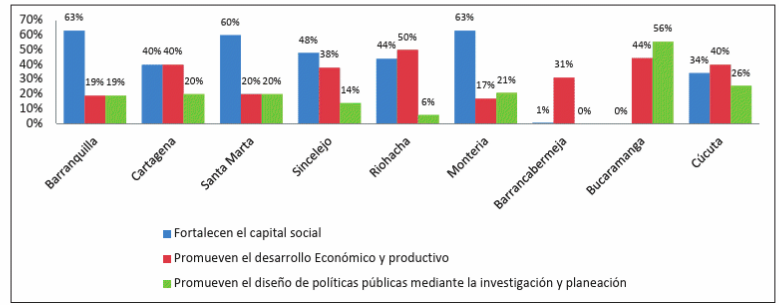
This figure illustrates the disparity in needs across municipalities in regions such as the Caribbean and the Santander departments, as well as the different approaches and priorities in each area. This demonstrates a lack of consensus among the leaders of these regions. These two large regions were selected because they represent a significant percentage of the efforts to promote the design of public policies.
The collected information reveals that in 2018 and so far in 2019, there have been numerous cases of frequent governance failures. According to the report of the Corporación Latinobarómetro (2018), low government approval ratings in Latin America are a strong indicator of democratic decline.
The following figure answers the question: Do you approve or disapprove of the performance of the government led by the president? The data is scored on a scale of 0 to 100 points.
|
Figure 2. Government approval report |
|
|
|
Source: Corporación Latinobarómetro, 2018, p.46. Note: the table appears in its original language. |
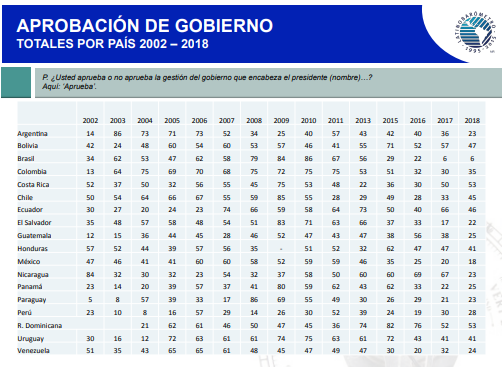
The data for Colombia is extracted from the table above, and the variation is shown in the following figure:
|
Figure 3. Approval percentage |
|
|
|
Source: own elaboration based on data from Corporación Latinobarómetro, 2018. |
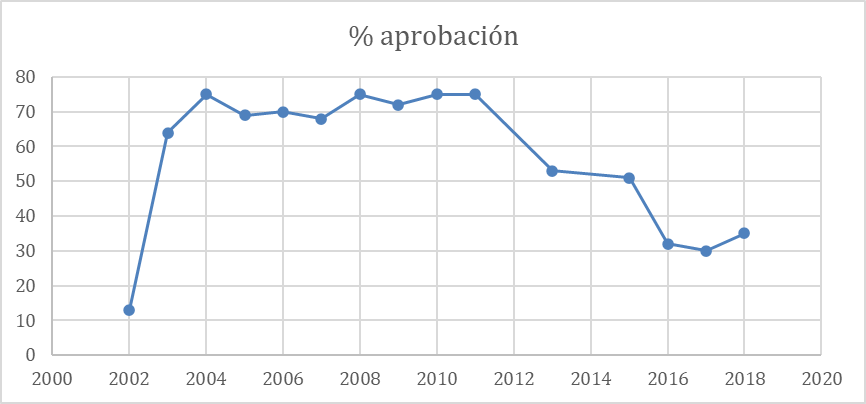
From the previous figure, it can be seen that, while it is known that Álvaro Uribe Vélez served as president from 2002 to 2010 and Juan Manuel Santos from 2010 to 2018, the credibility of both can be clearly differentiated, as the average ratings obtained are as follows: Álvaro Uribe Vélez: 64,55 % and Juan Manuel Santos: 48,2 % credibility on a scale of 1 to 100.
Public policies facilitate the reaching of agreements that align with the commitments made during the campaign, creating a pact to ensure that the winner fulfills what was agreed upon. Participatory governance expands primarily in contexts of conflict characterized by governance problems. In established democracies, participatory governance mechanisms appear “more as management and communication techniques than as effective instruments for democratizing the decision-making process.”
DISCUSSION
The current landscape of public administration and governance presents a dynamic field, rich in transformations and new challenges. This “state of the art” review has examined various thematic areas that converge on the central question: how to achieve effective, ethical, and just democratic governance in the contemporary context? Several conclusions emerge from the recent literature and trends. First, the distinction between governability (the capacity and stability of government) and governance (collaborative decision-making processes) is fundamental (Avalle, 2023).
A modern state must be governable—with strong and legitimate institutions—while simultaneously adopting open and flexible modes of governance that include civil society and other stakeholders. The proliferation of participatory governance mechanisms suggests that 21st-century democracy will be increasingly interactive; authorities no longer hold a monopoly on solutions, but rather design policies in collaboration with citizens. This can revitalize democracy, but it requires a genuine commitment to inclusion and social justice to avoid reproducing the same old inequalities in participatory processes.
Second, public ethics has gained renewed centrality. As Bowman and West (2021) affirm, ethics cannot be a rhetorical embellishment, but rather the core of public service, because trust in government depends on it. This implies promoting a culture where every public servant constantly asks themselves, “What is the right thing to do?”—applying the ethical imperative above undue pressures or incentives—and where institutions support this conduct with exemplary leaders, clear rules, and zero tolerance for corruption. Ethics and integrity are enabling conditions for everything else: without them, even the best policies fail due to a lack of credibility.
Third, a course correction is observed regarding the values that guide public policies. After decades of technocratic and economic-driven dominance, considerations of equity and justice are now being strongly reintroduced (Howlett, 2023). Social inequalities are no longer seen as something outside the purview of the public administrator, but rather as problems that they must help solve. Public administration is increasingly seen as a tool to promote social cohesion, equal opportunities, and the protection of the most vulnerable, while still striving for efficiency.
In other words, good governance is that which balances efficiency with moral legitimacy. Fourth, combating corruption and strengthening integrity is not just a technical issue, but a matter of democratic survival. The findings of the Corporación Latinobarómetro (2023) confirm that where corruption is rampant, faith in democracy declines. Therefore, governments must redouble their efforts to genuinely implement (not just on paper) anti-corruption measures, close implementation gaps, and be accountable for their progress.
Radical transparency—supported by technology, but above all by political will—is the best antiseptic against the opacity that fuels corruption. Similarly, citizen participation in social oversight (e.g., watchdog groups, citizen audits) complements institutional oversight, creating a network of ethical and democratic vigilance. Finally, technology is emerging as a transformative factor in public administration. Its intelligent integration can help solve complex problems, do more with less, and bring government closer to the citizen. However, as discussed, it also raises ethical dilemmas and requires new skills.
CONCLUSIONS
The state of the art suggests that the future will belong to those administrations that manage to be both innovative and transparent: those that utilize AI, big data, and digitalization, but always maintaining human control, algorithmic fairness, and public participation in digital decision-making. Democratic Algorithmic Governance could be a new frontier, where citizens collaborate even in the design of the technological solutions applied in cities. In conclusion, the field of public administration is evolving to respond to a constantly changing environment. The lessons from the authors reviewed—from Kant to research from 2025—invite us to reaffirm that the basic principles (legality, ethics, public service, equity, participation) remain the foundation. However, they must be reinterpreted and applied creatively in the face of new phenomena.
Governing today is more complex than ever: it requires navigating legitimate social demands (justice, equality), unexpected health or environmental crises, technological revolutions, and threats to democracy. However, we also have more conceptual and practical tools to address these challenges. The key will be to combine the best of tradition (enduring values of integrity and the common good) with the best of innovation (participatory methods, data science, multi-stakeholder collaboration). Only in this way can governance be simultaneously effective and legitimate, ensuring that public power fulfills its ultimate purpose: to improve people’s lives under principles of justice and honesty.
REFERENCES
Aguilar Villanueva, L. F. (2015). Gobernanza y gestión pública. México: Fondo de Cultura Económica. https://consultorestema.com/wp-content/uploads/2020/02/Aguilar_villanueva_gobernanza_y_gestionTC.pdf
Altomonte, H., & Sánchez, R. J. (2016). Hacia una nueva gobernanza de los recursos naturales en América Latina y el Caribe. https://repositorio.cepal.org/bitstream/handle/11362/40157/1/S1600308_es.pdf
Asenbaum, H. (2022). Rethinking Democratic Innovations: A Look through the Kaleidoscope of Democratic Theory. Political Studies Review, 20(4), 680-690. https://doi.org/10.1177/14789299211052890
Avalle, G. (2023). Gobernabilidad y gobernanza. Enfoques en tensión. Estudios Políticos (Medellín), (66), 28-47. https://doi.org/10.17533/udea.espo.n66a02
Béland, D., Campbell, A. L., & Weaver, R. K. (2022). Policy Feedback: How Policies Shape Politics (1.a ed.). Cambridge University Press. https://doi.org/10.1017/9781108938914
Berman, E. P. (2022). Thinking Like an Economist: How Efficiency Replaced Equality in U.S. Public Policy. Princeton University Press. https://doi.org/10.1515/9780691226606
Bowman, J. S., & West, J. P. (2021). Public Service Ethics: Individual and Institutional Responsibilities (3ª ed.). Routledge. https://doi.org/10.4324/9781003203148
Bussu, S., Bua, A., Dean, R., & Smith, G. (2022). Introduction: Embedding participatory governance. Critical Policy Studies, 16(2), 133-145. https://doi.org/10.1080/19460171.2022.2053179
Cairney, P., Keating, M., Kippin, S., & St Denny, E. (2022). Public Policy to Reduce Inequalities across Europe: Hope Versus Reality (1.a ed.). Oxford University PressOxford. https://doi.org/10.1093/oso/9780192898586.001.0001
Canto Chac, M. (2008). Gobernanza y participación ciudadana en las políticas públicas frente al reto del desarrollo. Política y cultura, (30), 9-37. http://www.scielo.org.mx/scielo.php?script=sci_arttext&pid=S0188-77422008000200002&lng=es&tlng=es
Castillo-Cubillos, M. (2017). El papel de la participación ciudadana en las políticas públicas, bajo el actual escenario de la gobernanza: reflexiones teóricas. Revista CS, (23), 157-180. https://doi.org/10.18046/recs.i23.2281
Centro Latinoamericano de administración para el desarrollo - CLAD. (2008). Una Nueva Gestión Pública para América Latina. http://www.clad.org/documentos/declaraciones/una-nueva-gestion-publica-para-america-latina.
Comunidad de Estados Latinoamericanos y Caribeños - CELAC. (2020). IV Reunión de ministras, ministros y altas autoridades de prevención y lucha contra la corrupción. https://ppt-celac.sre.gob.mx/es/comunicados-especiales-e-intervenciones/declaraciones-especiales/25-declaracion-conjunta-de-la-iv-reunion-de-ministras-ministros-y-altas-autoridades-de-prevencion-y-lucha-contra-la-corrupcion
Congreso de Colombia. (1993). Ley 80 de 1993. http://www.secretariasenado.gov.co/senado/basedoc/ley_0080_1993.html
Corporación Latinobarómetro. (2018). Informe 2018. Santiago de Chile: Corporación Latinobarómetro.
Corporación Latinobarómetro. (2023). Informe 2023: La recesión democrática de América Latina. Santiago de Chile: Corporación Latinobarómetro.
de Vries, M. (2013). The Challenge of Good Governance. The Innovation Journal: The Public Sector Innovation Journal, 18(1), 1-9. https://innovation.cc/wp-content/uploads/2013_18_1_2_de-vries_good-governance.pdf
Farazmand, A. (Ed.). (2022). Global Encyclopedia of Public Administration, Public Policy, and Governance. Springer International Publishing. https://doi.org/10.1007/978-3-030-66252-3
Foucault, M. (1991). On governmentality. The Foucault Effect: Studies in Governmental Rationality, Hemel Hempstead: Harvester Wheatsheaf. Reprinted in G. Burchell, C. Gordon and P. Miller (eds).
Grindle, M. S. (2004). Good Enough Governance: Poverty Reduction and Reform in Developing Countries. Governance, 17(4), 525–548. https://doi.org/10.1111/j.0952-1895.2004.00256.x
Gutierrez Ruiz, L. (2012). Corrupción y la profesión contable. https://leandro-gutierrez-ruiz.webnode.com.co/news/corrupcion-y-la-profesion-contable1/
Howlett, M. (2023). Designing Public Policies: Principles and Instruments (3.a ed.). Routledge. https://doi.org/10.4324/9781003343431
Ismail, M. D., Kathim, A. M., & Al-Kanani, M. M. (2023). Corporate Governance and its Impact on the Efficiency of Internal Control on Non-Profit Government Institutions: An Exploratory Study. International Journal of Professional Business Review, 8(1), e01155. https://doi.org/10.26668/businessreview/2023.v8i1.1155
Jaime, F. M., Dufour, G. A., Alessandro, M., & Amaya, P. (2013). Introducción al análisis de políticas públicas. Argentina - Buenos Aires: Universidad Nacional Arturo Jauretche. https://rid.unaj.edu.ar/handle/123456789/2715
Jones, K., Brown, J., & Bradshaw, J. (2023). Issues in Social Policy (1.a ed.). Routledge. https://doi.org/10.4324/9781003413967
Kant, I. (1909). Critique of practical reason. Huge Print Press.
Khanal, R., Gupta, A. K., & Bhattarai, P. C. (2022). Civil servants’ integrity in public sector: The case of Nepal. Heliyon, 8(12), e12632. https://doi.org/10.1016/j.heliyon.2022.e12632
Malishev, M. (2014). Kant: Ética del imperativo categórico. La colmena, 84, 9-21. https://www.redalyc.org/pdf/4463/446344312002.pdf
Maor, M. (2021). Deliberate disproportionate policy response: Towards a conceptual turn. Journal of Public Policy, 41(1), 185-208. https://doi.org/10.1017/S0143814X19000278
Martínez Moreno, R. (2011). Políticas públicas e innovación social. Marcos conceptuales y efectos en la formulación de las políticas. Trabajo Final/ Master Pensar y Gobernar las Sociedades Complejas/ Junio 2011, UAB. Barcelona: IGOP-UAB. https://ictlogy.net/bibliography/reports/projects.php?idp=2714
Meyer, K. Z., Luiz, J. M., & Fedderke, J. W. (2025). Corruption dynamics: Integrating structure, agency and institutional logics across contexts. International Journal of Management Reviews, 28(1), e12403. https://doi.org/10.1111/ijmr.12403
Mugellini, G., Della Bella, S., Colagrossi, M., Isenring, G. L., & Killias, M. (2021). Public sector reforms and their impact on the level of corruption: A systematic review. Campbell Systematic Reviews, 17(2), e1173. https://doi.org/10.1002/cl2.1173
OECD. (2014). Partners for Good Governance: Mapping the Role of Supreme Audit Institutions. https://one.oecd.org/document/GOV/PGC/ETH(2014)9/en/pdf
OECD. (2024). Anti-Corruption and Integrity Outlook 2024. París: OECD Publishing. https://www.oecd.org/en/publications/anti-corruption-and-integrity-outlook-2024_968587cd-en.html
Parada, J. J. (2018). Veblen’s imperial germany and the Industrialization of latin america. Journal of Economic Issues, 52(3), 637-652. https://doi.org/10.1080/00213624.2018.1495987
Park, S. (2022). The Construction of Social Inequity and the Role of Public Bureaucracies. Journal of Policy Studies, 37(4), 1-15. https://doi.org/10.52372/jps37401
Peng, B. (2022). Digital leadership: State governance in the era of digital technology. Cultures of Science, 5(4), 210-225. https://doi.org/10.1177/2096608321989835
Porta, L., & Silva, M. (2003). La investigación cualitativa: El Análisis de Contenido en la investigación educativa. Anuario digital de investigación educativa, (14).
Portal Martínez, J. M. (2016). Control interno e integridad: Elementos necesarios para la gobernanza pública. El Cotidiano, (198), 7-13. https://www.redalyc.org/articulo.oa?id=32546809002
Rosales, V. M., Jiménez, P. L., & Rosas Ferrusca, F. J. (2019). Gobernanza y políticas públicas. Toluca smart city actores y modelos de gobernanza. Transformaciones territoriales en México y Polonia: Vulnerabilidad, resiliencia y ordenación territorial, 607.
Rose-Ackerman, S. (2021). Corruption and COVID-19. EUNOMÍA. Revista En Cultura De La Legalidad, (20), 16-36. https://doi.org/10.20318/eunomia.2021.6061
Salazar Vargas, C., (2009). La evaluación y el análisis de políticas públicas. Revista Opera, (9), 23-51. https://www.redalyc.org/articulo.oa?id=67515007003
Schugurensky, D., & Mook, L. (2024). Participatory budgeting and local development: Impacts, challenges, and prospects. Local Development & Society, 5(3), 433-445. https://doi.org/10.1080/26883597.2024.2391664
Stivers, C., Pandey, S. K., DeHart‐Davis, L., Hall, J. L., Newcomer, K., Portillo, S., ... & Wright, J. (2023). Beyond social equity: Talking social justice in public administration. Public Administration Review, 83(2), 229-240. https://doi.org/10.1111/puar.13620
Svara, J. H. (2021). The Ethics Primer for Public Administrators in Government and Nonprofit Organizations (2ª ed.). Jones & Bartlett Learning.
van Noordt, C., & Misuraca, G. (2022). Artificial intelligence for the public sector: Results of landscaping the use of AI in government across the European Union. Government Information Quarterly, 39(3), 101714. https://doi.org/10.1016/j.giq.2022.101714
van Noordt, C., Medaglia, R., & Tangi, L. (2025). Policy initiatives for Artificial Intelligence-enabled government: An analysis of national strategies in Europe. Public Policy and Administration, 40(2), 215-253. https://doi.org/10.1177/09520767231198411
Varela, E. (2015). Nuevos roles de los gobiernos locales en la implementación de políticas públicas: Gobernabilidad territorial y competitividad global. EURE (Santiago), 41(123), 213-237. https://dx.doi.org/10.4067/S0250-71612015000300009
Wendry, B., Nimran, U., Utami, H. N., & Afrianty, T. W. (2023). The role of good corporate governance in mediating the effect of planning, coordination, supervision, and organizational culture on firm performance and firm sustainability. Environment, Development and Sustainability, 25(3), 2509-2521. https://doi.org/10.1007/s10668-022-02125-9
Zawacki-Richter, O., Bozkurt, A., Alturki, U., & Aldraiweesh, A. (2018). What Research Says About MOOCs – An Explorative Content Analysis. The International Review of Research in Open and Distributed Learning, 19(1). https://doi.org/10.19173/irrodl.v19i1
FINANCING
None.
CONFLICT OF INTEREST STATEMENT
None.
STATEMENT ON THE USE OF ARTIFICIAL INTELLIGENCE
No artificial intelligence was used in the development of the article.
AUTHORSHIP CONTRIBUTION
Conceptualization: Jasleidy Astrid Prada Segura.
Data Curation: Jasleidy Astrid Prada Segura.
Formal Analysis: Jasleidy Astrid Prada Segura.
Investigation: Jasleidy Astrid Prada Segura.
Methodology: Jasleidy Astrid Prada Segura.
Software: Jasleidy Astrid Prada Segura.
Supervision: Jasleidy Astrid Prada Segura.
Validation: Jasleidy Astrid Prada Segura.
Visualization: Jasleidy Astrid Prada Segura.
Writing – Original Draft: Jasleidy Astrid Prada Segura.
Writing – Proofreading & Editing: Jasleidy Astrid Prada Segura.