Scientific and Technological Research Article
Conceptual prism and interest centers for reading comprehension in secondary education
Prisma conceptual y centros de interés para la comprensión lectora en secundaria
Darwin Valmore Franco Gallego1  *
ABSTRACT
Introduction: This research examines the impact of the "conceptual prism" as a pedagogical strategy to strengthen reading comprehension among secondary school students.
Methods: The study employs a mixed-methods, design-based approach and conducts a systematic analysis of various sources using the PRISMA methodology. The intervention involved 134 students from the 10th and 11th grades and was structured into six stages, encompassing the identification of interests, the implementation of "interest centers," and the evaluation of results.
Results: Findings showed that 96.5% of the participants perceived the conceptual prism as an effective strategy, highlighting its utility in developing skills related to interpretation, argumentation, and critical stance. Additionally, the interest centers achieved 100% acceptance, demonstrating a high level of student motivation. However, 7% of the students still exhibit difficulties at the literal comprehension level.
Conclusions: These strategies foster learning, although adjustments are necessary to accommodate diverse learning styles.
Keywords: Communication technique; Secondary education; Reading instruction; Reading habits; Teaching method.
JEL Classification: I20, I21.
RESUMEN
Introducción: La investigación estudia el impacto del prisma conceptual como estrategia pedagógica para el fortalecimiento de la comprensión lectora en estudiantes de secundaria.
Métodos: El estudio adopta un enfoque mixto y basado en diseño, y realiza un análisis sistemático de diversas fuentes mediante la metodología PRISMA. La experiencia involucró a 134 estudiantes de grados 10.º y 11.º, y se estructuró en seis etapas que comprendieron el reconocimiento de intereses, la implementación de centros de interés y la evaluación de los resultados.
Resultados: Los hallazgos evidenciaron que el 96,5% de la población percibió el prisma conceptual como una estrategia efectiva, destacando su funcionalidad para desarrollar habilidades de interpretación, argumentación y postura crítica. Asimismo, los centros de interés alcanzaron una aceptación del 100%, lo que demostró un alto grado de motivación. Sin embargo, un 7% de los estudiantes aún muestra dificultades en el nivel literal.
Conclusiones: Estas estrategias favorecen el aprendizaje, aunque es necesario realizar ajustes para adecuarse a diferentes estilos de aprendizaje.
Palabras clave: Enseñanza secundaria; Enseñanza de la lectura; Hábito de lectura; Método de enseñanza; Técnica de comunicación.
Clasificación JEL: I20, I21.
Recibido: 12-07-2025 Revisado: 18-11-2025 Aceptado: 15-12-2025 Publicado: 02-01-2026
Editor: Alfredo
Javier Pérez Gamboa
1Secretaría de Educación de Medellín. Medellín, Colombia.
Cite as: Franco Gallego, D. V. (2026). Prisma conceptual y centros de interés para la comprensión lectora en secundaria. Región Científica, 5(1), 2026537. https://doi.org/10.58763/rc2026537
INTRODUCTION
Currently, a notable decline in interest in reading among young people is evident—a situation of particular significance given its impact on their academic performance, motivation, and holistic development. This reality poses a substantial challenge for education, as reading is a fundamental tool for fostering critical thinking and autonomous learning.
Consequently, it is crucial for teachers and educational institutions to design instructional strategies that address students' reading interests. Thus, the primary concern lies not merely in teaching the mechanics of reading, but in fostering reading experiences that create a unique connection between the reader, their own life, and their sociocultural environment.
The PISA 2022 report (Volume V) indicates that, across many nations, a significant proportion of students continue to struggle with essential skills such as reading and mathematics; indeed, only 20% to 30% achieve satisfactory performance levels in these competencies (OECD, 2024). These findings highlight the need to implement initiatives or meaningful experiences that strengthen reading comprehension among young people and adults.
Reading comprehension is a pivotal competency in students' ontological, axiological, and academic development. It enables not only access to knowledge but also the development of critical, creative, and logical thinking, while simultaneously enhancing performance in social and academic settings (De Oliveira et al., 2023). However, various national and international standardized assessments have identified persistent obstacles regarding this communicative skill (Kuhfeld et al., 2023; Thurston et al., 2023).
In the Colombian context, for instance, significant difficulties in reading comprehension persist—particularly at the inferential and critical levels—as reflected in recent results from the Saber 11 tests (Estupiñan Corredor, 2025). These gaps are wider in educational settings marked by sociocultural challenges, where reading motivation tends to be low. Given this scenario, it is relevant to explore approaches that integrate motivational practices—such as "centers of interest"—with didactic resources like the "conceptual prism" to address local educational needs more effectively.
This situation is further complicated in areas where disinterest in reading is prevalent. Consequently, it is necessary to develop strategies that align with both students' existing knowledge and the demands of the subject matter. This study aims to address this issue by proposing a link between the "conceptual prism" graphic organizer and centers of interest, serving as a tool to foster a deeper understanding of texts through an approach that encourages engagement, poses challenging questions, and provides context.
To reflect on the research categories, a document analysis was conducted using the PRISMA statement methodology—which should not be confused with the "conceptual prism" graphic organizer. The acronym PRISMA stands for Preferred Reporting Items for Systematic Reviews and Meta-Analyses; the statement was formulated by Page et al. (2021), who describe it as a method for conducting systematic document reviews based on inclusion and exclusion criteria. This tool aims to help authors clearly and transparently document the rationale for the review, the actions taken, and the results obtained, emphasizing the importance of transparency in systematic reviews across three key areas: justification, procedures performed, and findings.
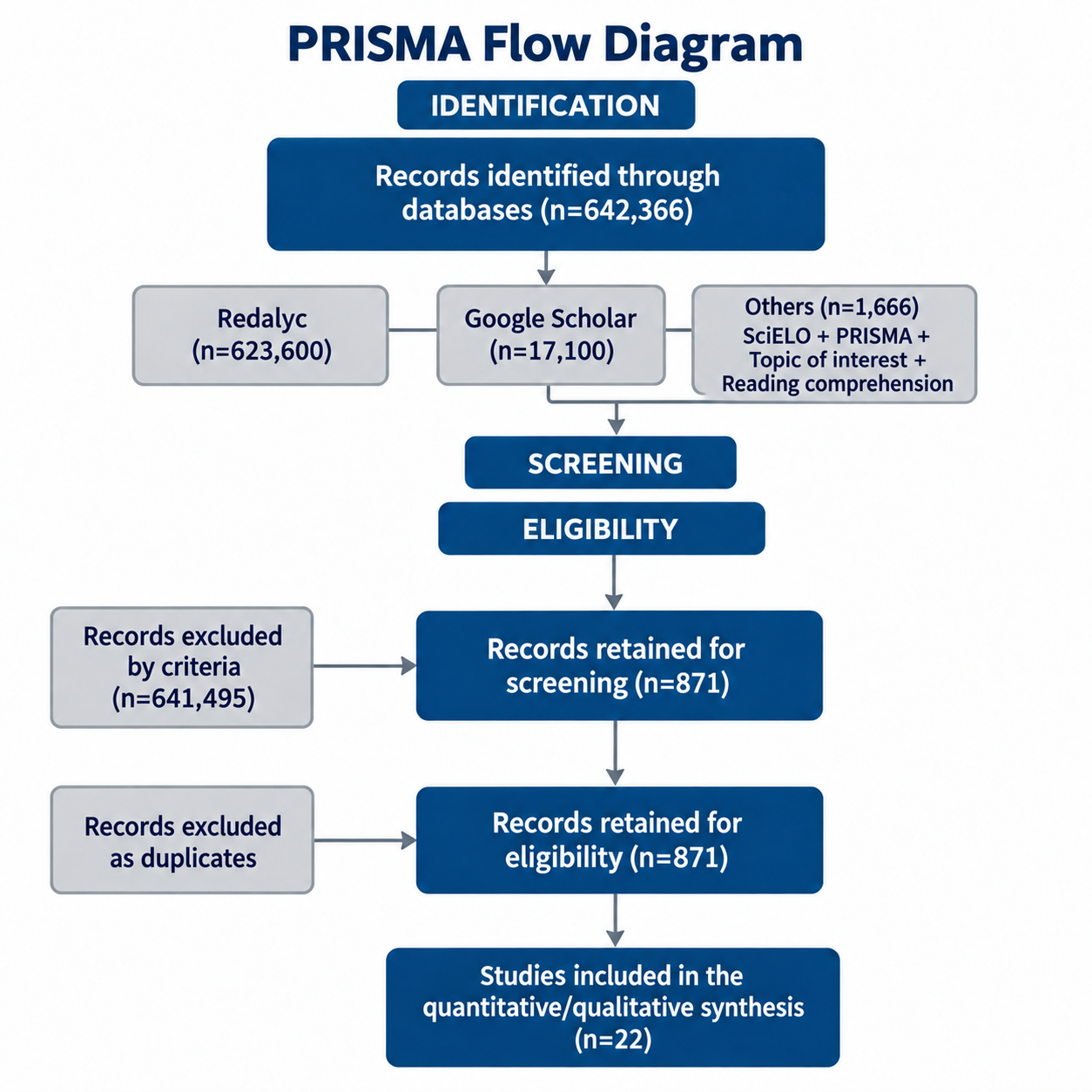
The document analysis based on the PRISMA statement seeks to examine the influence of the "conceptual prism" as a didactic tool on the development of reading comprehension, specifically through the implementation of centers of interest among lower secondary education students. The preliminary search identified 642,366 records from sources such as Redalyc, Google Scholar, and SciELO. During the screening phase, 641,495 records were excluded; the majority of exclusions resulted from the application of rigorous criteria regarding publication date and specific subject matter, alongside criteria concerning language, accessibility, and source type or methodology. This rigorous filtering reduced the set to 871 records that initially met the inclusion criteria. Following a more detailed review—which included the removal of duplicates and a final eligibility assessment—the study corpus was consolidated into 22 records, which were ultimately included in the quantitative and/or qualitative synthesis.
The graph representing the PRISMA flow is shown below.
Figure 1.
PRISMA flow diagram
Source: own elaboration.
Note: the figure appears in its original language.
The research question guiding this study is formulated as follows: How does the use of the "conceptual prism" as a didactic tool—implemented through "centers of interest"—affect the development of reading comprehension among lower secondary education students?
In line with this question, the general purpose of the research is to analyze the influence of the conceptual prism as a didactic resource on strengthening critical reading comprehension through the application of centers of interest with lower secondary education students aged 14 to 18.
To achieve this general objective, the following specific objectives are formulated:
- Identify the needs, challenges, and current reading comprehension levels of lower secondary students, as well as their primary literary interests, in order to develop relevant and meaningful "centers of interest."
- Design and implement a sequence of pedagogical activities that integrate the conceptual framework with centers of interest, aimed at strengthening literal, inferential, and critical reading comprehension levels while fostering student motivation and active engagement through topics that are meaningful to them.
- Evaluate the impact of the implemented strategy on students' reading comprehension and formulate recommendations or adjustments to optimize the use of the conceptual framework in similar educational contexts.
Conceptual framework
The theoretical-conceptual framework is built upon a systematic document review guided by the PRISMA methodology. The research categories guiding the reflection are the conceptual prism, centers of interest, and reading comprehension.
Conceptual prism
The conceptual prism is an emerging graphic organizer developed over the last three years (D. V. Franco-Gallego, 2024). Although there is existing documentation regarding its applicability, it is still considered a recent proposal that requires further study to demonstrate its validity from a robust scientific and methodological perspective.
Based on the texts examined in the review, it can be argued that this organizer is distinguished by its ability to foster reading comprehension processes. Its design allows for a text to be approached through its macrostructure, microstructures, pragmatic aspects, and critical dimensions, thereby promoting critical analysis, argumentation, and a more complex level of understanding. Likewise, existing studies agree that its primary contribution lies in strengthening students' analytical, inferential, and critical thinking skills, enabling a more rigorous and conscious approach to reading (D. Franco-Gallego, 2024).
Regarding this graphic organizer, it can also be maintained that it enhances the development of analytical and reflective skills through formative assessments that facilitate continuous guidance. Thus, the conceptual prism emerges as a comprehensive educational tool capable of going beyond simple text analysis. Its organization—based on macrostructures (general theme), microstructures (supporting ideas), pragmatics (functionality), and critical analysis—fosters a complex understanding of the content and mobilizes essential skills such as analysis and argumentation.
Ultimately, the conceptual prism stands out as a valuable pedagogical resource due to its nature and characteristics; its importance lies not only in its structure but also in its ability to integrate the three levels of critical reading: literal, inferential, and critical. When compared to traditional graphic organizers—such as concept maps, mind maps, comparison charts, or conceptual mind-facts—the conceptual prism offers a more organized approach to mobilizing these processes.
In this regard, Franco Gallego (2024) has systematized significant advancements in the critical thinking of students who employ this approach. However, this position is strengthened through dialogue with other pedagogical approaches or strategies regarding reading comprehension—such as those of Maldonado et al. (2023), who emphasize the need for differentiated strategies based on the specific text type being addressed.
Thus, the use of the conceptual prism does not constitute a rigid or doctrinaire exercise; rather, it is a flexible tool that can be implemented across various educational settings or styles.
Centers of Interest
This category refers to a pedagogical strategy structured around the interests and needs of the student body, aimed at fostering motivation and active participation in the learning process. Gallego Serna and Rojas Tombe (2022) maintain that centers of interest constitute an active methodology designed to develop meaningful classroom processes, as well as practical, experiential learning that takes the educational context into account—a decisive factor in ensuring students' natural participation.
Regarding centers of interest, Cerda Etchepare et al. (2021) note that they function as thematic stimuli that trigger the spontaneous generation of words, thereby allowing for the analysis of available lexicon and its semantic relationships within specific curricular domains. In their findings, Cerda Etchepare et al. (2021) acknowledge the importance of centers of interest for identifying students' available lexicon in these domains, reflecting both their conceptual understanding and potential educational gaps in key areas. Consequently, centers of interest serve as a vital resource for investigating the link between student vocabulary and conceptual understanding, enabling the identification of deficiencies and educational needs across various curricular areas (Rodríguez Jiménez, 2025).
Furthermore, the integration of the conceptual framework with centers of interest strengthens reading comprehension by serving as a pedagogical tool that boosts student motivation. It also creates the necessary conditions for developing more meaningful reading processes. By connecting personal interests with analytical structures, a more conscious approach to the text is fostered, laying the groundwork to strengthen various dimensions of reading comprehension—particularly those linked to critical thinking and the construction of meaning.
Reading Comprehension
Benavides and Zambrano-Ramírez (2023) state that the central purpose of reading comprehension is learning, as it establishes cognitive, metacognitive, and motivational processes—as well as practices—that enable the processing and organization of information regarding the subject matter to be learned. This category is fundamental because it links learning with personal and holistic development.
Sánchez-Bejerano et al. (2023) assert that strengthening reading comprehension is a genuine need for secondary school students. In contrast, Peña Rañileo et al. (2021) maintain that it is a broad process involving the autonomous use of a consolidated set of cognitive and metacognitive strategies; this demonstrates that, while not a simple task, it is fundamental to the individual's development.
In this regard, Roldán et al. (2021) state that reading comprehension is a fundamental tool for academic learning, as it helps process, organize, and contextualize information in order to construct meaning. For their part, Quiroz Palomino (2021) defines it as a constructive and interactive process in which the reader grasps the text's meanings and establishes connections with their own knowledge.
According to Gaibor Zurita et al. (2023), reading comprehension is understood as a practice that unfolds across several levels: literal, inferential, and critical. Similarly, Pinto and Rojas (2019) note that it is a constructive and interactive process in which the individual captures the text's meanings, makes sense of them, and establishes a link between what the text presents and what the reader already knows. Furthermore, Bernal-Ruiz et al. (2024) conceptualize it as a multifaceted competence involving the mental representation of the text and its meaning, allowing the reader to grasp the material and connect it with prior knowledge.
In the realm of language learning, Matamala Poblete and Muñoz Muñoz (2024) acknowledge that English proficiency is crucial within the Chilean school context, given that written texts serve as a significant resource for young people with limited exposure to the language. Furthermore, Hodelín Barrientos et al. (2024) emphasize the importance of reading comprehension for learning, as it enables students to construct meaning through the interaction between prior and newly acquired knowledge. Along these lines, Misari (2023) notes that this process involves active reader participation, utilizing cognitive strategies to grasp the text's content and develop new knowledge.
On the other hand, Armijos Uzho et al. (2023) argue that a lack of innovative methodological strategies constrains reading comprehension; consequently, they recommend using information and communication technologies to foster an interest in reading. Similarly, Francia-Jesús et al. (2022) recognize that reading comprehension is pivotal to academic performance and is influenced by factors such as self-esteem—an influence that particularly affects the inferential and critical levels, though not the literal one.
From a textual perspective, Maldonado et al. (2023) propose that reading comprehension of argumentative texts requires strategies aimed at processing information and managing textual structure, while also being influenced by motivational, sociocultural, and lexical factors. Meanwhile, Misari (2023) asserts that reading comprehension is a fundamental prerequisite for developing communicative competence and that a significant relationship exists between the two variables. Finally, the same author notes that critical comprehension entails the ability to reflect on and evaluate the text, whereas inferential comprehension requires analytical skills on the part of the reader.
Similarly, Hernández Rodríguez and Rodríguez Ortiz (2022) state that reading is not merely an acquired skill but also a process or competence that seeks to enhance critical and creative thinking. This aligns with the views of Intriago Cedeño et al. (2025), who maintain that reading comprehension is essential for autonomous and critical functioning, as it enables the analysis and transformation of information into meaningful learning.
Regarding the implementation of strategies to boost this competence, Wilson et al. (2023) argue that the use of concept maps significantly reinforces reading comprehension by allowing students to structure and organize knowledge hierarchically. Likewise, Mekuria et al. (2024) specify that metacognitive strategies strengthen reading comprehension, particularly at the inferential and critical levels.
Along similar lines, Roldán et al. (2021) state that thinking tools—such as concept maps—facilitate reading comprehension by fostering knowledge structuring and meaningful learning among students. For their part, Garcia-Pinilla and Rodríguez-Jiménez (2021) indicate that this competence is essential for learning and for engagement within the realms of education and culture.
Furthermore, Muche et al. (2024) explain that learning strategies are significantly linked to reading comprehension due to their impact on the planning, monitoring, and evaluation of the learning process. In this regard, Esquivel Rivera (2021) posits that reading comprehension is a dynamic process requiring interaction between the reader and the text, and involving both pedagogical and evaluative strategies to construct meaning and enhance learning.
Finally, Romero-Contreras et al. (2021) explain that the implementation of reading comprehension workshops significantly improves students' communicative competence. Similarly, Novoa-Castillo et al. (2021) report that reading comprehension improves significantly through the application of metacognitive strategies, as evidenced by the superior performance of experimental groups compared to control groups.
METHODOLOGY
It is worth noting at the outset that the research and pedagogical experience were conducted with the informed consent of the participants and their legal representatives, as well as with institutional authorization; furthermore, anonymity was guaranteed in the data processing. To provide a foundation for the intervention and to understand how the conceptual framework and "centers of interest" have been addressed in recent studies, a systematic document review was carried out. The PRISMA model was employed for this purpose, guiding the rigorous identification and selection of relevant references. This procedure ensured coherence among the study's theoretical framework, methodology, and pedagogical decisions.
Methodological Design
The research adopts a mixed-methods approach by integrating two complementary methodological components: a document review following the PRISMA statement and Design-Based Research (DBR). The document review enabled the identification, selection, and analysis of relevant theoretical references in accordance with PRISMA criteria (Page et al., 2021), thereby fostering greater transparency, rigor, and coherence in the construction of the conceptual framework.
The mixed-methods approach is justified by its combination of qualitative elements—linked to the analysis of the study's core categories (reading comprehension and centers of interest)—and quantitative components, such as the use of structured surveys with Likert-type scales to assess perceptions and achievement levels in literal, inferential, and critical comprehension, as noted by Acosta (2023) in characterizing this type of design.
Furthermore, the research was grounded in the principles of Design-Based Research, understood as a flexible, systematic process aimed at improving educational strategies through iterative cycles of design, implementation, and evaluation. According to Coicaud (2021), this approach goes beyond merely explaining educational phenomena; it intervenes directly in them to bring about well-founded transformations. This perspective was particularly essential for the study, as it allowed the pedagogical strategy to be adjusted in response to emerging progress and challenges.
Population and sample
The population for the study consisted of 462 students in grades 6 through 11. The selected sample comprised 134 secondary school students from grades 10 and 11, aged 14 to 18. This sample represents 29% of the total population and was selected using convenience sampling, based on the level of critical reading skills the students had developed during their academic education.
Procedure
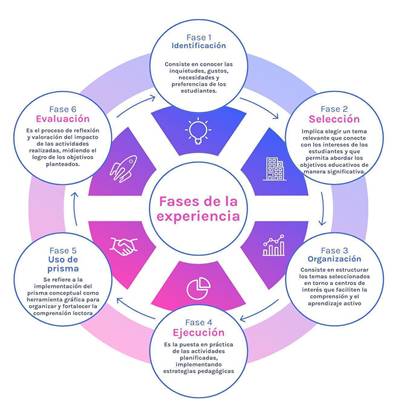
The strategy was organized into a pedagogical sequence comprising six consecutive phases: an initial reading comprehension assessment, identification of student interests, thematic selection, design of interest centers, implementation of the conceptual framework, and evaluation of results.
Two main instruments were used to collect information: an initial diagnostic test to determine levels of literal, inferential, and critical reading, and a structured survey using a Likert scale to assess students' perceptions of the experience.
Additionally, participant observation with qualitative recording was implemented to supplement the information. Quantitative data were systematized using percentages and comparative tables, while qualitative information was analyzed through emerging categories that allowed for the identification of patterns in the participants' responses and assessments. Figure 2 details the procedure by phase.
Figure 2.
Phases of the experience
Source: own elaboration.
Note: the figure appears in its original language.
Identification of reading comprehension level:
During this phase, a diagnostic assessment was conducted to evaluate the students' reading comprehension process prior to the implementation of the strategy.
Identification of interests and needs:
To identify the students' interests, needs, and preferences, a survey was administered featuring the following questions:
· Which literary genres appeal to you the most?
· Which literary genre do you feel unfamiliar with but would like to explore?
· If you could turn your life into a book, what genre would it be?
Topic selection:
Based on the survey results, a topic is selected to be developed through "centers of interest."
Organization of centers of interest:
This phase involves structuring the selected topics around centers of interest that facilitate understanding and active learning, while fostering student participation. This organization is illustrated in the following table:
|
Table 1. Organization of centers of interest |
|||||
|
Center of Interest (genre) |
Presentation on the literary genre |
Art exhibition and related objects |
Reading of texts |
Discussion Session |
Development of a conceptual prism |
|
Romance |
Presentation of the characteristics, evolution, and prominent authors of the Romantic genre. |
Exhibition of romance novel covers, love letters, and inspiring music. |
Reading excerpts from classic or contemporary love stories. |
Reflection on love, emotional conflicts, and the values represented. |
Analysis of a Romantic excerpt, addressing literal, inferential, and critical levels. |
|
Adventure |
Explanation of the genre's key elements: heroes, challenges, and explorations. |
Display of maps, travel illustrations, and representative objects. |
Reading chapters from travel novels or accounts of exploration. |
Discussion on the spirit of adventure, challenges, and personal growth. |
Critical analysis of an adventure excerpt through the conceptual prism. |
|
Terror |
Description of the genre's characteristics, its evolution, and iconic authors. |
Presentation of dark imagery, book covers, and objects symbolizing fear. |
Reading short stories or excerpts from horror novels. |
Debate on fear, the unknown, and the emotions they evoke. |
Application of the conceptual prism to break down a horror text. |
|
Poetry |
Overview of the genre, its styles, literary devices, and significant poets. |
Display of illustrated poems and objects evoking the poetic. |
Reading of poems notable for their symbolism and literary beauty. |
Dialogue on emotions, metaphors, and subjectivity in the texts. |
Analysis of a poem using a literal, inferential, and critical approach. |
|
Historical |
Explanation of the historical genre, its connection to real events, and influential authors. |
Showcase of documents, antique maps, and elements representative of bygone eras. |
Reading of excerpts from novels based on historical events. |
Discussion on historical context, characters, and their contemporary relevance. |
Contextualized analysis of a historical excerpt through a conceptual lens. |
Source: own elaboration.
Execution of the experience:
This phase involves carrying out the planned strategies through the implementation of instructional activities designed to foster cognitive acquisition and connect participants with the topics addressed.
Use of the conceptual prism:
This refers to utilizing the conceptual prism as a graphic organizer to strengthen the reading and critical understanding of the content covered.
Evaluation of the experience:
This constitutes the process of reflecting on and assessing the impact of the activities, measuring the extent to which the proposed objectives were met and the effectiveness of the strategies implemented.
During this phase, a Likert-scale survey was administered to the participating group. The response options were: strongly agree, agree, disagree, and strongly disagree. The structure of the instrument is outlined in the following table.
|
Table 2. Structure of the experience evaluation survey |
||||||||
|
Criterion |
Design and relevance of the pedagogical experience |
Development of reading comprehension |
Application and transfer of knowledge |
Overall assessment. |
||||
|
Question |
Do you consider that the use of the conceptual prism facilitated the understanding of the texts studied? |
Were the selected centers of interest meaningful and motivating for you? |
Did the organization of activities (readings, debates, analyses) contribute to meaningful learning? |
Do you consider that you improved your literal comprehension of the texts thanks to this experience? |
Did the conceptual prism help you make inferences and connect ideas within the text? |
Does the experience foster the development of critical thinking regarding the texts studied? |
Did the methodology used increase your interest in reading and analyzing texts? |
Would you recommend using the conceptual prism and centers of interest for future pedagogical experiences? |
|
Answer options |
Strongly agree, agree, disagree, strongly disagree. |
Strongly agree, agree, disagree, strongly disagree. |
Strongly agree, agree, disagree, strongly disagree. |
Yes, absolutely. No, definitely. |
||||
Source: own elaboration.
Finally, the results obtained from the population regarding critical reading levels following the implementation of the conceptual prism as a pedagogical strategy were taken into account.
This section presents the most relevant results obtained using the previously described instruments. First, the findings from the diagnostic assessment are presented; the results were as follows:
|
Table 3. Reading comprehension assessment |
|||||
|
Grade |
Number of students |
Literal level |
Inferential level |
Critical level |
Total |
|
10 |
72 |
80.0% |
66.7% |
20% |
55,6 |
|
11 |
62 |
90.0% |
80% |
60% |
76,7 |
Source: own elaboration.
The results demonstrate better performance in the 11th grade, particularly at the inferential (80%) and critical (60%) levels, whereas the 10th grade shows a low percentage in critical comprehension (20%). Although both grades achieve good results in literal comprehension, the difference in the overall average (76.7% for 11th grade and 55.6% for 10th grade) highlights the need to strengthen critical thinking among 10th-grade students. Furthermore, the disparity between the two grades regarding critical comprehension reveals that the strategy's impact varies according to the students' level of cognitive development. The 10th-grade performance thus reaffirms the need to foster critical thinking from an earlier age, in line with the research problem. Subsequently, following the completion of the phases and the administration of the evaluation survey, the following results were obtained:
Figure 3.
The conceptual prism and reading comprehension
Source: own elaboration.
Note: the figure appears in its original language.
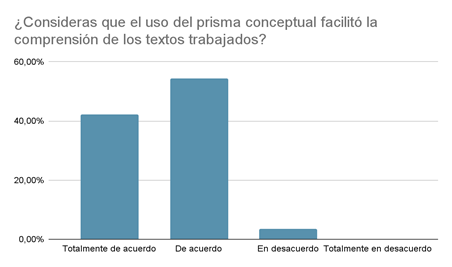
Based on the results, it can be argued that the conceptual prism was notably well-received as a practical tool for text comprehension, garnering 96.5% favorable opinions. Specifically, 54.4% of the participants stated they "strongly agreed" regarding its effectiveness, while 42.1% indicated they "agreed." These data demonstrate that the strategy was well-received in the context of reading development.
However, 3.5% of participants expressed disagreement, although no one selected the "strongly disagree" option. The absence of responses in this latter category suggests that, while the tool may not have achieved the expected impact in every instance, the overall assessment remains positive. This perspective opens the door to considering adjustments in its implementation, such as adapting it to different learning styles.
Drawing on the implementation of the conceptual prism and its impact on reading comprehension, Franco Gallego (2024) asserts that this graphic organizer enhances critical thinking by structuring text comprehension through various frameworks, including macrostructures, microstructures, and pragmatic and critical dimensions. The study's results confirm its effectiveness, given that 96.5% of participants evaluated it positively—with 54.4% expressing strong agreement and 42.1% indicating agreement. This level of acceptance aligns with the findings of Quiroz Palomino (2021), who highlights the value of graphic organizers in fostering meaningful learning.
Furthermore, the conceptual prism supports continuous guidance throughout the learning process. Franco Gallego (2024) notes that its implementation not only enables a deeper understanding of texts but also promotes analysis and interpretation. This is evidenced by the study, in which 96.5% of participants stated that this pedagogical practice helped them identify inferences and establish connections between ideas within the text. However, 3.5% reported difficulties with its application, highlighting the need to provide greater support to students to ensure its implementation.
Furthermore, given that the "centers of interest" are designed to strengthen reading comprehension based on students' interests, the following literary genres were selected: romance, adventure, horror, poetry, and historical fiction. The general results of the evaluation of these centers of interest are presented in the following figure.
Figure 4.
Impact of centers of interest
Source: own elaboration.
Note: the figure appears in its original language.
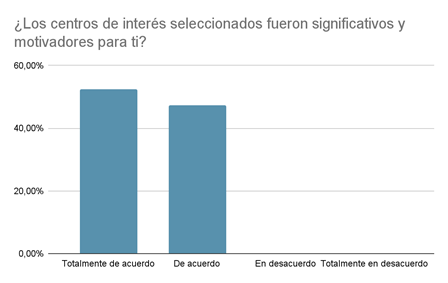
The results reveal a markedly favorable assessment regarding the selection of "centers of interest," as all participants deemed this strategy pertinent and appropriate. Specifically, 52.6% stated they "strongly agreed," and 47.4% stated they "agreed." These data indicate that the proposed content successfully captured the students' attention and sparked their interest, suggesting alignment with their needs, interests, and prior knowledge.
The absence of responses in the "disagree" and "strongly disagree" categories indicates no signs of rejection or lack of motivation regarding the selected thematic topics. Nevertheless, it remains essential to continue exploring new content and active methodologies to sustain this level of acceptance.
Furthermore, the students rated the centers of interest exceptionally well, achieving a 100% approval rate, with 52.6% selecting "strongly agree" and 47.4% selecting "agree." These findings support the views of Cerda Etchepare et al. (2021), who argue that organizing knowledge around topics of interest fosters vocabulary recognition and links it to specific curricular areas. However, Gaibor Zurita et al. (2023) caution that while this strategy can boost motivation, it does not always guarantee improvements in inferential (39%) and critical (26%) comprehension. Although 98.2% of the participants acknowledged that the strategy had a positive impact on their critical thinking, 7% reported making no progress at the literal level.
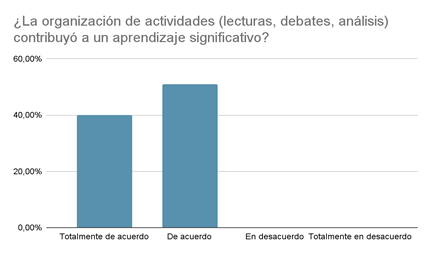
Figure 5.
Organization and meaningful learning
Source: own elaboration.
Note: the figure appears in its original language.
The data demonstrate that organizing activities such as readings, debates, and analyses was highly effective in fostering meaningful learning, yielding 100% positive responses. Specifically, 49.1% of participants "strongly agreed" with this statement, while 50.9% "agreed." This indicates that the planning and sequencing of the activities had a positive impact on the learning process, facilitating both comprehension of and critical reflection on the material covered.
The absence of responses in the "disagree" and "strongly disagree" categories confirms that there were no negative assessments regarding how the activities were structured; this demonstrates that the chosen method was well-suited to encouraging participation and reinforcing the material learned. Nevertheless, these results also suggest a need to continue refining the organization of these activities—ensuring they remain dynamic, challenging, and contextually relevant—to maintain this high level of student acceptance.
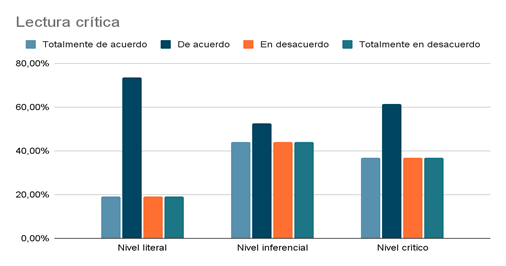
Figure 6.
Development of critical reading skills
Source: own elaboration.
Note: the figure appears in its original language.
The results reflect a predominantly positive perception of the experience's effect on literal comprehension, inferential ability, and critical thinking development. Regarding literal comprehension, 93% of participants indicated that it improved as a result of the experience, with 19.3% "strongly agreeing" and 73.7% "agreeing." However, 7% expressed disagreement, highlighting the need to optimize strategies to ensure all students progress at this level of comprehension.
Regarding the use of the conceptual prism to draw inferences and connect ideas within the text, 96.5% rated it positively (43.9% "strongly agreed" and 52.6% "agreed"), while only 3.5% recorded a negative response. As for critical thinking development, 98.2% recognized the experience as a favorable factor, with 36.8% "strongly agreeing" and 61.4% "agreeing." The process's effectiveness is reinforced by the absence of "strongly disagree" responses across all questions, although the small percentage of disagreement drives the continuous improvement of strategies to foster an even more inclusive and enriching experience.
Regarding pedagogical strategies, Benavides and Zambrano-Ramírez (2023) state that reading comprehension is directly linked to cognitive and motivational processes; this aligns with the study's findings, as 94.7% of participants affirmed that the strategy increased their interest in reading and text analysis. However, 5.3% stated they had not noticed significant progress. According to Muche et al. (2024), these pedagogical strategies have a notable impact on reading comprehension—a fact demonstrated in the study through improved inference identification and strengthened critical thinking. That said, authors such as Maldonado et al. (2023) demonstrate that the study of argumentative texts requires specific techniques to understand their structure, suggesting that the conceptual framework could be integrated with other methodologies depending on the type of text analyzed.
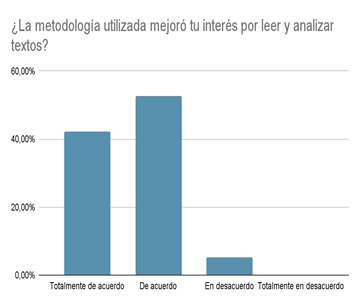
Figure 7.
Impact of the methodology
Source: own elaboration.
Note: the figure appears in its original language.
The results demonstrate that the methodology employed had a predominantly positive impact on interest in reading and text analysis, with 94.7% of responses being favorable. Specifically, 42.1% stated they "strongly agreed," while 52.6% indicated they "agreed." These findings show that the strategies implemented succeeded in generating motivation among the majority of students.
On the other hand, 5.3% of the study group indicated they "disagreed," suggesting that while the strategy was effective overall, not all participants perceived an improvement in their interest in reading.
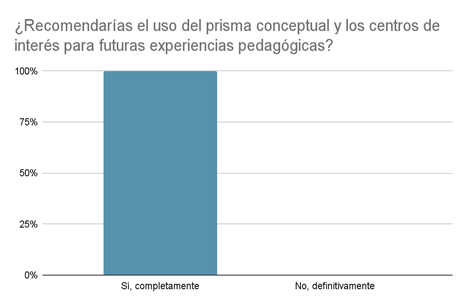
Figure 8.
General assessment
Source: own elaboration.
Note: the figure appears in its original language.
The results confirm the unanimous acceptance of the conceptual prism and "centers of interest" as valid pedagogical strategies, as all participants would recommend their use in future teaching interventions. This unanimity supports the conclusion that students viewed both educational approaches as useful learning resources, as they facilitated the understanding, analysis, and critical reflection regarding the texts studied.
Similarly, the absence of responses selecting the "No, definitely" option indicates that no negative views regarding these methodologies were recorded. This finding not only acknowledges their validity in the setting where they were implemented but also highlights their potential for application in other educational contexts.
In addition to the use of questions, another data collection technique was employed: participant observation. To this end, a data collection instrument was designed, consisting of descriptive qualitative rubric. In practice, the results obtained were as follows:
|
Table 4. General evolution of results in the implementation of the conceptual prism |
||
|
Phase |
Activity description |
Observed level of achievement |
|
Phase 1: Diagnosis |
Implementation of a literal, inferential, and critical comprehension activity based on a text, without the mediation of the conceptual prism. |
Low level of comprehension: students struggled to establish connections, identify the author's intentions, and formulate their own questions. |
|
Phase 2: Partial implementation |
Guided application of the conceptual prism, focused on a specific reading and directing the identification of ideas, emotions, questions, relationships, and metaphors. |
Intermediate level of comprehension: students began to formulate questions and detect basic connections between elements of the text. |
|
Phase 3: Autonomous implementation |
Autonomous application of the conceptual prism by students, using diverse texts integrated into themes of interest selected by the students themselves. |
High level of comprehension: students were able to interpret critically, establish multiple connections, and use metaphors consciously. |
Source: own elaboration.
The information systematized in the table demonstrates significant progress in students' reading comprehension across the three phases of the implemented strategy. The initial assessment revealed limited comprehension, characterized by difficulties in identifying main ideas, establishing connections between concepts, and formulating questions based on the text—reflecting a reading experience centered on rote memorization.
During the second stage, the incorporation of the "conceptual prism" framework—guided by the teacher—led to notable advances: students began identifying emotions, formulating questions, and establishing internal connections within the texts. This demonstrates that the pedagogical methodology facilitates more complex analytical processes.
In the final phase, the participating students used the graphic organizer autonomously, driven by their own interests. This experience resulted in more robust critical reading, characterized by the generation of personal inferences, the use of literary devices, and the construction of substantiated arguments. The observed progress reflects not only cognitive development but also the successful adoption of the strategy. Given that the conceptual prism framework fosters development at the literal, inferential, and critical levels, the following results were achieved; these can be compared with the findings from the initial diagnostic assessment.
|
Table 5. Comparative analysis of the results |
|||
|
Reading level. |
Diagnostic result (overall average) |
Subsequent result (using the conceptual prism) |
Percentage improvement |
|
Literal. |
85.0% |
95.7% |
+10.7% |
|
Inferential. |
73.35% |
92.9% |
+19.5% |
|
Critical. |
40.0% |
89.0% |
+49.0% |
|
Overall average. |
66.1% |
92.5% |
+26.4% |
Source: own elaboartion.
These results demonstrate the positive impact of the pedagogical intervention, which, by incorporating the conceptual prism into the centers of interest, moves beyond traditional approaches and fosters active, critical, and proactive reading.
CONCLUSIONS
Research results demonstrate that using the "conceptual prism" has a positive impact on strengthening reading comprehension through a critical reading strategy, with a 96.5% approval rate among participants. Its implementation led to improvements at both the inferential and critical levels, enabling a more complex understanding of texts. However, 3.5% of participants reported difficulties using it, suggesting a need for methodological refinements to ensure its effectiveness across different learning styles.
Furthermore, identifying literary affinities allows for the creation of "centers of interest" that spark high student motivation, achieving 100% acceptance. Nevertheless, 7% of students still struggled with literal-level comprehension, indicating that increased motivation does not automatically guarantee learning. These findings highlight the importance of designing complementary strategies to address the various levels of reading comprehension.
Students responded positively to the design and implementation of pedagogical strategies centered on specific themes—incorporating the conceptual prism as a graphic organizer—with 100% approval regarding the organization of readings, presentations, and interpretations. This finding suggests that integrating activities around engaging thematic topics boosts motivation and fosters meaningful learning. However, the methodology requires further strengthening to ensure progress across all levels of critical reading.
Finally, 94.7% of participants reported an increased interest in reading, validating the conceptual prism and centers of interest as innovative pedagogical strategies. Yet, 5.3% reported no substantial improvement, highlighting the need to integrate complementary approaches, such as active learning methodologies and more effective teacher guidance.
While the majority of participants viewed the implemented pedagogical strategy positively, 3.5% reported experiencing difficulties during its application. This situation demonstrates that interest or motivation does not always guarantee improvements in reading. Consequently, adopting a socio-constructivist approach centered on student learning makes it essential to identify these variations and adjust methodology and pedagogical practices. Likewise, the fact that 7% of students showed no progress at the literal level necessitates the continued development of innovative strategies tailored to the specific characteristics and nature of the groups.
Finally, although the results show significant improvements across various levels of critical reading, they must be analyzed carefully given certain methodological limitations. The absence of a control group makes it impossible to establish direct causal links between the intervention and the observed progress. Therefore, a scientific reflection based on a quasi-experimental design is required to ensure a more robust comparative process.
REFERENCES
Armijos Uzho, A., Paucar Guayara, C., & Quintero Barberi, J. (2023). Estrategias para la comprensión lectora: Una revisión de estudios en Latinoamérica. Revista Andina de Educación, 6(2), 000626. https://doi.org/10.32719/26312816.2022.6.2.6
Benavides, N., & Zambrano-Ramírez, J. (2023). Comprensión lectora autorregulada apoyada en tecnología en estudiantes de Educación Básica. Revista Electrónica Educare, 27(3), 1–19. https://doi.org/10.15359/ree.27-3.17221
Bernal-Ruiz, F., Guzmán, C., Gamboa, M., Pizarro-Díaz, N., Núñez, A., & Cañas, M. (2024). Efecto de la inhibición y la flexibilidad cognitiva en la comprensión lectora de escolares. Pensamiento Educativo, Revista de Investigación Educacional Latinoamericana, 61(3). https://doi.org/10.7764/PEL.61.3.2024.6
Cerda Etchepare, G., Perez Wilson, C., & Chandia Muñoz, E. (2021). Disponibilidad léxica en centros de interés asociados a ejes curriculares de matemáticas en estudiantes de contextos de alta vulnerabilidad social. Revista de Estudios y Experiencias en Educación, 20(42), 33–51. https://doi.org/10.21703/rexe.20212042cerda2
De Oliveira, A. M., Santos, J. L. F., & Capellini, S. A. (2023). Reading comprehension performance of elementary and senior high school students. Frontiers in Education, 8, 1086040. https://doi.org/10.3389/feduc.2023.1086040
Esquivel Rivera, A. (2021). Propuesta de protocolo de investigación para el diseño de secuencias didácticas para la comprensión lectora de textos científicos. Dilemas contemporáneos: Educación, Política y Valores. https://doi.org/10.46377/dilemas.v8i2.2554
Estupiñan Corredor, G. del C. (2025). Concepciones docentes sobre políticas públicas colombianas implementadas en post pandemia específicamente en lectura y comprensión lectora. Latam: revista latinoamericana de Ciencias Sociales y Humanidades, 6(3), 32. https://dialnet.unirioja.es/servlet/articulo?codigo=10329615
Francia-Jesús, M. E., Mendoza-González, A., & Andrade-Díaz, E. M. (2022). Influencia de las TIC en la comprensión lectora y la escritura creativa: Una revisión sistemática. Tierra Nuestra, 16(1), 68–78. https://doi.org/10.21704/rtn.v16i1.1899
Franco Gallego, D. V. (2024). El prisma conceptual como herramienta para el fortalecimiento de la lectura crítica. Praxis Pedagógica, 24(37), 268–294. https://doi.org/10.26620/uniminuto.praxis.24.37.2024.268-294
Franco-Gallego, D. (2024). El Uso del Prisma Conceptual en la Comprensión Lectora en Estudiantes con Barreras para el Aprendizaje. Chamariz: estudios en Didáctica de la Lengua y la Literatura, (2). https://doi.org/10.25267/Chamariz.2024.i2.1106
Franco-Gallego, D. V. (2024). Prisma conceptual: Un organizador gráfico integral para la comprensión lectora. Dékau Perú, 2(1), 10–20. https://doi.org/10.55996/dekape.v2i1.241
Gaibor Zurita, C. C. E., Sánchez Bonilla, A. M., Enríquez Jaya, B. M., Guajan Guevara, Y. G., & Bonilla-Jiménez, M. M. (2023). La comprensión lectora como fundamento del pensamiento crítico. Ciencia Latina Revista Científica Multidisciplinar, 7(2), 8756–8776. https://doi.org/10.37811/cl_rcm.v7i2.5985
Gallego Serna, I. C., & Rojas Tombe, P. A. (2022). Elementos de los Centros de Interés como Transformadores de los Ambientes de Aprendizaje en la Fundación Valora-t. https://repository.unilasallista.edu.co/items/12c9165a-9f33-47c0-bb35-6d516be356f7
Garcia-Pinilla, J. I., & Rodríguez-Jiménez, O. R. (2021). Círculos de Enseñanza como estrategia para mejorar la comprensión lectora. Educación y Educadores, 24(2), 267–286. https://doi.org/10.5294/edu.2021.24.2.5
Hernández Rodríguez, J. C., & Rodríguez Ortiz, A. M. (2022). ¡Pongámosle lógica! Aportes al pensamiento crítico, la argumentación y la comprensión lectora a partir del aprendizaje de la lógica formal. Folios, (56). https://doi.org/10.17227/folios.56-12712
Hodelín Barrientos, A., Moreira Carbonell, C., & Cuña Quintana, B. L. (2024). Orientación didáctica de la comprensión lectora, como nodo interdisciplinar, en preuniversitario. EduSol, 24(86), 50–61. https://dialnet.unirioja.es/servlet/articulo?codigo=9538197
Intriago Cedeño, A. R., Andrade Rosado, G. L., Aranda Pazmiño, S. P., Briones Iturralde, M. E., & Remache Guerrero, C. G. (2025). Estrategias activas para el mejoramiento de la comprensión lectora en estudiantes de básica media: Active strategies for the improvement of reading comprehension in middle school students. LATAM Revista Latinoamericana de Ciencias Sociales y Humanidades, 6(2). https://doi.org/10.56712/latam.v6i2.3640
Kuhfeld, M., Lewis, K., & Peltier, T. (2023). Reading achievement declines during the COVID-19 pandemic: Evidence from 5 million U.S. students in grades 3–8. Reading and Writing, 36(2), 245–261. https://doi.org/10.1007/s11145-022-10345-8
Maldonado, F. C., Ulloa Cordova, V. D., Príncipe Concha, B., & Solis-Trujillo, B. P. (2023). Comprensión lectora de textos argumentativos: Una revisión sistemática desde el nivel básico hasta el universitario. ReHuSo: Revista de Ciencias Humanísticas y Sociales, 8(1). https://doi.org/10.33936/rehuso.v8i1.4980
Matamala Poblete, R., & Muñoz Muñoz, B. (2024). Comprensión lectora en L2: Efecto de la instrucción explícita de estrategias de aprendizaje cognitivas y metacognitivas. ALPHA: Revista de Artes, Letras y Filosofía, 1(58), 137–150. https://doi.org/10.32735/S0718-22012024000583586
Mekuria, A., Bushisho, E. W., & Wubshet, H. (2024). The effects of reading strategy training on students’ reading strategy use and critical reading ability in EFL reading classes. Cogent Education, 11(1), 2310444. https://doi.org/10.1080/2331186X.2024.2310444
Misari, A. (2023). Comprensión lectora y su relación con los niveles de competencia comunicativa. Lengua y Sociedad, 22(1), 535–555. https://doi.org/10.15381/lengsoc.v22i1.23664
Muche, T., Simegn, B., & Shiferie, K. (2024). Self-Efficacy and Metacognitive Strategy Use in Reading Comprehension: EFL Learners’ Perspectives. The Asia-Pacific Education Researcher, 33(1), 219–227. https://doi.org/10.1007/s40299-023-00721-5
Novoa-Castillo, P. F., Uribe-Hernandez, Y. C., Garro-Aburto, L. L., & Cancino-Verde, R. F. (2021). Estrategias metacognitivas en entornos digitales para estudiantes con baja comprensión lectora. Revista Electrónica de Investigación Educativa, 23, 1–34. https://doi.org/10.24320/redie.2021.23.e28.3953
OECD. (2024). PISA 2022 Results (Volume V): Learning Strategies and Attitudes for Life. OECD Publishing. https://doi.org/10.1787/c2e44201-en
Page, M. J., McKenzie, J. E., Bossuyt, P. M., Boutron, I., Hoffmann, T. C., Mulrow, C. D., Shamseer, L., Tetzlaff, J. M., Akl, E. A., Brennan, S. E., Chou, R., Glanville, J., Grimshaw, J. M., Hróbjartsson, A., Lalu, M. M., Li, T., Loder, E. W., Mayo-Wilson, E., McDonald, S., … Moher, D. (2021). The PRISMA 2020 statement: An updated guideline for reporting systematic reviews. BMJ, n71. https://doi.org/10.1136/bmj.n71
Peña Rañileo, K., Ponce Godoi, A., Montecinos Herrera, D., Torres Reinoso, D., Catalán Montiel, P., & Villagra Bravo, C. (2021). Comprensión de textos escritos a través del trabajo colaborativo en la Educación Básica. Revista de Estudios y Experiencias en Educación, 20(43), 455–475. https://doi.org/10.21703/rexe.20212043pena24
Pinto, J. P., & Rojas, S. P. (2019). Lectura crítica en el aula en relación con dimensiones inferencial y literal. Educación y Ciencia, (23), 265–279. https://doi.org/10.19053/0120-7105.eyc.2019.23.e10284
Quiroz Palomino, N. E. (2021). Mapas conceptuales como estrategia para la comprensión lectora en estudiantes de primaria [Universidad Cesar Vallejo]. https://www.lareferencia.info/vufind/Record/PE_b18222a1f41e7fbcf987d29ef9dfea11
Rodríguez Jiménez, M. R. (2025). Análisis de las prácticas pedagógicas en los centros de interés para la comprensión lectora en la educación básica secundaria. GADE: Revista Científica, 5(3), 1003–1022. https://doi.org/10.63549/rg.v5i3.761
Roldán, L. Á., Zabaleta, V., & Barreyro, J. P. (2021). Efectos de una propuesta para mejorar la comprensión de textos en estudiantes de educación secundaria. Revista mexicana de investigación educativa, 26(89), 575–594. https://www.scielo.org.mx/scielo.php?pid=S1405-66662021000200575&script=sci_arttext
Romero-Contreras, S., Silva-Maceda, G., & Snow, C. E. (2021). Vocabulario académico y habilidades de lenguaje académico: Predictores de la comprensión lectora de estudiantes de primaria y secundaria en México. Pensamiento Educativo, Revista de Investigación Educacional Latinoamericana, 58(2). https://doi.org/10.7764/PEL.58.2.2021.4
Sánchez-Bejerano, L., Pérez Fernández, L. M., & Griffin, K. L. (2023). El uso de organizadores textuales para comprensión lectora en lengua meta, una experiencia durante la pandemia por la Covid-19. Educatio Siglo XXI, 41(1), 55–84. https://doi.org/10.6018/educatio.495121
Thurston, A., Bernal, G. L., Abadía Alvarado, L. K., Cockerill, M., MacKenzie, A., Keeffe, J. O., Ospina, J. M. G., Orellana, P., & Chiang, T.-H. (2023). Results from a Phase 2 exploratory trial of Paired Reading in Spanish language in Colombia. International Journal of Educational Research Open, 4, 100244. https://doi.org/10.1016/j.ijedro.2023.100244
Wilson, M., Howell, C., Martin-Morales, K., & Park, S. (2023). Concept Mapping and Reading Comprehension. Journal of Political Science Education, 19(3), 408–431. https://doi.org/10.1080/15512169.2023.2164861
FINANCING
None.
CONFLICT OF INTEREST STATEMENT
None.
STATEMENT OF ARTIFICIAL INTELLIGENCE USE
Tools for grammar and spelling correction were used, but generative artificial intelligence resources were not employed.
AUTHORSHIP CONTRIBUTION:
Conceptualization: Darwin Valmore Franco Gallego.
Data curation: Darwin Valmore Franco Gallego.
Formal analysis: Darwin Valmore Franco Gallego.
Investigation: Darwin Valmore Franco Gallego.
Methodology: Darwin Valmore Franco Gallego.
Supervision: Darwin Valmore Franco Gallego.
Validation: Darwin Valmore Franco Gallego.
Visualization: Darwin Valmore Franco Gallego.
Writing – original draft: Darwin Valmore Franco Gallego.
Writing – proofreading and editing: Darwin Valmore Franco Gallego.