doi: 10.58763/rc2026535
Scientific and Technological Research
Cognitive functioning, cognitive reserve, and creativity in older Cuban adults: a mixed study
Funcionamiento cognitivo, reserva cognitiva y creatividad en adultos mayores cubanos: un estudio mixto
Alicia Lianne García González1  *, Ariadna
Gabriela Matos Matos1 *
*, Ariadna
Gabriela Matos Matos1 *
ABSTRACT
Introduction: The research analyzes the relationship between cognitive functioning, cognitive reserve, and creativity in older adults belonging to a community classroom of the University Chair for Older Adults (CUAM) in Camagüey, Cuba.
Methodology: Using a mixed approach, with a sequential explanatory design (DEXPLIS) and purposive sampling, 10 older adults with an average age of 82.1 years were evaluated. Instruments such as the Montreal Cognitive Assessment (MoCA), the Cuban Cognitive Reserve Scale, the Creativity Questionnaire (CAQ), and semi-structured interviews with participants were used.
Results: The results showed mild cognitive impairment in domains such as memory and executive functions, with moderate-high cognitive reserve positively influenced by years of schooling. Creativity showed great variability, standing out in practical solutions (domestic inventions). Relationships were found between cognitive functioning, reserve, and creativity, with the latter showing a significant correlation with cognitive reserve. The qualitative study, through interviews, revealed exceptional cases and nuances in the relationship between the variables.
Conclusions: Although aging involves some decline, cognitive reserve and creativity act as protective factors, allowing functional adaptations and preserving quality of life.
Keywords: Adult learning, ageing, cognition, creativity.
JEL Classification: I1, I31.
RESUMEN
Introducción: La investigación analiza la relación entre el funcionamiento cognitivo, la reserva cognitiva y la creatividad en adultos mayores pertenecientes a un aula comunitaria de la Cátedra Universitaria del Adulto Mayor (CUAM) en Camagüey, Cuba.
Metodología: Mediante un enfoque mixto, con diseño explicativo secuencial (DEXPLIS) y muestreo intencional, se evaluaron 10 adultos mayores con una edad promedio de 82.1 años. Se utilizaron instrumentos como el Montreal Cognitive Assessment (MoCA), la Escala Cubana de Reserva Cognitiva, el Cuestionario de Creatividad (CAQ), así como entrevistas semiestructuradas a los participantes.
Resultados: Los resultados mostraron un deterioro cognitivo leve en dominios como memoria y funciones ejecutivas, con una reserva cognitiva moderada-alta e influenciada positivamente por años de escolaridad. La creatividad presentó una gran variabilidad, destacándose en soluciones prácticas (inventos domésticos). Se evidenciaron relaciones entre el funcionamiento cognitivo, la reserva y la creatividad, esta última con una correlación significativa con la reserva cognitiva. El estudio cualitativo, a través de entrevistas, reveló casos excepcionales y matices de relación entre las variables.
Conclusiones: Aunque el envejecimiento implica cierto declive, la reserva cognitiva y la creatividad actúan como factores protectores, permitiendo adaptaciones funcionales y preservando la calidad de vida.
Palabras clave: Aprendizaje de adultos, cognición, creatividad, envejecimiento.
Clasificación JEL: I1, I31.
Received: 29-07-2025 Revised: 19-09-2025 Accepted: 30-10-2025 Published: 01-01-2026
Editor:
Alfredo Javier Pérez Gamboa 
1Universidad de Camagüey. Camagüey, Cuba.
Cite as: García González, A. L., y Matos Matos, A. G. (2026). Funcionamiento cognitivo, reserva cognitiva y creatividad en adultos mayores cubanos: un estudio mixto. Región Científica, 5(1), 2026532. https://doi.org/10.58763/rc2026535
INTRODUCTION
The figures on cognitive impairment in older adults are alarming. In 2015, there were 46.8 million people with neurocognitive disorders and/or Alzheimer's disease worldwide, and this figure is estimated to double in two decades (Zhao et al., 2021). The increase will be more pronounced in low- and middle-income countries, which will account for more than two-thirds of cases by 2050. Latin America, in particular, will face a significant challenge due to the high costs associated with the disease and the lack of preparedness of its health systems (Lopera et al., 2023).
In this context, the concept of "healthy aging," understood as the process of maintaining and enhancing functional capacity to ensure well-being in old age, takes on special relevance. This approach integrates genetic factors, personal characteristics, and health conditions, considering aspects such as lifestyle habits, physiological changes, disease risks, and geriatric syndromes. Furthermore, it goes beyond physical health, highlighting the importance of optimal cognitive functioning as a fundamental pillar for a fulfilling old age.
The relevance of the topic lies in the review of cognitive health as a recent field of research, contextualized in older Cuban adults, as well as the relationship between cognitive health and creativity, transcending the approach to the topic from a pathological dimension towards a more positive and salutogenic approach, which highlights the need to manage cognitive health from a multidisciplinary and dynamic perspective. The purpose of the research is to analyze the relationship between cognitive functioning, cognitive reserve, and creativity in older adults belonging to a community classroom of the University Chair for Older Adults (CUAM) in the municipality of Camagüey.
Cognitive health has emerged as a fundamental construct in the psychology of aging, defined as the optimal state of functioning of cognitive processes that allows individuals to adapt effectively to their environment (Livingston et al., 2020). This concept transcends the mere absence of deterioration, incorporating dimensions of efficiency, plasticity, and adaptive capacity (Varangis et al., 2023). Its current relevance derives from evidence demonstrating its central role in quality of life and functional autonomy during aging, constituting an indispensable component of overall health (Altieri et al., 2021; Feldberg et al., 2024).
Cognitive functioning encompasses interdependent processes (attention, memory, executive functions) supported by dynamic brain networks that show plasticity throughout life (Naveh-Benjamin & Cowan, 2023). Longitudinal studies confirm that healthy aging is associated with selective declines (processing speed) but with stability in vocabulary and emotional regulation (Sánchez-Izquierdo & Fernández-Ballesteros, 2021; Yang et al., 2023). Cognitive function in older adults, understood as the integrated functioning of processes such as memory, attention, and executive functions, shows differential changes depending on the domains evaluated (Naveh-Benjamin & Cowan, 2023). This heterogeneity, mediated by cognitive reserve, underpins preventive interventions that reduce the risk of neurocognitive disorders by up to 40% through the management of modifiable factors (Livingston et al., 2020).
Cognitive reserve thus emerges as a protective factor that has evolved significantly over the last decade, from being an explanation for discrepancies between brain pathology and clinical manifestations to becoming a multidimensional construct with important implications for understanding healthy brain aging. Recent studies in cognitive neuroscience have shown that cognitive reserve operates through both passive (brain structure-related) and active (functional compensation-related) mechanisms, mediating the relationship between age-related neuropathological changes and their behavioral expression (Alvares Pereira et al., 2022; Savarimuthu & Ponniah, 2024).
In old age, creativity undergoes a particular evolution that challenges traditional conceptions of cognitive decline. Recent neuroscientific studies indicate that creativity in older adulthood is supported by neural networks that are different from those of young adults, showing greater activation of frontopolar regions and more efficient integration between the executive and default systems (Cancer et al., 2023; Dubec et al., 2025).
From a cognitive perspective, the creative reversal model posits that older adults optimize their intellectual resources through compensatory strategies that combine expert knowledge with mental flexibility (Varangis et al., 2023). Longitudinal studies show that while some components of creativity (such as rapid divergent production) may decline, other aspects, such as conceptual originality and complex problem solving, remain stable or even improve (Ross et al., 2023; Tromp & Glăveanu, 2025). This apparent paradox is explained by the development of more sophisticated metacognitive strategies and the integration of richer and more complex semantic networks (Cosgrove et al., 2023; Cosgrove et al., 2025).
The relationship between creativity, reserve, and cognitive functioning in older adulthood is a complex field of study where neurobiological processes, cognitive mechanisms, and psychosocial factors converge. Recent research in cognitive neuroscience reveals that creativity does not depend on a unitary cognitive system, but instead on the dynamic interaction between specific neural networks: the executive system (dorsolateral prefrontal cortex), the default mode network (posterior cingulate and medial prefrontal cortex), and the associative temporal regions (Beaty et al., 2023; Constant et al., 2024). This neurofunctional organization explains why, despite declines in processing speed and working memory, many older adults maintain or even increase their creative capacity, particularly in domains where they can apply their accumulated experience.
METHODOLOGY
The choice of a mixed methodological approach to investigate the relationship between cognitive functioning and creativity in older adults is justified from the perspective of Hernández-Sampieri and Mendoza (2018), who argue that complex psychological phenomena require complementary methodological approaches for their comprehensive understanding. This study employs a mixed approach, with a sequential explanatory design (DEXPLIS: QUAN → QUAL), which combines quantitative and qualitative methodologies to understand these complex phenomena comprehensively.
In the quantitative phase (first), standardized instruments such as the Montreal Cognitive Assessment (MoCA) are used to assess overall cognitive functioning, the Creativity Questionnaire (CAQ) to assess creative behaviors, and the Cognitive Reserve Scale to quantify protective factors. Through semi-structured interviews, the qualitative phase (second) delves into the subjective experiences of the participants, exploring dimensions such as cognitive self-perception, everyday creative manifestations, and compensatory strategies. Both phases of results analysis are integrated into the discussion of the results.
Intentional non-probabilistic sampling was the most appropriate strategy for this study, complemented by specific selection criteria. We share the criteria of authors such as Pérez-Gamboa et al. (2024) when referring to intentional or targeted sampling (which, although more frequently used in qualitative research, is not exclusive to it), who specify that the composition of the sample should be conceived as a substantive phase of the research design, involving a deliberate process that ranges from the choice of selection criteria for informants to the articulation of recruitment techniques, and may even combine different sampling modalities in a single project. The procedures detailed below are in line with these premises.
The sample studied consisted of 10 older adults between the ages of 70 and 95, with an average age of 82.1 years, belonging to one of the community classrooms that are part of the Chair of Older Adults in the province of Camagüey, Cuba. Females predominated (70%, n=7) over males (30%, n=3). In terms of handedness, 60% were right-handed (n=6) and 40% were left-handed (n=4).
Regarding education, 40% completed 12 years of schooling (n=4), another 40% completed 17 years (n=4), and the remaining 20% had between 19 and 20 years (n=2). The majority identified as Caucasian (70%, n=7), followed by mestizo (20%, n=2) and Afro-descendant (10%, n=1). Sixty percent of participants (n=6) had high blood pressure (HBP), 20% had diabetes (n=2), and 10% had chronic kidney failure (n=1). Two subjects (20%) reported no illnesses. The most common comorbidity was HBP + diabetes.
The sample size is justified by its exploratory-explanatory nature in a sequential design, and as Mulisa (2022) points out, small samples are valid when the initial phase guides qualitative deepening. The chair of the department acts as an "insider informant," providing a structural view of group dynamics. Meanwhile, extreme case sampling through the analysis of an interview with an older adult allows for an in-depth analysis of the configuration of variables in a subject with high cognitive reserve (Wei et al., 2024).
The study presented a sequential design that initially combined criterion sampling (high-performing participants) for the exploratory quantitative phase, followed by extreme case sampling (outstanding participant) to delve deeper into causal mechanisms. In a third stage, key informants (chair of the department) were sampled to contextualize the results.
The methods and instruments used consisted of:
Montreal Cognitive Assessment (MoCA)
A brief cognitive screening instrument (10-15 minutes) that assesses multiple domains: episodic memory (delayed recall of 5 words), executive functions (Clock Test, verbal fluency), language (repetition of complex sentences), attention (numerical seriation), and orientation. With a maximum score of 30 points, the cutoff point adjusted for Cuban older adults with low educational attainment is ≥18 (Islam et al., 2023; Khan et al., 2022). The MoCA is particularly sensitive in detecting mild executive impairment, which is relevant in the study of creativity, which depends on frontal processes.
Cognitive Reserve Scale (Cuban version)
The Cognitive Reserve Scale (Cuban Version) is a neuropsychological instrument developed to assess the brain's compensatory capacity in the face of cognitive impairment in older adults within the Cuban sociocultural context (Rodríguez-Salgado et al., 2021). Based on Stern's (2021) cumulative cognitive reserve model, this scale integrates four key dimensions: formal education (years of schooling), occupational complexity (according to the cognitive demands of the job performed), intellectual activities (such as reading and strategic games), and specific sociocultural factors (including multilingualism and participation in international missions, a unique aspect of the Cuban version).
Likewise, Cuesta et al. (2020) provide a key methodological reference by confirming analogous dimensions (education, occupation, intellectual activities, and fundamental sociocultural factors) in Latin America, demonstrating schooling as a dominant predictor, which validates the feasibility of adjusting cognitive reserve instruments to regional realities through expert judgment and prioritization of educational variables.
Creativity Questionnaire (CAQ)
The Creative Achievement Questionnaire (CAQ), in its Spanish version adapted from the original version by Carson et al. (2005), is a self-report instrument designed to assess objective and recognized creative achievements in various domains. It consists of two main sections: the first identifies areas of perceived talent (Visual Arts, Music, Dance, Sports, Design/Architecture, Business, Writing, Humor, Inventions, Science, Theater/Film, Culinary Arts) in comparison with the average. The second section evaluates, using scales of 0 to 7 points specific to each domain (10 in total), the level of concrete achievement attained, considering training, social recognition, awards, sales, professional publications, patents, or specialized criticism. The score is calculated by adding the points for the items selected in each domain, weighting those with an asterisk (*) according to their frequency, and then adding the partial totals to obtain an overall creative achievement score.
The CAQ stands out for its ability to assess tangible creative achievements and its applicability in various contexts, from research to clinical evaluation. However, one limitation is its dependence on self-perception, which can introduce bias. Its advantage lies in quantifying creativity as a dynamic trait, complementing the performance tasks of the MoCA.
Semi-structured interviews
Two semi-structured interviews are used for the qualitative phase of the research. The first is aimed at older adults with relevant scores in the quantitative phase assessment and is designed as an extreme case. It was designed to assess the subjective experience of cognitive aging and creativity qualitatively.
The second interview, aimed at the president of the CUAM, who was conceived as a special or key informant for the research, was designed to qualitatively analyze experts' perceptions of aging, cognitive functioning, and creativity.
Triangulation technique
Triangulation as a research technique approaches the object of study from different contrasting perspectives, comparing the different data obtained in the study; theoretical triangulation is used to evaluate the different approaches to the problem under investigation from different perspectives and experiences.
For the collection of data, the logic of analysis and sequence of the type of design carried out were taken into account: sequential explanatory (DEXPLIS: QUAN → QUAL), which combines quantitative and qualitative methodologies to understand this complex phenomenon comprehensively. In the initial quantitative phase, standardized instruments such as the MoCA were applied to evaluate overall and domain-specific cognitive functioning, the Creativity Questionnaire (CAQ) to evaluate creative behaviors according to various dimensions of analysis, and the Cognitive Reserve Scale to quantify protective factors also through various dimensions. Prior to the application of these instruments, an initial interview was conducted to explore sociodemographic variables in older adults.
In the qualitative phase, consisting of a single session, semi-structured interviews were conducted with the chair of the department and an older adult with outstanding test results to delve into the subjective experiences of the participants, exploring dimensions such as cognitive self-perception, everyday creative expressions, and compensatory strategies.
Data analysis was carried out using a mixed approach, integrating descriptive and inferential statistics, comparative analysis, and content analysis. First, a descriptive examination of sociodemographic (age, gender, education, diseases) and cognitive (MoCA scores, cognitive reserve, creativity) variables was performed, calculating measures of central tendency (means, medians) and dispersion (standard deviation, ranges), as well as percentage distributions for categorical variables.
Subsequently, correlational analyses were applied to explore relationships between variables, using correlation coefficients (Spearman) to evaluate correlations between cognitive functioning, cognitive reserve, and creativity, identifying significant correlations at values of p < 0.05 (significant correlations) and p < 0.01 (highly significant correlations). These initial processes carried out in the first phase of the research were performed using the SPSS statistical package (version 23.0) and assisted by Excel.
RESULTS and DISCUSSION
Analysis of the data based on the MoCA results, shown in Table 1, reveals overall cognitive functioning below the expected cutoff point (mean = 23.4, SD = 2.7), suggesting possible mild cognitive impairment in the sample evaluated, given that the mean score is below the normal threshold (≥26). The most affected domain is memory (mean = 2.1, SD = 1.1), which could indicate difficulties in encoding or retrieving information, a common finding in the early stages of neurodegenerative conditions.
Abstraction also shows reduced performance (mean = 1.6, SD = 0.5), pointing to possible limitations in conceptual thinking or mental flexibility. In contrast, orientation remains intact (mean = 6.0, SD = 0.0), suggesting that spatiotemporal awareness remains stable. Executive functions (mean = 4.9, SD = 1.2) and attention (mean = 4.8, SD = 0.6) show moderate performance, albeit with some variability, which could reflect difficulties in planning or sustained concentration. Language (mean = 3.5, SD = 0.9) remains relatively stable, but with room for improvement in complex tasks.
|
Table 1. Descriptive statistics of cognitive functioning across the domains of the Montreal Cognitive Assessment (MoCA) |
|||
|
Variable and domains |
Maximum |
Mean (DE) |
Observations |
|
MoCA total score |
30 |
23.4 (2.7) |
Range: 18–28 |
|
Memory |
5 |
2.1 (1.1) |
Most affected domain |
|
Abstraction |
2 |
1.6 (0.5) |
Second most affected domain |
|
Orientation |
6 |
6.0 (0.0) |
Preserved in all participants |
|
Executive functions |
- |
4.9 (1.2) |
Includes verbal fluency, clock drawing test |
|
Language |
- |
3.5 (0.9) |
Assessed by sentence repetition |
|
Attention |
- |
4.8 (0.6) |
Assessed by numerical seriation |
Source: own elaboration based on data generated by SPSS, version 23.0.
Quantitative analysis of the data for cognitive reserve, shown in table 2, reveals a moderate-high level in the sample evaluated (mean = 73.2, SD = 12.4), suggesting a relatively strong capacity to compensate for possible cognitive decline thanks to factors such as education, occupation, and intellectual activities. Formal education stands out as the most influential component (mean = 22.5, SD = 5.8), with a range from basic to higher levels, reflecting a robust cognitive base in most of the participants.
Occupational complexity, although moderate (mean = 18.7, SD = 6.2), shows considerable variability, indicating that while some individuals have performed intellectually demanding tasks, others have had less stimulating occupations. Intellectual activities show high participation (mean = 20.1, SD = 3.9), pointing to an active lifestyle in terms of cognitive engagement, such as reading or mental games. Finally, sociocultural factors (mean = 11.9, SD = 2.1) show notable relevance, suggesting that the social and cultural environment has contributed positively to the development of cognitive reserve.
|
Table 2. Descriptive statistics of cognitive reserve through the dimensions of the Cuban Cognitive Reserve Scale |
||||
|
Variable and dimensions |
Maximum |
Mean (DE) |
Observed Range |
Interpretation |
|
Total cognitive reserve |
100 |
73.2 (12.4) |
Moderate-High |
Moderate-High |
|
Formal education |
30 |
22.5 (5.8) |
12–30 |
High influence |
|
Occupational complexity |
30 |
18.7 (6.2) |
8–28 |
Moderate |
|
Intellectual activities |
25 |
20.1 (3.9) |
12–25 |
High participation |
|
Sociocultural factors |
15 |
11.9 (2.1) |
7–15 |
Cultural relevance |
Source: own elaboration based on data generated by SPSS, version 23.0.
Creativity in older adults is a multifaceted phenomenon, with significant variability among participants. Table 3 shows descriptive statistics overall and by specific domains based on areas of perceived talent.
The mean score on the Creative Achievement Questionnaire (CAQ) was 10.8 (SD = 9.1), indicating a wide range, from individuals with little involvement in creative activities to others with notable involvement. Areas such as practical inventions stand out, with an average of 12.7 points, reflecting a tendency to adapt objects or solve everyday problems in innovative ways. The culinary arts, with an average of 10.5, and humor, with an average of 9.1, also stand out from the other areas of perceived talent. On the other hand, domains such as theater or cinema had lower averages (2.8), suggesting that certain forms of creative expression are less frequent at this stage for the sample investigated.
|
Table 3. Descriptive statistics of creativity across the dimensions of the Creative Achievement Questionnaire (CAQ) by specific domains |
||||
|
Creative Domain |
Maximum Score |
Mean (DE) |
Observed Range |
Activities examples |
|
Visual Arts |
35 |
8.2 (5.1) |
0-22 |
Painting, sculpture, photography |
|
Music |
35 |
6.5 (4.8) |
0-21 |
Playing instruments, composition |
|
Dance |
35 |
3.2 (3.0) |
0-15 |
Choreography, traditional dance |
|
Design/Architecture |
35 |
5.8 (4.2) |
0-19 |
Crafts, home improvement |
|
Creative Writing |
35 |
7.4 (5.6) |
0-25 |
Poetry, stories, memoirs |
|
Humor |
35 |
9.1 (6.3) |
0-28 |
Jokes, comic storytelling |
|
Inventions |
35 |
12.7 (7.5) |
0-30 |
Practical adaptations, household solutions |
|
Science |
35 |
4.3 (3.9) |
0-18 |
Technical solutions, innovative gardening |
|
Theater/ |
35 |
2.8 (2.5) |
0-12 |
Acting, amateur directing |
|
Film |
35 |
10.5 (6.8) |
0-29 |
Innovative recipes, creative presentation |
Source: own elaboration based on data generated by SPSS, version 23.0.
The relationship between cognitive functioning, cognitive reserve, and creativity in older adults can initially be assessed through a correlational analysis using Spearman's coefficient, as shown in table 4. Cognitive functioning assessed using the MoCA has a highly significant (at the 0.01 level), substantial, and positive correlation with cognitive reserve (p=0.002; r=0.750). There is no significant relationship with creativity. The nature of these correlations indicates that as the scores in one of the variables increase (or decrease), the scores in the others also increase (or decrease). This relation is bidirectional.
In turn, cognitive reserve, in addition to having, as mentioned, a highly significant, strong, and positive correlation with cognitive functioning (p=0.002; r=0.75), correlates significantly (at the 0.05 level), positively, and moderately with creativity (p=0.043; r=0.590). This last variable, creativity, assessed through the CAQ, showed only a correlation with cognitive reserve, and given the bidirectional nature of the correlations, it is classified in the same way as that already described: significant, positive, and moderate correlation.
|
Table 4. Spearman's correlation in the variables: Age, Years of schooling, MOCA-Total (Cognitive functioning), CR-Total (Cognitive reserve), CAQ-Total (Creativity) |
|||||
|
|
Age |
Schooling |
Moca Total |
RC Total |
CAQ Total |
|
Age |
1.000 |
|
|
|
|
|
Correlation |
|
-0.450 |
-0.620 |
-0.380 |
-0.120 |
|
Sig. (bilateral) |
|
0.192 |
0.056 |
0.277 |
0.738 |
|
N |
10 |
10 |
10 |
10 |
10 |
|
Education |
|
1.000 |
|
|
|
|
Correlation |
-0.450 |
|
0.710* |
0.680* |
0.530 |
|
Sig. (bilateral) |
0.192 |
|
0.021 |
0.030 |
0.115 |
|
N |
10 |
10 |
10 |
10 |
10 |
|
MoCA Total |
|
|
1.000 |
|
|
|
Correlation |
0.620 |
0.710* |
|
0.750** |
0.410 |
|
Sig. (bilateral) |
0.056 |
0.021 |
|
0.002 |
0.242 |
|
N |
10 |
10 |
10 |
10 |
10 |
|
RC Total |
|
|
|
1.000 |
|
|
Correlation |
-0.380 |
0.680* |
0.750** |
|
0.590* |
|
Sig. (bilateral) |
0.277 |
0.030 |
0.002 |
|
0.043 |
|
N |
10 |
10 |
10 |
10 |
10 |
|
CAQ Total |
|
|
|
|
1.000 |
|
Correlation |
-0.120 |
0.530 |
0.410 |
0.590* |
|
|
Sig. (bilateral) |
0.738 |
0.115 |
0.242 |
0.043 |
|
|
N |
10 |
10 |
10 |
10 |
10 |
Source: own elaboration based on data generated by SPSS, version 23.0.
In a more detailed descriptive analysis, visible from the case matrix and its individualized results, general cognitive functioning in the MoCA (mean = 23.4, SD = 2.7) is evident, falling within the range of mild impairment, suggesting possible difficulties in domains such as memory or executive functions, but with a remarkably high cognitive reserve (mean = 136.8, SD = 14.2), which could be mitigating the impact of natural age-related decline. This high reserve, composed of factors such as education, occupation, and intellectual activities, acts as a protective factor, allowing for better cognitive performance despite expected neurological changes (see Tables 1, 2, and 3 and Appendix 1, Table 5).
Creativity, measured using the CAQ (mean = 10.8, SD = 9.1), shows significant variability, with scores ranging from very low to moderate levels, indicating that although some older adults maintain active creative abilities, others show limited engagement in activities that encourage innovative thinking. This result suggests that, despite having a robust cognitive reserve, additional factors, such as motivation, may influence creative expression, access to stimulating opportunities, or even emotional aspects such as self-efficacy (see Tables 1, 2, and 3 and Appendix 1, Table 5).
The discrepancy between high cognitive reserve and moderate-low creativity may reflect that, although cognitive resources are preserved, the ability to apply them innovatively is not always maintained, possibly due to less exposure to environments that encourage creative exploration at this stage of life. These findings highlight the importance of designing interventions that not only strengthen cognition but also promote creativity through meaningful activities tailored to the needs of older adults, leveraging their cognitive reserve as a basis for more active and fulfilling aging.
Analysis of the demographic and cognitive data of the 10 subjects reveals significant patterns of relationships between the central variables under investigation according to age, gender, education, and chronic diseases (these analyses are based on Table 4 and Appendix 1, Table 5).
The participants' ages range from 72 to 95, with a majority in the over-80 range, suggesting advanced aging in the sample. It is important to note that this variable does not correlate significantly with the central variables of the study, which could suggest, for these particular cases, that cognitive functioning, cognitive reserve, and creativity are not associated with a specific age (see Table 4).
The female gender predominates (70%), and laterality is distributed as 60% right-handed and 40% left-handed, with the latter variable showing no clear association with cognitive functioning. Years of schooling fall into three main groups: 12 years (40%), 17 years (40%), and 19-20 years (20%), with higher schooling (17+ years) being associated with higher cognitive reserve (see Appendix 1, Table 5), also supported by Spearman's coefficient with a moderate, significant, and positive value: p=0.030; r=0.680 (see Table 4), except in one case (Subject 6), where despite high schooling, cognitive reserve was low.
The case was similar in the correlation of years of schooling with cognitive functioning from the MoCA, with equally significant, positive values and a strong intensity in the correlation (p=0.021; r=0.710). This result means that years of schooling were not associated, from the correlations applied (Spearman), with the values and scores of the CAQ, a questionnaire for assessing creativity, which means that there were no statistically significant correlations between them: creativity is not related to years of schooling in the sample of subjects studied (see Table 4 and Appendix 1, Table 5).
In terms of diseases, high blood pressure (HBP) is the most common comorbidity (60%), followed by diabetes (20%) and kidney disease (10%), with a notable impact on cognitive domains such as memory and abstraction (see Appendix 1, Table 5).
MoCA performance varied considerably, with scores ranging from 18/30 (Subject 10) to 28/30 (Subject 7), highlighting that subjects with greater cognitive reserve and creativity performed better, confirming the correlations between these variables described in previous analyses. These good performances in cognitive reserve and creativity are particularly noteworthy, translating into good cognitive functioning, even at very advanced ages. In this regard, and as detailed above, cognitive reserve showed a significant correlation with years of schooling (r = 0.680, p < 0.05), supporting its protective role. Likewise, creativity, measured using the CAQ, showed a moderate positive association with cognitive reserve (r = 0.590, p = 0.030), especially in artistic and scientific activities, suggesting that these could act as factors of cognitive resilience (see Tables 1, 2, 3, and 4 and Appendix 1, Table 5).
Subjects with hypertension and diabetes showed greater deficits in attention and executive functions. However, the presence of high creativity and cognitive reserve mitigated this effect in some cases (see Appendix 1, Table 5).
The sample reflects heterogeneous aging, where cognitive reserve and creativity act as protective factors, mitigating the impact of chronic diseases such as hypertension.
Memory and abstraction emerge as vulnerable domains, while high educational attainment and creative activity were associated with better cognitive performance, even in advanced ages (see Tables 1, 2, 3, and 4 and Appendix 1, Table 5).
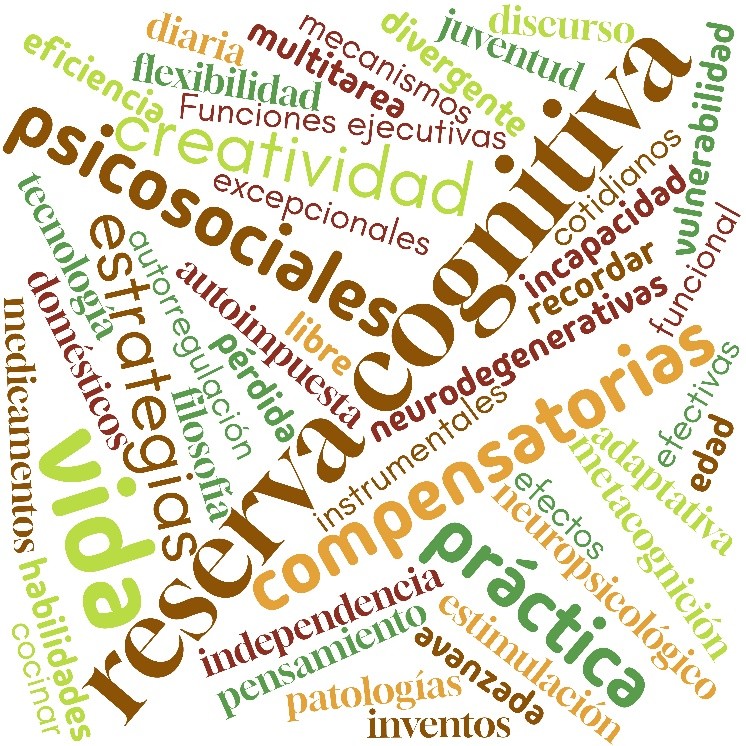
After analyzing the interview with the older adult, Denis (pseudonym) (considered an extreme case given the contrast between his advanced age and optimal MoCA scores), a 95-year-old male subject with a professional background as an accountant, a remarkable neuropsychological profile characterized by significant cognitive resilience and adaptability was demonstrated. Figure 1, shown below, reflects the central elements analyzed after his verbalizations, which in turn integrate nuances of the relationship between the central variables of the research: cognitive functioning, reserve, and creativity.
|
Figure 1. Integrated word cloud of central elements following analysis of the verbalizations of older adults |
|
|
Source: own elaboration.
Note: the figure appears in its original language.
A history of deep reading, chess playing, and crossword puzzle solving suggests considerable cognitive reserve, which has mitigated the typical effects of brain aging. This reserve is manifested in his ability to develop effective compensatory strategies, such as using a skimmer as an external cue to remember to turn off the turbine, which demonstrates preserved metacognition and intact self-regulation skills.
Despite some everyday forgetfulness (such as how to prepare food), which is consistent with normal aging, he shows no signs of significant neurodegenerative pathologies. His ability to learn to use advanced technology (tablets, internet) in old age reflects remarkable mental flexibility and openness to learning, traits that tend to diminish with age.
In the area of executive functions, Denis shows a systematic and methodical problem-solving process, although with a slower processing speed compared to earlier stages of his life. His narrative reveals a transition from a multitasking approach in his youth to a more sequential and leisurely method today, a change that could be related to the natural reduction in prefrontal efficiency associated with aging.
The subject's creativity, more associated with practice and innovation, evidenced in his domestic "inventions," emerges as an adaptive response to boredom and free time after retirement, showing a preserved capacity for divergent thinking and innovation. These creative mechanisms not only serve a utilitarian function but also act as protective factors against cognitive decline, providing continuous mental stimulation.
From an emotional and social perspective, Denis exhibits a resilient profile, with a proactive attitude toward aging and a clear resistance to self-imposed or family-imposed limitations. His philosophy of life, which rejects stereotypes associated with old age as a period of incapacity, together with his family support network that encourages his creativity, are key psychosocial factors for his successful aging.
The functional independence he maintains in instrumental activities of daily living (such as cooking, running errands, and managing medications) reinforces this perspective. However, an emotional tension related to the loss of loved ones emerges in his discourse, an aspect that, although it does not currently interfere with his cognitive functioning, represents a typical psychological vulnerability factor in extreme longevity. Overall, Denis's case illustrates how the interaction between cognitive reserve, compensatory strategies, sustained mental activity, and positive psychosocial factors can lead to exceptional aging trajectories, even at very advanced ages.
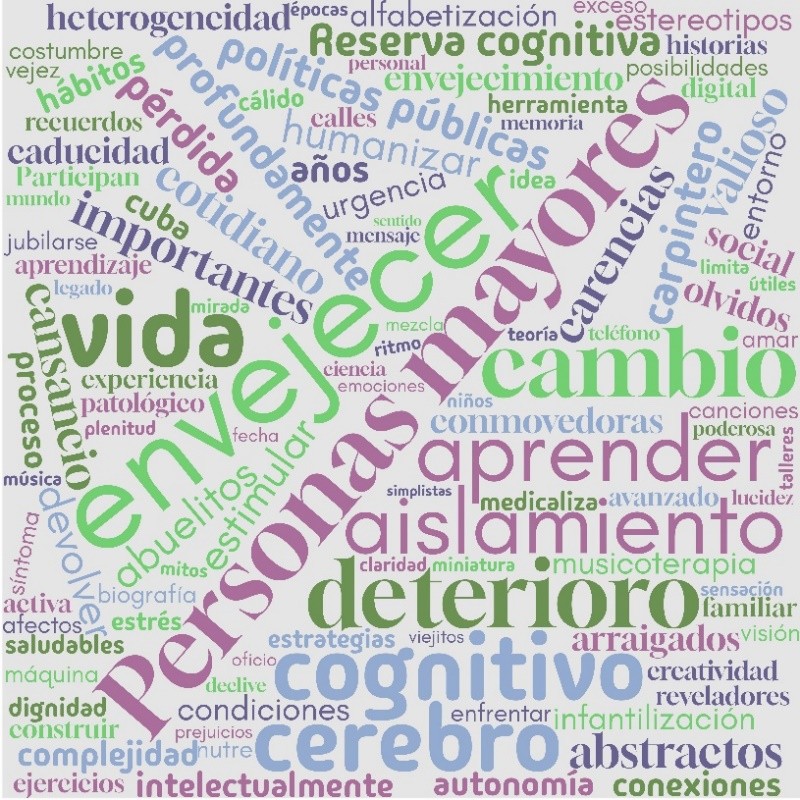
The interview with the expert, conceived as a key informant given her role as president of the University Chair for the Elderly (CUAM) in the territory and her level of scientific and practical experience in the subject, reveals a profound and nuanced view of aging, moving away from simplistic stereotypes to delve into the complexity of what it means to age with dignity. Before continuing with the analysis of the statements made, Figure 2 is presented, from which key points to be taken into account in establishing the nuances of the relationship between the central variables studied from the perspective of the interviewed professional can be visualized.
|
Figure 2. Integrated word cloud of central elements following analysis of key informant's statements (president of CUAM) |
|
|
Source: own elaboration.
Note: the figure appears in its original language.
The expert does not speak from cold theory, but from direct experience, emphasizing that each older person carries with them a unique history, their own pace of change, and a particular way of facing the years. When she mentions sudden forgetfulness, she does not do so as a pathological symptom, but as a natural process that can even appear long before old age, linked to stress or fatigue. It is a way of humanizing what is often overly "medicalized."
One of the most revealing aspects is how she explains the heterogeneity of cognitive decline. It is not just about genes or healthy habits, but something more intimate: biography. It is not the same to grow old having had an intellectually active life as it is to do so in isolation. However, even here, there are important nuances. The expert mentions cases of people with advanced cognitive decline who, thanks to a warm and stimulating family environment, maintain a certain lucidity. This situation, she emphasizes, "reminds us that the brain is not a machine that shuts down, but a deeply social organ that thrives on affection and human connections."
When talking about strategies to stimulate cognitive reserve, she does not limit herself to abstract memory exercises but talks about workshops that are meaningful to those who participate in them. Of music therapy, for example, she says: "It is not just a technique, but a bridge to buried emotions, songs that marked eras, memories that come back to life." The same is true of digital literacy: "It is not just about learning how to use a phone, but about feeling part of the world, about breaking out of isolation." Here, science mixes with everyday life, because "what really matters is not just 'activating the brain,' but giving older people back the feeling that they are still useful, that their voice counts."
The myths she debunks are particularly significant because they reflect deep-rooted prejudices. The infantilization of older people, the habit of calling them "oldies" or "grandparents" as if they were children, is not innocent: it robs them of their autonomy, it diminishes them. The same is true of the idea that they can no longer learn, love, or create. The expert states it clearly: learning has no expiration date. Moreover, she illustrates this with moving stories, such as that of the carpenter who, upon retiring, began to build miniature furniture, leaving a tangible legacy of his craft. Alternatively, the older adult who, after years of not playing an instrument, rediscovers music and with it, a part of herself she thought was lost.
The most valuable part of her speech is how she links all this to public policy. She is not content with pointing out shortcomings; she proposes a change of perspective. She talks about well-lit streets, benches in squares, spaces where older people are not an addition but a natural part of the landscape. Moreover, she does so with urgency because Cuba is aging rapidly, and there is no time to lose. Her final message is clear: aging is not a decline, but another stage of life, full of possibilities. Furthermore, creativity, in all its forms, is a powerful tool for living it to the fullest. The study reveals a dynamic relationship between cognitive functioning, cognitive reserve, and creativity in older adults, showing how these factors interact to modulate brain aging.
The quantitative results show that, although MoCA performance (mean = 23.4) suggests mild cognitive impairment—especially in memory (mean = 2.1) and abstraction (mean = 1.6)— high cognitive reserve (mean = 73.2) acts as a buffer, consistent with recent findings highlighting its protective role against decline (Cammisuli et al., 2022). This reserve, driven by years of schooling (r = 0.68) and intellectual activities, is associated with better cognitive performance, even in the presence of comorbidities such as hypertension or diabetes, reinforcing the theory that modifiable factors can compensate for neuropathological changes (Livingston et al., 2020).
Creativity, although less directly correlated with cognitive functioning, emerges as a key adaptive component. Cases such as that of the 95-year-old adult illustrate how practical innovation (e.g., home adaptations) and sustained mental activity (reading, chess) preserve functionality. The findings partially support the protective role of creativity reported in the literature, but qualify its universality. The high variability observed suggests that its protective effect could be mediated by factors such as education, the type of creative activities performed, or the presence of comorbidities.
The seemingly contradictory results between the absence of significant correlation (p > 0.05) in the quantitative analysis and individual cases with high creativity and good cognitive performance can be explained by a multifactorial analysis of the sample. The Spearman correlation (r = 0.41, p = 0.242) between the CAQ and the MoCA did not reach statistical significance, suggesting that, at the group level, there is no direct linear relationship between these variables.
However, the observed heterogeneity—such as subjects with high reserve but moderate creativity—suggests that, although the cognitive basis remains, creative expression depends on environmental opportunities, personal motivation, and other factors. In samples with a high prevalence of hypertension, such as the one in this study, vascular conditions could affect frontal domains, which would explain differences in correlation patterns.
The narrative of the older adult investigated, with his practical inventiveness and late learning of technology, exemplifies the theory of "socio-emotional selectivity" (Carstensen, 2021): prioritizing meaningful goals optimizes cognitive resources. This case, together with quantitative evidence, suggests that public policies—such as the CUAM classrooms—should integrate not only memory exercises but also spaces for everyday innovation.
CONCLUSIONS
The results showed that, although some older adults experience a decline in certain cognitive areas, especially memory and executive functions, others maintain preserved abilities, such as orientation and basic language skills. The data reflect the heterogeneity of aging, where factors such as education, continued mental activity, and sociocultural context play a key role.
The MoCA assessment identified cases of mild impairment, but also highlighted cognitive resilience in people who, despite their advanced age, retain remarkable mental clarity. Likewise, life stories illustrate how the combination of education and sustained mental habits can influence cognitive functioning and reserve. Ultimately, creativity plays an essential role in this regard.
Creativity was expressed in different ways among older adults. While some showed more practical creativity, such as adapting everyday objects to solve problems, others excelled in artistic or narrative areas. Older adults with modest scores on standardized tests showed flashes of ingenuity when sharing their experiences, suggesting that creativity at this stage is less linked to speed and more to the depth of accumulated experience.
The data revealed that these three variables are related. High cognitive reserve was associated with better cognitive functioning, but creativity acted as a bridge between the two, especially in those who applied their knowledge in innovative ways. Adults with mild impairment in memory tests demonstrated the ability to solve everyday problems with originality. Creativity becomes an adaptive tool that can compensate for limitations.
Age was not an absolute determinant. Some participants scored better, while other younger participants showed greater difficulties. Years of schooling correlated with cognitive functioning and cognitive reserve. They were not associated with creativity. Conditions such as hypertension or diabetes affected some cognitive domains, but did not negate the possibility of creativity.
The small sample size and cross-sectional design limit generalizability, although methodological triangulation enriches internal validity. Future studies could expand the sample and include neuroimaging to explore neural substrates. In addition, investigating how specific cultural variables, such as Cuban family networks, enhance cognitive reserve could offer unique insights for interventions in similar contexts.
REFERENCES
Altieri, M., Garramone, F., & Santangelo, G. (2021). Functional autonomy in dementia of the Alzheimer’s type, mild cognitive impairment, and healthy aging: A meta-analysis. Neurological Sciences, 42(5), 1773–1783. https://doi.org/10.1007/s10072-021-05142-0
Alvares Pereira, G., Silva Nunes, M. V., Alzola, P., & Contador, I. (2022). Cognitive reserve and brain maintenance in aging and dementia: An integrative review. Applied Neuropsychology: Adult, 29(6), 1615–1625. https://doi.org/10.1080/23279095.2021.1872079
Beaty, R. E., Cortes, R. A., Merseal, H. M., Hardiman, M. M., & Green, A. E. (2023). Brain networks supporting scientific creative thinking. Psychology of Aesthetics, Creativity, and the Arts. https://doi.org/10.1037/aca0000603
Cammisuli, D. M., Franzoni, F., Scarfò, G., Fusi, J., Gesi, M., Bonuccelli, U., Daniele, S., Martini, C., & Castelnuovo, G. (2022). What Does the Brain Have to Keep Working at Its Best? Resilience Mechanisms Such as Antioxidants and Brain/Cognitive Reserve for Counteracting Alzheimer’s Disease Degeneration. Biology, 11(5), 650. https://doi.org/10.3390/biology11050650
Cancer, A., Iannello, P., Salvi, C., & Antonietti, A. (2023). Executive functioning and divergent thinking predict creative problem-solving in young adults and elderlies. Psychological Research, 87(2), 388–396. https://doi.org/10.1007/s00426-022-01678-8
Carson, S. H., Peterson, J. B., & Higgins, D. M. (2005). Reliability, Validity, and Factor Structure of the Creative Achievement Questionnaire. Creativity Research Journal, 17(1), 37–50. https://doi.org/10.1207/s15326934crj1701_4
Carstensen, L. L. (2021). Socioemotional Selectivity Theory: The Role of Perceived Endings in Human Motivation. The Gerontologist, 61(8), 1188–1196. https://doi.org/10.1093/geront/gnab116
Constant, A., Friston, K. J., & Clark, A. (2024). Cultivating creativity: Predictive brains and the enlightened room problem. Philosophical Transactions of the Royal Society B: Biological Sciences, 379(1895), 20220415. https://doi.org/10.1098/rstb.2022.0415
Cosgrove, A. L., Beaty, R. E., Diaz, M. T., & Kenett, Y. N. (2023). Age differences in semantic network structure: Acquiring knowledge shapes semantic memory. Psychology and Aging, 38(2), 87–102. https://doi.org/10.1037/pag0000721
Cosgrove, A. L., Diaz, M. T., DiStefano, P. V., Kenett, Y. N., & Beaty, R. E. (2025). Associative Thinking and Creative Ability in Older Adulthood. Creativity Research Journal, 1–14. https://doi.org/10.1080/10400419.2024.2443720
Cuesta, C., Cossini, F., & Politis, D. (2020). Enfermedad de Alzheimer¿ cómo impacta la reserva cognitiva en el curso de la enfermedad? XII Congreso Internacional de Investigación y Práctica Profesional en Psicología. XXVII Jornadas de Investigación. XVI Encuentro de Investigadores en Psicología del MERCOSUR. II Encuentro de Investigación de Terapia Ocupacional. II Encuentro de Musicoterapia. https://www.aacademica.org/000-007/337
Dubec, L., Gerver, C. R., Dennis, N. A., & Beaty, R. E. (2025). Enhancing creative divergent thinking in older adults with a semantic retrieval strategy. Aging, Neuropsychology, and Cognition, 32(3), 449–458. https://doi.org/10.1080/13825585.2024.2414855
Feldberg, C., Barreyro, J. P., Tartaglini, M. F., Hermida, P. D., Moya García, L., Benetti, L., Somale, M. V., & Allegri, R. (2024). Estimation of cognitive reserve and its impact on cognitive performance in older adults. Applied Neuropsychology: Adult, 31(2), 117–127. https://doi.org/10.1080/23279095.2021.2002864
Islam, N., Hashem, R., Gad, M., Brown, A., Levis, B., Renoux, C., Thombs, B. D., & McInnes, M. D. (2023). Accuracy of the Montreal Cognitive Assessment tool for detecting mild cognitive impairment: A systematic review and meta‐analysis. Alzheimer’s & Dementia, 19(7), 3235–3243. https://doi.org/10.1002/alz.13040
Khan, G., Mirza, N., & Waheed, W. (2022). Developing guidelines for the translation and cultural adaptation of the Montreal Cognitive Assessment: Scoping review and qualitative synthesis. BJPsych Open, 8(1), e21. https://doi.org/10.1192/bjo.2021.1067
Livingston, G., Huntley, J., Sommerlad, A., Ames, D., Ballard, C., Banerjee, S., Brayne, C., Burns, A., Cohen-Mansfield, J., Cooper, C., Costafreda, S. G., Dias, A., Fox, N., Gitlin, L. N., Howard, R., Kales, H. C., Kivimäki, M., Larson, E. B., Ogunniyi, A., … Mukadam, N. (2020). Dementia prevention, intervention, and care: 2020 report of the Lancet Commission. The Lancet, 396(10248), 413–446. https://doi.org/10.1016/S0140-6736(20)30367-6
Lopera, F., Custodio, N., Rico-Restrepo, M., Allegri, R. F., Barrientos, J. D., Garcia Batres, E., Calandri, I. L., Calero Moscoso, C., Caramelli, P., Duran Quiroz, J. C., Jansen, A. M., Mimenza Alvarado, A. J., Nitrini, R., Parodi, J. F., Ramos, C., Slachevsky, A., & Brucki, S. M. D. (2023). A task force for diagnosis and treatment of people with Alzheimer’s disease in Latin America. Frontiers in Neurology, 14, 1198869. https://doi.org/10.3389/fneur.2023.1198869
Mulisa, F. (2022). When Does a Researcher Choose a Quantitative, Qualitative, or Mixed Research Approach? Interchange, 53(1), 113–131. https://doi.org/10.1007/s10780-021-09447-z
Naveh-Benjamin, M., & Cowan, N. (2023). The roles of attention, executive function and knowledge in cognitive ageing of working memory. Nature Reviews Psychology, 2(3), 151–165. https://doi.org/10.1038/s44159-023-00149-0
Pérez Gamboa, A. J., Sánchez Castillo, V., & Gómez Cano, C. A. (2024). El proceso de investigación cualitativa: Herramientas teórico-metológicas para su desarrollo. Corporación Unificada Nacional de educación superior-CUN. https://repositorio.cun.edu.co/handle/cun/7143
Rodríguez-Salgado, A. M., Llibre-Guerra, J. J., Tsoy, E., Peñalver-Guia, A. I., Bringas, G., Erlhoff, S. J., Kramer, J. H., Allen, I. E., Valcour, V., Miller, B. L., Llibre-Rodríguez, J. J., & Possin, K. L. (2021). A Brief Digital Cognitive Assessment for Detection of Cognitive Impairment in Cuban Older Adults. Journal of Alzheimer’s Disease, 79(1), 85–94. https://doi.org/10.3233/JAD-200985
Ross, S. D., Lachmann, T., Jaarsveld, S., Riedel-Heller, S. G., & Rodriguez, F. S. (2023). Creativity across the lifespan: Changes with age and with dementia. BMC Geriatrics, 23(1), 160. https://doi.org/10.1186/s12877-023-03825-1
Sánchez-Izquierdo, M., & Fernández-Ballesteros, R. (2021). Cognition in Healthy Aging. International Journal of Environmental Research and Public Health, 18(3), 962. https://doi.org/10.3390/ijerph18030962
Savarimuthu, A., & Ponniah, R. J. (2024). Cognition and Cognitive Reserve. Integrative Psychological and Behavioral Science, 58(2), 483–501. https://doi.org/10.1007/s12124-024-09821-3
Stern, Y. (2021). How Can Cognitive Reserve Promote Cognitive and Neurobehavioral Health? Archives of Clinical Neuropsychology, 36(7), 1291–1295. https://doi.org/10.1093/arclin/acab049
Tromp, C., & Glăveanu, V. P. (2025). A Model of Creative Aging (MOCA): Unlocking the potential of constraints for creativity in older adults. Psychology of Aesthetics, Creativity, and the Arts, 19(2), 247–256. https://doi.org/10.1037/aca0000538
Varangis, E. M., Soldan, A., & Stern, Y. (2023). Cognitive Reserve in Healthy Ageing and Neurodegenerative Disease. En The SAGE Handbook of Clinical Neuropsychology (pp. 102–115). SAGE Publications Ltd. https://doi.org/10.4135/9781529789522.n8
Wei, W., Wang, K., Shi, J., & Li, Z. (2024). Instruments to Assess Cognitive Reserve Among Older Adults: A Systematic Review of Measurement Properties. Neuropsychology Review, 34(2), 511–529. https://doi.org/10.1007/s11065-023-09594-3
Yang, Y., Wang, D., Hou, W., & Li, H. (2023). Cognitive Decline Associated with Aging. En Cognitive Aging and Brain Health (Vol. 1419, pp. 25–46). Springer Nature Singapore. https://doi.org/10.1007/978-981-99-1627-6_3
Zhao, X., Li, C., Ding, G., Heng, Y., Li, A., Wang, W., Hou, H., Wen, J., & Zhang, Y. (2021). The Burden of Alzheimer’s Disease Mortality in the United States, 1999-2018. Journal of Alzheimer’s Disease, 82(2), 803–813. https://doi.org/10.3233/JAD-210225
FINANCING
The authors did not receive funding for the development of this research.
DECLARATION OF CONFLICT OF INTEREST
The authors declare that there is no conflict of interest.
ACKNOWLEDGEMENTS
We would like to thank the faculty of the Master's Degree in Clinical and Educational Neuropsychology at the University of Camagüey, Cuba, especially the program coordinator, Dr. Anai Guerra Labrada, and Dr. Yunier Broche Pérez for their teachings and contributions to the writing of this article and the research work in general.
AUTHORSHIP CONTRIBUTION
Conceptualization: Alicia Lianne García González and Ariadna Gabriela Matos Matos.
Data curation: Alicia Lianne García González and Ariadna Gabriela Matos Matos
Formal analysis: Alicia Lianne García González and Ariadna Gabriela Matos Matos.
Research: Alicia Lianne García González and Ariadna Gabriela Matos Matos.
Methodology: Alicia Lianne García González and Ariadna Gabriela Matos Matos.
Software: Alicia Lianne García González and Ariadna Gabriela Matos Matos.
Supervision: Alicia Lianne García González and Ariadna Gabriela Matos Matos.
Validation: Alicia Lianne García González and Ariadna Gabriela Matos Matos.
Visualization: Alicia Lianne García González and Ariadna Gabriela Matos Matos.
Writing – original draft: Alicia Lianne García González and Ariadna Gabriela Matos Matos.
Redacción – revisión y edición: Alicia Lianne García González and Ariadna Gabriela Matos Matos.
ANNEXES: (Annexe 1)
|
Tabla 5. Matriz de casos y resultados generales de las pruebas |
|||||||||
|
Sujeto |
Edad |
Género |
Lateralidad |
Años de escolaridad |
Color de piel |
Enfermedades |
Puntuación MoCA FC |
Puntuación RC |
Puntuación CAQ C |
|
1 |
75 |
F |
Derecha |
12 |
Caucásico |
HTA y diabetes |
25 |
140 |
1 |
|
2 |
80 |
F |
Zurda |
12 |
Caucásico |
Ninguna |
22 |
135 |
0 |
|
3 |
79 |
M |
Zurda |
17 |
Caucásico |
HTA |
24 |
143 |
18 |
|
4 |
85 |
F |
Derecha |
12 |
Mestiza |
Diabetes |
24 |
147 |
30 |
|
5 |
82 |
M |
Zurda |
17 |
Caucásico |
HTA |
26 |
152 |
6 |
|
6 |
72 |
F |
Derecha |
17 |
Afrodescendiente |
Ninguna |
21 |
104 |
3 |
|
7 |
95 |
M |
Derecha |
17 |
Caucásico |
HTA |
28 |
139 |
3 |
|
8 |
87 |
F |
Derecha |
19 |
Caucásico |
Insuficiencia Renal |
27 |
152 |
16 |
|
9 |
83 |
F |
Derecha |
20 |
Mestiza |
HTA |
23 |
111 |
3 |
|
10 |
83 |
F |
Zurda |
12 |
Caucásico |
HTA |
18 |
125 |
14 |
Fuente: elaboración propia a partir de datos generados por SPSS, versión 23.0