doi: 10.58763/rc2026528
Review article
Tecnofeudalismo y pensamiento complejo: Edgar Morin en resistencia epistemológica, social y cultural
Technofeudalism and complex thinking: Edgar Morin in epistemological, social and cultural resistance
Juan
Carlos Osorio Amaya1  *
*
RESUMEN
Introducción: Se ha observado el riesgo del Tecnofeudalismo en el desarrollo científico, político y económico de las sociedades latinoamericanas; aquí el pensamiento complejo aporta modelos de análisis polivalentes que trascienden los dispositivos impuestos desde los centros de poder mundial.
Metodología: de diseño cualitativo, basado en el pensamiento complejo y la RSL. La búsqueda de información se concentró en las bases de datos Web of Science, Google Scholar y la plataforma Academia.edu, siguiendo los procedimientos de la técnica PRISMA y la construcción de RAES.
Resultados: Los efectos del Tecnofeudalismo superan las dimensiones económica y política. Se plantean relaciones no lineales realimentadas entre tecnología ↔ dependencia ↔ vigilancia, y otras como educación ↔ producción de conocimiento.
Conclusiones: El impacto de las plataformas se asume como un problema complejo superable con el uso de alternativas de código abierto y sinergias transnacionales ajustadas a las necesidades y prioridades del sur global, como desarrollo de software, hardware y plataformas, garantizando la producción intelectual y científica.
Palabras clave: Feudalismo digital, pensamiento complejo, sujeto, usuario, ética planetaria, investigación, sociedad.
Clasificación JEL: O30, O31.
ABSTRACT
Introduction: The risk of Digital Feudalism has been observed in the scientific, political, and economic development of Latin American societies. Here, complex thinking provides multipurpose analytical models that transcend the mechanisms imposed by global power centers.
Methodology: A qualitative design, based on complex thinking and SRL. The information search focused on the Web of Science databases, Google Scholar, and Academia.edu platform, following the PRISMA technique and the construction of RAES.
Results: The effects of Digital Feudalism go beyond the economic and political dimensions. Nonlinear feedback relationships are proposed between technology ↔ dependency ↔ surveillance, and others such as education ↔ knowledge production.
Conclusions: The impact of platforms is assumed to be a complex problem that can be overcome with the use of open-source alternatives and transnational synergies tailored to the needs and priorities of the global south. This includes the development of software, hardware, and platforms that guarantee intellectual and scientific production.
Keywords: Digital Feudalism, complex thinking, subject, user, planetary ethics, research, society.
JEl Classification: O30, O31.
Received: 29-09-2025 Revised: 08-12-2025 Accepted: 15-12-2025 Published: 02-01-2026
Editor:
Alfredo Javier Pérez Gamboa
1Servicio Nacional de Aprendizaje. Bogotá, Colombia.
Cite as: Osorio Amaya, J. C. (2026). Tecnofeudalismo y pensamiento complejo: Edgar Morin en resistencia epistemológica, social y cultural. Región Científica, 5(1), 2026528. https://doi.org/10.58763/rc2026528
INTRODUCTION
Technofeudalism has been gaining ground in intellectual circles before finally reaching the everyday sphere. Its first reference appears in the work of Yanis Varoufakis (2024) (economist and former Greek Minister of Finance), as a new configuration of power resulting from current technological development and an ancient political, economic, and social model. Authors such as Gilbert (2024) call this platform capitalism, but due to its dynamics based on the concentration of power, it can only be called Technofeudalism. This model exacerbates economic, social, and cultural differences in the center↔periphery loop, no longer related to states, but to technological giants, for whom there are no longer subjects, but users from whom information can be “harvested” and whose use and existence in the infinite virtual space can be permitted in exchange for the fruits of their unpaid labor.
Although multiple studies have been conducted on the topic and its implications, many of these works, such as that of Youvan (2025), propose solutions based on state regulation to protect citizens. However, these gigantic organizations exceed the power of most nations in the world, as they seem to succumb to their influence; while society becomes dependent on their applications, platforms, social networks, and, more recently, artificial intelligence (AI).
In this sense, the present analysis revolves around the question: what can Edgar Morin’s complex thinking contribute to counteracting the effects of Technofeudalism on knowledge generation processes in the Global South, especially in Latin America during the second decade of the 21st century? That is, to conduct an exercise in exploring possible solutions that go beyond the ideal realm, generating concrete actions based on the principles of complex thinking. The hypothesis is that complex thinking possesses conceptual tools to formulate alternatives to Technofeudalism in the knowledge generation process.
Unlike other studies on Technofeudal practices and scope, the original contribution of this study lies in proposing transdisciplinary conceptual tools, based on complex thinking, to counteract Technofeudal strategies in knowledge generation processes. Therefore, this study aims, first, to characterize Technofeudalism and its strategies; second, to propose conceptual tools based on complex thinking; and third, to suggest strategies to counteract the actions and effects of Technofeudalism.
To achieve this purpose, this document is divided into four parts. The first part describes the methodology, providing a brief overview of the methodological approach. The second part presents the results, including a review of the current state of research on Technofeudalism and its implications. The third part, the discussion, focuses on developing alternatives based on the principles of complex thinking. Finally, the fourth part, the conclusions, summarizes the main findings of the study.
METHODOLOGY
The methodology implemented was qualitative, based on complex thinking and the systematic literature review technique, as the objective was to propose conceptual tools, based on Edgar Morin’s ideas, to counteract technofeudal strategies in knowledge generation processes. Information was searched in the academic databases Web of Science, Google Scholar, and the Academia.edu platform, between April 15 and June 27, 2025. The search terms were modified using Boolean operators (y, o, and, or). The search began with the terms “technofeudalism” or “digital feudalism.” The documents were reviewed and selected or rejected using the PRISMA technique, according to the criteria explained in table 1.
|
Table 1. Inclusion/exclusion criteria using the PRISMA technique |
||
|
Category |
Inclusion (I) |
Exclusion (E) |
|
Publication type. |
Original articles, review articles, and opinion pieces |
Theses, complete books, book chapters, newspaper articles. |
|
Time frame. |
Published between 2020 and 2025. |
Documents published before 2020. |
|
Language. |
English and Spanish. |
Other languages. |
|
Thematic importance. |
Articles that address the topics of Technofeudalism, digital feudalism, and complex thinking. |
Articles from other disciplines such as economics. |
|
Source: own elaboration based on Ciapponi (2021). |
||
Regarding the selection process, the initial search yielded 200 documents, which were reduced to 100 during the screening phase. The process of reading abstracts and evaluating (up-to-date) bibliographic sources resulted in 75 documents, and subsequently, 50 were selected for full-text reading. The selected articles were evaluated using a self-developed protocol focused on methodological rigor. This process included publications related to complex thinking, specifically works based on the ideas of Edgar Morin, which, through other authors, generated different ways of understanding complex thinking, its multiple layers, and its potential to drive significant transformations in the human dimension.
The documents were analyzed using educational analytical summaries (EAS), which examined the objectives, methodologies, results, and conclusions, extracted in distinct sections. The analysis method used was documentary-thematic-inductive, referencing principles of complex thinking. Therefore, the central categories were the systemic principle (the whole is more and less than the sum of its parts), the principle of self-eco-organization (autonomy/dependence of the phenomenon), and the dialogical principle (complementary and antagonistic associations). The triangulation was documentary in nature, focusing on categories such as conflict between agents, local, regional, and global representation, and positive and negative effects.
RESULTS
Technofeudalism: the return of an old power structure
New technologies have enabled the emergence of power relations similar to feudalism, which, linked to a digital space with new forms of vassalage exercised by technology companies that own the infrastructure, artificial intelligence, and algorithmic governance, results in a total dependence on platforms and the loss of privacy and independence for their users (Youvan, 2025). Here, power is exercised through the exploitation of digital rents from users and smaller organizations, a product of the control and access to data (Gilbert, 2024). Platform economies like Google, Amazon, Apple, Microsoft, and Facebook compete for absolute control over their subjects with sophisticated strategies such as the creation of ecosystems in which connected devices only allow the use of a single family of applications, which, as a result, alters social and cultural relations (Jensen, 2020).
This new form of power generates oppression, especially in developing countries, which, as mere sub-users, provide their data (Wan & Qi, 2024), while large technology companies exploit these new resources to enrich themselves. Thus, what was initially seen as a tool for connectivity and a source of innovation gives rise to new practices of exploitation on a planetary scale that can rightly be called digital colonialism (Qosimov, 2025), challenging the sovereignty of states and changing international relations. In this sense, the platform economy creates economic value while shaping knowledge management processes (Taghizade & Ahmadov, 2025), turning users into “digital peasants” (Kreiczer-Levy, 2022), reinstituting the exploitation associated with feudalism.
From the factory to the cloud
The shift from the West to the East in manufacturing production led to the specialization of the Global North in the diversification of capital production, giving rise to cloud technology. This brought with it varying degrees of hardship for workers in a process that Varoufakis called a “dark pact,” which fragmented the global economy (Henkle, 2024). Indeed, tangible goods are purchased once, but intangible goods and the right to use them must be purchased multiple times, and in this process, the cloud produces capital without the need for wage labor; since it is the users of applications like Twitter or TikTok themselves who generate it (Baruphakēs & Zumpulakēs, 2023).
In a world where the use of technologies is conditioned on accepting the impositions of the great technofeudal lords, the price to pay is not only monetary; it is also dependence, surveillance, loss of freedom, and the limitation of democracy. It means the disappearance of citizen participation in the face of the platforms’ ability to destabilize the world’s states (Pal, 2022). In this way, power is concentrated in the hands of technological nobles, men with global political influence who, thanks to platforms like X/Twitter and the infrastructure provided by companies like Starlink, manipulate public opinion, influencing elections and even counterbalancing states (Yüksel, 2025).
Therefore, the effects of technofeudalism transcend the economic and political dimensions. In this sense, they can be as vital as the gentrification caused by the commercial operation of platforms like Airbnb, which have displaced traditional residents unable to adapt to the increased cost of living in tourist areas, a phenomenon that Dosi (2020) calls an increase in the use of individual resources to obtain economic benefits. On the other hand, there are effects on intangible aspects such as education, since teaching processes require access to costly services such as the use of information sources, data storage, educational administration, and commercial communication for academic institutions, which makes them strategically valuable clients (Rivera Grimaldo, 2023).
Cultures are also at risk, as social media has shifted the objective pursued by individuals, moving from communication to self-promotion, generating reward systems for the production of outrageous, fear-inducing, or mocking content in a context governed by instantaneity. In this way, the platforms that initially fostered community building end up supporting polarization and rendering truth irrelevant compared to the viral power of emotions (Pereira Roca, 2025). This period is characterized by the emergence of Malthusian ideas that were supposedly refuted or superseded by humanist ideals; thus, social phenomena such as poverty are seen as a consequence of overpopulation (Habib Gómez, 2023), rather than as a product of structural problems such as inequality.
However, some voices attempt to refute the concept of Technofeudalism; they emphasize the advantages of generating digital footprints to improve the services offered by platforms like Google and predict our behavior in order to personalize advertising. They also question the idea of “intellectual monopolization,” arguing that search engines do not own the pages they provide as search results (Morozov, 2022). The problem with this reasoning is that it ignores the effect that these types of technologies have on people’s habits, consumption, and public opinion. In this sense, the stance of experts like Morozov seems to be limited to the practical aspects of the devices, disregarding the complex relationship between technology and its users.
The model for understanding complex thinking
Upon recognizing the cognitive crisis facing the world, Edgar Morin offered an alternative called Complex Thinking, and within it, a new path for approaching reality, based on seven guiding principles for understanding life’s phenomena.
Thus, the first, called the systemic principle, considers that phenomena are composed of heterogeneous, non-decomposable elements, structured through recursive interaction (Montenegro & Schroeder, 2020). The second, the holographic principle, based on the hologram, posits that each part of the whole contains the complete information of the whole (Rodríguez & Bullones García, 2023). The third is the feedback loop principle, according to which the cause acts on the effect and the effect on the cause. The fourth is the recursive loop principle, which shows how the same element can be both cause and effect of itself (Anchundia-Gómez et al., 2022). The fifth is the self-eco-organization principle, which allows us to understand how living systems self-produce, the function of their internal processes, and their interaction with the external environment, maintaining their structure, which is why it is also called the autonomy/dependence principle (Bravo-Huaynates, 2021).
Furthermore, the sixth is the dialogical principle, which, unlike processes of simplification and disjunction, shows that opposites do not exclude each other; rather, they remain united in the conception of the phenomenon (Andrade Salazar & Villela Cervantes, 2024). Finally, the principle of reintroduction (of the knower in all knowledge), which, as a fundamental rule, explains that all knowledge is, at the same time, a unique reconstruction for each researcher-knower; a process in which previous experiences and culture play a role (Unda, 2024).
In short, the principles proposed by Morin aim to contribute to the understanding of natural phenomena as systems that interact with their environment in order to exist. In this process of understanding, both causes and effects are equally important, necessary factors that, in fulfilling their function, become possibilities for themselves, while acting upon/affecting multiple dimensions. Complex thinking, then, allows us to see the phenomenon in its true scope, with its gaps and nuances, without which it would not be possible, or at least not in the way the observer apprehends it.
The epistemology of complexity contradicts the reductionism and simplification inherent in classical science. Therefore, it focuses on revealing the underlying relativity through notions such as system, subsystem, and suprasystem, which are obscured by this paradigm. Furthermore, it seeks to reconnect what has been separated and fragmented, preventing its use in other contexts (Lobo Sosa & Pacheco Millan, 2021). This implies accepting that knowing the parts does not mean understanding the whole, an idea characteristic of Cartesian dualistic reductionism (Fernández Mora, 2022), which has based its success on manipulation and exclusion that have impoverished science (Gembillo, 2022).
The above demonstrates the need for interdisciplinary practice that requires true teamwork, free from disciplinary boundaries, ownership, or proprietary rights (Galati, 2023); that is, genuine networked action. This process must be complemented by analysis at different levels of reality, different logics that weave together the act of thinking and are known as transdisciplinarity (Carrizo, 2021). From this, the need for the subject, in its role as a reflective entity—mutable and variable due to the effect of reflective action (González Encalada, 2024)—is deduced; in necessary correlation with the object, which should be called the knowing subject (Gonfiantini, 2024).
It should also be mentioned that putting complex thinking into action requires strategies that consider uncertainty and emergence, such as the one proposed by Soler Gil (2023), which suggests the development of an integrative, interdisciplinary method, adapted to the context based on social, environmental, ethical, political, and cultural factors, which are incorporated into the model thanks to subjectivity. However, complex thinking has its greatest strength in teacher training, since including Morin’s a-method will integrate, along with science and technology, the potential to teach the virtues of the human spirit to the students of the future (Colina Vargas, 2020).
In this sense, the advantages of education based on complex thinking will allow for the emergence of skills such as innovation and adaptation (Chiquin Jalal, 2024). These competencies are not restricted to the academic sphere but extend to the organizational realm, where they allow for the integration of all hierarchical levels, creating true organizational networks (Romero, 2025). Similarly, this type of education will foster the emergence of the new planetary citizen embedded in the loop of complex thinking ↔ planetary ethics ↔ social transformation (López-Calva, 2022).
As a result, complex thinking creates alternatives to classical liberalism, such as complex liberalism (Rodriguez Zoya, 2021), which articulates the best aspects of liberalism with the ethical dimensions of the individual → the community → humankind. This should lead to the creation of a planetary consciousness, in the face of which any individualistic perspective loses meaning; a form of planetary decoloniality that will give rise to the human subject (Rodríguez, 2021).
DISCUSSION
Towards a model of understanding based on complex thinking
Technofeudalism, in addition to being a product of the divisive and reductionist paradigm of science, is also one of its tools. It ignores the existence of uncertainty and reduces reality to mere data; developments in data storage, communication infrastructure, and computing power have made this possible (del Horno, 2025). In this regard, Morin proposes the systemic principle, and within it, the need to approach reality with its nonlinear dynamics far from equilibrium, which gives rise to emergence (see table 2); for the whole is more than the sum of its parts, but it is also different from the parts (Arce Rojas, 2021).
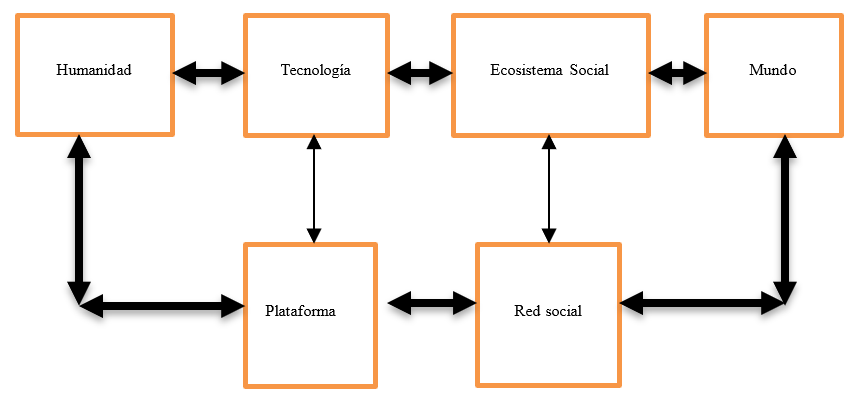
In other words, social media platforms and networks are now integrated into the social ecosystem → world, and therefore, any emergent phenomenon in society, resulting from interaction with these digital ecosystems, must be analyzed based on the technology ↔ humanity relationship (see figure 1).
|
Figure 1. Model of social ecosystem integration - world/technology-humanity |
|
|
At this point, the function of infinite scrolling and the development of personalized algorithms have given rise to social phenomena such as filter bubbles, which, under the guise of improving the user experience by selecting and prioritizing content based on identified patterns, prevent access to different or complementary information (Pariser, 2011; Vázquez, 2025). This has led users to form gigantic echo chambers (Lombana-Bermúdez et al., 2022), characterized by ideological homogeneity that increases polarization and tends to rapidly spread misinformation. For Morin, these two phenomena are symptomatic of the flaws of the disjunctive paradigm, which is countered by the multidimensional nature of knowledge, stemming from the integral human being and contrasting the two-dimensional-quantitative with experience and the conceptual frameworks that construct reality (Oliveros Castro et al., 2023).
Another effect of Technofeudalism is the structural dependence on platforms, a product of the asymmetries between the governance of states and their inability to control the global virtual infrastructure. This is not only limited to the production, administration, and control of software by megacorporations in the Global North (Gómez-Cumpa & Fanning-Balarezo, 2025); it is also embedded in the development of technologies such as AI, which, as a harbinger of hypercognitive rationalism, has colonized strategic areas for the development of Third World countries, such as education. Thus, neocolonial practices are normalized in educational systems of the Global South through technological incorporation, generating dependence on virtual infrastructure and allowing the dissemination and shaping of ideologies, habits, and political stances (Díez-Gutiérrez & Jarquín-Ramírez, 2025).
In this scenario, complex thinking proposes the auto-eco-organizing principle (see Table 2), which promotes the autonomy-dependence of systems and living beings in close relationship with the environment. This, applied to Technofeudalism, closely links society, individuals, and culture, generating regional synergies focused on developing alternatives tailored to the needs and conditions of the Global South (Hidalgo-Flor, 2022). These alternatives must go beyond user autonomy by including the ethical handling of data in their parameters, rather than its commercial use, which in some cases borders on fraudulent.
On the other hand, the increasing limitation of creative freedom and the circulation of alternative discourses, a consequence of the evolution of learning algorithms, has driven structural changes in the topos (τόπος) shaped by the interaction of the feedback loop between society ↔ politics ↔ coexistence (Benito-García, 2025; Ortiz, 2025). Extensively, the application of the dialogical principle of complex thinking to the architecture of algorithms (see Table 2) can potentially allow for other points of view in civic engagement, preventing the degradation of democracy and the suppression of antagonisms (Rodriguez-Zoya, 2022).
Finally, Technofeudalism reduces people to mere statistics and consumption data. This process is not new, but it accelerated during the Covid-19 pandemic, a time when technologies focused on social control were deployed (i Almar, 2022). What was initially considered a tool that would make people’s lives easier has become a tool of tyranny that, through algorithms, devalues human activity, giving rise to a new form of vassalage in which electronic devices, far from being servants, are the lower nobility that harvests the data (Rosenman, 2024). Edgar Morin would propose, as a response to this problem, the formation of planetary citizens who transcend individualistic and competitive education, focused on the cost-benefit relationship, for which it is irrational to protect the individual when the market is what matters (see table 2) (López Calva, 2023).
|
Table 2. Comparative table: technofeudal mechanism → complex principle → mitigation strategy |
||
|
Technofeudal mechanism |
Complex principle |
Mitigation strategy |
|
Reduction of reality to mere data. |
Systemic principle. |
Analysis based on the technology → humanity function. |
|
Dependence on platforms. |
Self-eco-organizing principle. |
Regional synergies/development of alternatives tailored to the Global South. |
|
Limitation of creativity and the circulation of alternative discourses. |
Dialogical principle. |
Opening up the architecture of algorithms. |
|
Reduction of people to statistics. |
Planetary citizenship. |
Education of global citizens. |
CONCLUSIONS
While technological development is a process simultaneous with human social and economic development, the emergence of Technofeudalism, with its asymmetrical power relations characterized by the technological colonization of all aspects of daily life, represents nothing more than an artifice resulting from the desire for dominance of the new elites. Users, transformed into vassals responsible for the production of the new fiefdoms, perform productive tasks with no compensation other than their mere existence and interaction in the virtual space, while these fiefdoms have become so powerful that they cause disruptions in the global social and political context. This includes the atomization of the social fabric and the polarization of the political landscape of states to the benefit of ideological currents aligned with their objectives.
In this context, complex thinking offers multiple contributions: ideal and material vanishing points. The potential to lead humanity to a new golden age can be found in the principles of the Morin method. Its genesis lies in the subject becoming a planetary citizen and in a cosmopolis project in which all differences, wars, and desires for dominance are transcended. On the other hand, cultural differences strengthen the social fabric. In this scenario, center-periphery relations lose their power in the face of a multiplicity of centers, languages, and knowledge systems. In this sense, the dialogical, holographic, and general intelligence principles are applied, through which respect for difference and, consequently, an agonistic orientation of society, will allow for the flourishing of human society.
Based on the research findings, the following aspects should be highlighted: first, the need to approach reality as a complex system, ensuring the existence of non-linear dynamics through self-managed open-source alternatives protected by community members. Second, establishing synergies in Latin America that adapt to the needs and priorities of the global South, focused on the development of hardware, software, and platforms to decentralize information and guarantee access to maintain the intellectual and scientific production of the region. Third, the exercise of dialogue that allows for the coexistence of other points of view, in order to build a true planetary citizen.
Furthermore, the impact of platforms and algorithms on society must be emphasized, as they reduce the individual to a mere user in the digital world who, unlike the subject, lacks a political function. Instead, this individual is a consumer engaged in a passive activity where others impose ideas. At the same time, algorithms act as censors, filtering out anything that deviates from the preferences they have been programmed with and the parameters on which they were built.
Based on the dialogical principle, the main theoretical contribution of this study relates to the development of spaces for critical reflection in response to technofeudalism. Regarding limitations, it is clarified that both the results and the researcher’s perspective have only offered an approximation of the complexity, and therefore, further effort is needed for the discussion and presentation of other approaches and viewpoints. Regarding future research, it should focus on developing strategies to maintain the independence of the production and circulation of knowledge, free from the dangers of concentration and centralization, requiring transdisciplinary models based on the holographic principle.
REFERENCES
Anchundia-Gómez, O. E., Vera-Macay, M. V., Armendáriz-Zambrano, C. R., & Luna-Mendieta, G. A. (2022). Modelo Educativo basado en Pensamiento Complejo de Edgar-Morin para fortalecer la Gestión Escolar, Unidad Educativa Ángel Polibio Chaves, Ecuador 2021. Polo del Conocimiento: Revista científico-profesional, 7(3), 12. https://dialnet.unirioja.es/servlet/articulo?codigo=8399848
Andrade Salazar, J. A., & Villela Cervantes, C. E. (2024). El pensamiento complejo y la construcción de conocimiento: una perspectiva Moriniana. Revista Vida, 6(1), 33-50. https://doi.org/10.36314/revistavida.v6i1.41
Arce Rojas, R. S. (2021). Relaciones entre el pensamiento complejo y los sistemas complejos adaptativos. Simbiótica. Revista Eletrônica, 8(1), 1-13. https://www.redalyc.org/articulo.oa?id=575967011001
Baruphakēs, G., & Zumpulakēs, M. (2023): On technofeudalism: What killed capitalism? An interview with Yanis Varoufakis. Economic Thought, 11(2), 25-30. https://www.econstor.eu/bitstream/10419/315850/1/188160442X.pdf
Benito-García, J. M. (2025). Mercado Audiovisual e Inteligencia Artificial. Relaciones y Aspectos Éticos. European Public & Social Innovation Review, 10, 1-17. https://doi.org/10.31637/epsir-2025-2156
Bravo-Huaynates, G. (2021). De la teoría narrativa de la identidad a los principios del pensamiento complejo de Morín. 593 Digital Publisher CEIT, 6(4), 41-52. https://doi.org/10.33386/593dp.2021.4.654
Carrizo, L. (2021). Interdisciplinariedad y valores. Dins Toro, B. i Tallone, A.[coords.], Educación, valores y ciudadanía. Metas educativas, 171-184. https://www.academia.edu/847073/Interdisciplinariedad_y_valores
Chiquin Jalal, I. E. (2024). El futuro de la educación a través de los saberes de Edgar Morin. Revista Vida, 6(1), 137-144. https://doi.org/10.36314/revistavida.v5i1.52
Ciapponi, A. (2021). La declaración PRISMA 2020: una guía actualizada para reportar revisiones sistemáticas. Evidencia, actualizacion en la práctica ambulatoria, 24(3), e002139. https://doi.org/10.51987/evidencia.v24i4.6960
Colina Vargas, A. M. (2020). La educación superior desde la visión del pensamiento complejo. Revista Científica Ecociencia, 7, 1-18. https://doi.org/10.21855/ecociencia.70.288
del Horno, M. B. (2025). Hacia un poscapitalismo digital: aportaciones desde la economía social y solidaria. Revista Iberoamericana de Estudios de Desarrollo= Iberoamerican Journal of Development Studies, 14(1), 134-157. https://doi.org/10.26754/ojs_ried/ijds.10647
Díez-Gutiérrez, E. J., & Jarquín-Ramírez, M. (2025). Capitalismo digital y universidades: una reflexión sobre los riesgos educativos del uso de tecnología orientada a la ganancia. Sintaxis, (14), 49-68. https://doi.org/10.36105/stx.2025n14.04
Dosi, G. (2020). Liberalismo desenfrenado y pandemia: la encrucijada entre el tecnoautoritarismo y una nueva organización social. Revista de la CEPAL, 2020(132), 185-194. https://doi.org/10.18356/16820908-2020-132-9
Fernández Mora, V. de J. (2022). Algunos apuntes sobre la contribución del pensamiento de Edgar Morin para un Nuevo Humanismo y unas Nuevas Humanidades. Erebea. Revista de Humanidades y Ciencias Sociales, 12(1), 117-135. https://doi.org/10.33776/erebea.v12i1.7650
Galati, E. (2023). Filosofía de la génesis de la interdisciplinariedad en su relación con la transdisciplinariedad. Ciencia, docencia y tecnología, (68), 1. https://doi.org/https://doi.org/10.33255/3468/1502
Gembillo, G. (2022). El método del método de Edgar Morin. https://doi.org/10.30827/Digibug.75995
Gilbert, J. (2024). Techno-feudalism or platform capitalism? Conceptualising the digital society. European Journal of Social Theory. 27(4). 561-578. https://doi.org/10.1177/13684310241276474
Gómez-Cumpa, J. W., & Fanning-Balarezo, M. M (2025). Geopolítica de la complejidad: hegemonía, control digital y el Sur Global. Quellccak Revista de Ciencias Sociales, 1(2), 7. https://revistas.academiadepoliticaspublicas.org.pe/index.php/q/article/view/7
Gonfiantini, V. (2024). Debates epistémicos entre el pensamiento complejo y la transdisciplina. Aportes desde los sistemas complejos. Revista Científica Educ@ção, 9(14). https://doi.org/10.46616/rce.v9i14.115
González Encalada, A. E. (2024). Epistemología de la relación sujeto-objeto: Hacia una comprensión compleja del conocimiento humano. DISCE. Revista Científica Educativa y Social, 1(1), 21-30. https://doi.org/10.69821/DISCE.v1i1.5
Habib Gómez, Z. (2023). Del sistema mundial capitalista al sistema mundial tecno-feudal: un análisis decolonial. Tabula Rasa, (48), 267-278. https://doi.org/10.25058/20112742.n48.10
Henkle, J. (2024). Technofeudalism or Technosocialism? WeChat as Socialist Alternative to Platform Capitalism. https://doi.org/10.33682/y85b-8mn1
Hidalgo-Flor, R. (2022). Caos y orden, complemento o dilema en las empresas, un análisis desde la complejidad. Estudios de la Gestión: Revista Internacional de Administración, (11), 44-63 https://revistas.uasb.edu.ec/index.php/eg/article/view/3073
i Almar, E. R. (2022). El mundo de la pandemia de la COVID-19 en 5D. Desmaterialización, deshumanización, desigualdad, desencanto y desasosiego en los tiempos del viroceno. Posición. Revista del Instituto de Investigaciones Geográficas, (7). https://posicion-inigeo.unlu.edu.ar/posicion/article/view/32
Jensen, J. L. (2020). Democracy in the age of digital feudalism. Emerald publishing. https://www.emeraldgrouppublishing.com/opinion-and-blog/democracy-age-digital-feudalism
Kreiczer-Levy, S. (2022). Reclaiming Feudalism for the Technological Era. Cardozo Arts & Entertainment Law Journal, (Forthcoming 2023), 41, 183. http://dx.doi.org/10.2139/ssrn.4282789
Lobo Sosa, H. E., & Pacheco Millan, A. C. (2021). El complejo pensamiento de Edgar Morin. En Educação e complexidade = Educación y complejidad. (pp. 26-68). Pimenta Cultural. https://doi.org/10.31560/pimentacultural/2021.004.26-68
Lombana-Bermúdez, A., Vallejo Mejía, M., Gómez Céspedes, L. M., & Pino Uribe, J. F. (2022). Cámaras de eco, desinformación y campañas de desprestigio en Colombia. Un estudio de Twitter y las elecciones locales de Medellín en 2019. Política y gobierno, 29(1). https://politicaygobierno.cide.edu/index.php/pyg/article/view/1494
López Calva, J. M. (2023). Construir la Cosmópolis para formar la ciudadanía planetaria. Sinéctica, (60), e1547. https://doi.org/10.31391/s2007-7033(2023)0060-011
López-Calva, J. M. (2022). Pensamiento complejo, ética planetaria y transformación social en la formación del profesorados. Revista Digital de Investigación en Docencia Universitaria, 16(1), e1568. https://doi.org/10.19083/ridu.2022.1568
Montenegro, G., & Schroeder, I. (2020). Dimensiones del pensamiento sistémico aplicado: un estudio de casos múltiple desde la perspectiva de sistemas complejos y el aprendizaje organizacional. Psicología, Conocimiento y Sociedad, 10(2), 51-68. https://doi.org/10.26864/pcs.v10.n2.4
Morozov, E. (2022). Crítica al tecnofeudalismo. Morozov, E. (2022). Crítica de la razón tecnofeudal. New Left Review, 133/134, 99-142. https://newleftreview.es/issues/133/articles/critique-of-techno-feudal-reason-translation.pdf
Oliveros Castro, S., Valenzuela Urra, C., & Núñez Chaufleur, C. (2023). “ Los siete saberes necesarios para la educación del futuro”, de Edgar Morin: Una mirada desde la alfabetización en información. Revista Andina de Educación, 6(2), e206. https://doi.org/10.32719/26312816.2022.6.2.8
Ortiz, T. (2025). Redefiniendo El Futuro de la Inteligencia Artificial en la Sociedad Transmoderna. Revista Venezolana de Pedagogía y Tecnologías Emergentes, 5(1), 12. https://revistascespe.com/index.php/REVEPTE/article/view/111
Pal, Dipayan. (2022). ‘Democracy and digital feudalism’, Op-ed, The Statesman (2022). https://www.thestatesman.com/opinion/democracy-digital-feudalism-1503081161.html
Pariser, E. (2011). The filter bubble: How the new personalized web is changing what we read and how we think. Penguin.
Pereira Roca, D. (2025). La batalla cultural en la era del Tecnofeudalismo. Revista Aportes de la Comunicación y la Cultura, (38), 85-94. https://doi.org/10.56992/a.v1i38.502
Qosimov, M. (2025). DIGITAL COLONIALISM: WHO OWNS THE WORLD’S DATA ECONOMY?. Теоретические аспекты становления педагогических наук, 4(16), 60-77. https://inlibrary.uz/index.php/tafps/article/view/109509
Rivera Grimaldo, J. M. (2023). Equidad en la educación: el capitalismo y la privatización de la educación en la pospandemia. Revista Cadena de Cerebros, 7(2), 101-109. https://doi.org/10.5281/zenodo.11238896
Rodriguez Zoya, L. (2021). El provenir del pensamiento complejo y el futuro de la humanidad. 593 Digital Publisher, 1(1), 73-87. https://ri.conicet.gov.ar/handle/11336/166022
Rodriguez Zoya, L. (2022). Pensamiento complejo y democracia: Problematización de los paradigmas liberal y populista. Gazeta de Antropología, 38(2), http://hdl.handle.net/10481/76252
Rodríguez, M. E. (2021). El ciudadano planetario: urgente constructo complejo-ecosófico en la Tierra–Patria. Revista Educar Mais, 5(5), 1348-1362. https://doi.org/10.15536/reducarmais.5.2021.2641
Rodríguez, M. E., & Bullones García, M. C. (2023). El principio hologramático en la educación matemática decolonial planetaria compleja. Revista Internacional de Pesquisa em Didática das Ciências e Matemática, e023007-e023007. https://periodicoscientificos.itp.ifsp.edu.br/index.php/revin/article/view/1012
Romero, N. (2025). Teoría de la complejidad en la gestión del recurso humano organizacional, basada en el pensamiento complejo. Experior, 4(2), 124-139. https://doi.org/10.56880/experior42.2
Rosenmann, M. R. (2024). La humanidad que viene. Crítica al capitalismo digital. Capitalismo digital después de la pandemia: Nuevo paradigma del trabajo global.
Soler Gil, R. (2023). El método científico y el pensamiento complejo para la investigación en la educación superior actual. Revista Logos Ciencia & Tecnología, 15(2), 147-160. https://doi.org/10.22335/rlct.v15i2.1780
Taghizade, E., & Ahmadov, E. (2025). Techno Feudalism and the New Global Power Struggle: Echoes of a Digital Cold War. Research & Scientific Innovation Society. https://dx.doi.org/10.47772/IJRISS.2025.9020093
Unda, J. L. (2024). Desarrollo sostenible. Reflexiones desde el pensamiento complejo y transdisciplinario. Revista COMPSIDEA| Universidad Yacambú, 1(2), 18-25. https://revista.uny.edu.ve/ojs/index.php/compsidea/article/view/526
Varoufakis, Y. (2024). Tecnofeudalismo: El sigiloso sucesor del capitalismo. Deusto Bilbao.
Vázquez, M. (2025). No digan cómo vivo, díganme cómo vivir. El movimiento Do It Yourself y el capitalismo de vigilancia. Inmediaciones de la Comunicación, 20(1), e209. https://doi.org/10.18861/ic.2025.20.1.3992
Wan, S., & Qi, H. (2024, December). Exploring the Dissolution of Data Colonialism under the “Belt and Road” Initiative from the Perspective of Marxist World History Theory. In 2024 9th International Conference on Modern Management, Education and Social Sciences (MMET 2024) (pp. 706-717). Atlantis Press. https://doi.org/10.2991/978-2-38476-309-2_86
Youvan, D. C. (2025). Digital Feudalism and the Collapse of Autonomy: A Complexity Theory Approach to Systemic Control and Resistance. https://doi.org/10.13140/RG.2.2.28439.89760
Yüksel, Ç. (2025). Technofeudal Lord: Elon Musk and the Rise of a New Digital Empire. Researchcentre. https://researchcentre.trtworld.com/wp-content/uploads/2025/02/Technofeudal-Lord.pdf
FINANCING
The author did not receive funding for the development of this research.
CONFLICT OF INTEREST STATEMENT
None.
STATEMENT ON THE USE OF ARTIFICIAL INTELLIGENCE
No artificial intelligence was used in the development of the article.
AUTHORSHIP CONTRIBUTION
Conceptualization: Juan Carlos Osorio Amaya.
Data Curation: Juan Carlos Osorio Amaya.
Formal analysis: Juan Carlos Osorio Amaya.
Investigation: Juan Carlos Osorio Amaya.
Methodology: Juan Carlos Osorio Amaya.
Project administration: Juan Carlos Osorio Amaya.
Software: Juan Carlos Osorio Amaya.
Supervision: Juan Carlos Osorio Amaya.
Validation: and Juan Carlos Osorio Amaya.
Visualization: Juan Carlos Osorio Amaya.
Writing – Original Draft: Juan Carlos Osorio Amaya.
Writing – proofreading and editing: Juan Carlos Osorio Amaya.